
Low End Mac Round Table
Change: Sometimes We Embrace It, and Sometimes We Hate It
Low End Mac Staff - 2011.08.05
At Low End Mac, we love our older Macs, weappreciate the ability to stretch them forward using new versions ofthe Mac OS and new software. We get excited about projects likeClassilla and TenFourFox, whichbring open source Firefox technology to unsupported hardware andoperating systems.
That said, we're among the most vocal when Apple makes a change thatimpacts our workflow. We were disappointed when OS X 10.5Leopard required an 867 MHz G4 or better - and we were among thefirst to report on workarounds that enabled users to run Leopard on 350 MHz andfaster G4 Macs. We are very disappointed that Apple has removed supportfor PowerPC apps with OS X 10.7Lion, because there's really no good reason to do so - Rosetta hasallowed Intel Macs to run PowerPC software since 2006, allowing us tokeep using software we are familiar with that meets our needs.
We don't complain for the sake of complaining. We are not opposed tochange as long as it is progress. But sometimes Apple seems to makearbitrary changes that feel like a slap in the face for longtime Macusers, which most of our writers are. We are Mac users. Macs are ourtools. And you shouldn't redesign a tool that works without a goodreason.
That is the subject of this, the first Low End Mac round table: WhatApple changes have most benefitted you? And which changes have mostfrustrated you?
Allison Payne (The Budget Mac):I sort of live in two worlds when it comes toApple gear. On the one hand, I've collected and shaped a set of toolsthat have served me very well through the PowerPC era, and it's hard togive those up when Apple does things like drop FireWire support andremove optical drives or Rosetta. On the other hand, I absolutely lovesome of the advances they're making in the realm of usability for theaverage user, portability, support for virtualization, and raw speedand extended battery life with the adoption of SSDs and lithium polymerbatteries.
So far, I've found an equilibrium by maintaining a working G4PowerBook to handle all tech support work for that era, and I've keptan ear to the ground about up-and-coming hardware/software, activelylooking for good replacements for some of my more critical tools, likeTarget Disk Mode and file recovery software. Apple has shown uncannyforesight when it comes to orphaning defunct technology (floppy drives,anyone?), and they haven't yet used up all my faith in their ability toprovide me with good tools for the future.
Austin Leeds (Apple Everywhere): Ithink I speak for many, many people when Isay that embracing the USB standard was perhaps the most positivechange Apple ever made. By making USB the main peripheral port onthe iMac in 1998, Applestarted leaning the rest of the tech world away from serial, parallel,and PS/2 ports and toward a fast, durable, hot-pluggable, almost do-allthat has proven itself time and again for almost 15 years.
Apple's recent trend of faster and faster obsolescence is the mostnegative change they've implemented. We can look back at System 7,which will run on Macs from the late 80s to the late 90s, many of themrunning the last version (7.6), and yet Mac OS X 10.6 Snow Leopard only ranon Macs less than three years older than itself. In this respect,OS X 10.4 Tiger proves itselfalmost a new System 7, officially supporting 5-year-old hardware whenit was introduced and unofficially supporting upgraded pre-G3 Macs.OS X 10.7 Lion, on the otherhand, is leaving Core Solo and Core Duo Macs high and dry.
One final note: I'm not a very vocal supporter of Mac OSbackwards-compatibility. While I welcome any effort Apple has taken toprovide backwards compatibility, I have come to accept that Apple willcontinue its strategy of rapid replacement. With that in mind, I viewGNU/Linux as the best alternative to Mac OS X on older Macs, as Linuxdistributions continue to receive new updates to (or providealternatives for) software such as Firefox, regardless of system architecture. Iapplaud the Linux community at large for keeping PowerPC alive and wellin the tech world, and I plan to begin contributing to their efforts assoon as learning permits.
Brian Gray (Fruitful Editing): I'vebeen a Mac user since 2002. When I purchasedmy first "new" Mac (a refurbished G5 iMac) at the end of 2005, I knewthe Intel change was coming. I also knew the value of the machine I waspurchasing and trusted Apple to keep the software I needed reasonablysupported. It still runs Tiger and is processing some video for meright now - just as well as the day it arrived on my doorstep.
One of my biggest frustrations is with the constant updates toiTunes. A 10-year-old PC with Windows XP can run the latest version ofiTunes, but no Mac running Tiger can. Why? It seems to make sense thatApple would want to keep as many users as possible capable of makingpurchases.
Dan Bashur (Apple, Tech, and Gaming):As a Mac veteran of over 20 years, there havebeen too many changes to possibly imagine, and as much as drasticchange annoys longtime Mac users like myself, many great decisions havebeen made by Apple to improve the hardware, OS, and software on theMac.
On the other hand, there have definitely been some less thandesirable features added, while support for applications and hardwarewas dropped in various changes to the Mac and the operating system,fueling intense frustration. To compare and contrast these beneficialand frustrating decisions by Apple, I decided to narrow things down tomy top five Apple changes that have benefited me, and my top 5frustrations.
Top 5 Apple changes that have benefited me:
- Mac OS X - It's amazing how easily OS 9 is forgotten when somany variations of Mac OS X install on machines dating back to some ofthe earliest Power Macs (with G3 or G4 upgrades). Earlier versions ofMac OS X had very forgiving system requirements, and you can usuallyget around those requirements with XPostFacto onmachines just under the bar Apple sets. There are even workarounds to Leopard installs onG4s under the 867 MHz bar Apple set, keeping Macs up to date longerthan Apple even planned. The advent of Mac OS X unleashed severalfeatures that we have come to love and adore - and made each releasesomething to get excited about.
- FireWire - Although FireWire never gained enough steam tobecome as widely accepted as USB, it had so many more advantages. Themost notable (on a Mac) was FireWireTarget Disk Mode. It made troubleshooting a Mac and migrating dataseamlessly between machines easy. FireWire also allowed for much fasterexternal drive access and even made it possible to boot from anexternal drive. I couldn't imagine getting by without FireWire.
- The SuperDrive - Apple was the first to come out with a DVDwriter, and with a multitude of authoring and editing softwareavailable on the Mac ranging from iMovie and iDVD to Final Cut Pro andDVD Studio Pro, any average to advanced user could suddenly become abudding Hollywood DVD producer. All that you needed was a Mac equippedwith FireWire and a SuperDrive, along with a Digital Video capablecamcorder with a 4-pin FireWire connection (Sony was the best to adoptthis and dubbed its version iLink).
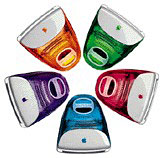 Design - Apple's design boom thatbegan in the late 90s (and is arguably still going strong today)replaced boring beige boxes and all black laptops with fruity colors and intriguingnew form factors, such as the G4 Cube, Mac mini, and MacBook Air, to name a few. Thismovement began what has helped solidify Apple's position in today's MacWorld.
- Universal Binary - Although Apple decided to move to Intelprocessors in 2005 and unveiled the first wave of Intel Macs in early2006, Apple didn't forget its PowerPC fans (at least most of them) byallowing OS X 10.5 Leopard to be installed on G4s over 867 MHz, ratherthan eliminating PowerPC support altogether. Not only was this a greatintermediary step between 10.4 Tiger and 10.6 Snow Leopard, it alsogave birth to other Universal Binary software. This was great if youowned a PowerPC Mac and decided to move to an Intel Mac. The softwarewas assured to install properly on both systems.
Now for my top 5 Apple frustrations:
- Lion - You've all heard how I have felt about Lion. Myfour-part series that gives Lion fair consideration, OS X Lion and the Post-PCEra: Yay or No Way clearly sets the tone. My opinions have notchanged. Lion so far hasn't just changed the way the Mac works, butalso how it does not work. Numerous bugs have been reported,including security vulnerabilities. Amazing how you can ruin a greatthing by trying to transform it into a different product. I'm not goingto rant any further. since this is my biggest frustration with Apple ofall time, so I rest my case.
- Untimely Product Releases - Apple is notorious for releasinga new model with specifications far beyond the previous model withinmonths of the previous model's release. I purchased a new 600 MHz Graphite iMac G3 (Summer2001) for $1,299, only to find four months later I could have had aflat panel iMac G4with SuperDrive for the same price. To add insult to injury, Applecontinued to sell the iMac G3 I bought for a while longer at a price of$999. My sister-in-law experienced the same fate after she purchased a13" Core 2 Duo Mid2010 MacBook Pro last December, only to have Apple release the Core i5 model,which is roughly twice as fast and is equipped with Thunderbolt, amonth later. Apple has certainly made buying new a frustratingexperience, but with all technology it's the nature of the beast. It'sjust a lot harder pill to swallow when you're spending upwards of$1,000.
- No Blu-ray - Apple was one of the fist members of theBlu-ray Disc Association (BDA, formerly Blu-ray Disc Consortium) andsupported the technology. After being an initial supporter, why hasApple doubled back and why has Steve Jobs called Blu-ray a "bag ofhurt", among many other outspoken negative emotions towards thetechnology? Blu-ray is the HD optical disc standard, so why Applehasn't made 15.4" MacBook Pros with 1920 x 1080 screen resolutions(similar to Sony's Vaio VGN-FW line) still baffles me. I understandSteve's philosophy with protecting his investment in the iTunes Storefor digital HD content, but consumers still want physical media, andBlu-ray provides physical media with much greater quality and claritythan DVD. The SuperDrive had its time, and rather than eliminate theoptical drive altogether (which seems to be the direction Apple wantsto take), Apple should have given Blu-ray a chance.
- Eliminating User-Serviceable Parts - Little by little, Appleis taking away our ability to upgrade our Macs. Why couldn't everyportable be more like the Pismo PowerBook? Instead, welost removable batteries with the unibody and have to pay highwayrobbery to have them replaced when they eventually go. The MacBook Airhas the RAM soldered to the board and can't be upgraded by the userafter it's ordered. Processors on the Mac mini that were once removableare now soldered on. Has a machine that costs upwards of $1,000 becomefixed in a state of unchanging operating capability intentionally tobecome "disposable"?
- The Clone Era - Before Steve's return to Apple in 1997,there was a strong period of PowerPCMac clones that came to be. This was an attempt to increase thescope of Mac OS and make Apple more like Microsoft through licensingits operating system. With the tiny share of the market Apple had atthe time, this wasn't a terrible idea on paper, but it led tosub-standard hardware (although many owners stand by their clones,especially owners of DaystarGenesis machines). When Steve Jobs ended this failed program, itonly meant good things for Apple. As a huge fan of Apple, it wasdefinitely a frustration to see Apple going against the very philosophythat made them great in the first place and ushered in a new era of"ThinkDifferent".
That's my 2 cents...
Adam Rosen (Adam's Apple): As notedby others in the group, I think theplatform changes Apple has made with the launch of Mac OS X haveprovided the most benefits. Using standard file naming extensions, aUnix-based OS, the switch to Intel processors, and all the whileendeavoring to make those changes as transparent to existing users aspossible. This has allowed the continued evolution and migration of theplatform. In the past decade, the Mac is more stable, capable, andcross-platform compatible than ever before.
The most frustrating changes occur not because Apple drops oldtechnologies and formats in new products, but in how they do so: theday a new product goes on sale, the old one is no longeravailable. Didn't upgrade to Leopard before Snow Leopard came out?Sorry, Leopard is no longer for sale. Need to run the old Final Cut Profor a bit longer before migrating to iMovie Pro (err, I mean Final CutPro X)? Sorry, you can't buy that any longer. iOS 4 sucks on youriPhone 3Gs? Sorry, no way to downgrade.
We've learned to live with Apple Giveth, and Apple TakethAway. But it really wouldn't hurt to provide some overlap betweenproducts - the real world doesn't always move at the speed of Apple.Meanwhile, I'll fight to the death to keep FireWire Target Disk Modearound as long as possible!
Charles Moore (several columns):Hey, if anyone wants to call me a Luddite because Istill have two 11-year-old Apple laptops in daily service forproduction work, have at it. I use the G4-upgraded Pismo PowerBooks because theydo what I require of them quite well, are astonishingly reliable(especially considering their advanced age), and subjectively because Ilike the tactile feel of the Pismo as a work tool better than any othercomputer I've ever used.
I spend four hours or so on one or the other or both Pismos daily -sometimes more - and I don't get tired of them. Sure, I wouldn't mindmore speed, especially graphics support, but running OS X 10.4.11 Tigerthey're actually decently lively.
However, I'm a realist. I know that I'll be able to play this stringout for only so long, and I'm serene, although a bit sad about that.It's not sentimentality. They're just a great production tool.
Last winter, I was beginning to think the string had run out -frustrated by lack of support by any state-of-the-art browser.Thankfully, the Pismos have a new lease on life thanks to thedevelopers of TenFourFox, a port of open source Firefox 5 that supportsPowerPC Macs running Mac OS X 10.4.11 and 10.5, and it works reallywell on my ancient PowerBooks, especially recent builds - decently fastand stable, and with most of the Firefox 5 feature set intact.Incidentally, it also is dynamic proof that there was no technicalimpediment to Mozilla.org continuing support for PPC Macs.
However, I have no aversion to using new technologies, providedthey're a bona fide improvement, rather than just change forchange's sake or focused on serving a set of priorities that doesn'tfit my needs. For example, I had hoped that the iPad 2 I bought two months ago would servesatisfactorily as a partial substitute for the old Pismos forproduction tasks. Alas, it's been a big disappointment in that regard -essentially useless as a production platform in the context of myworkflow and efficiency requirements, although it's reasonably good ata limited range of other functions. But compared with even the ancientPismos, let alone my Core2 Duo MacBook or newer Mac laptops, the iPad is lame and clunky atperforming the tasks that are mission-critical for me.
That's not Luddism - it's realism. If Apple is even able to make theiPad a tolerably efficient performer for text editing and manipulation,I/O connectivity, and adds real multitasking and file system support toiOS, I'll happily revisit it, but for now, I'm kinda wishing I'dapplied the cash I spent on the iPad to purchasing a MacBook Air, whichis new technology I can enthusiastically embrace.
In the meantime, I'll continue happily using my old Pismos for awhile yet, because they're still the best tool I have at hand for thework I do with them.
Steve Watkins (The Practical Mac): Twowholly positive changes jump to mind, as theyboth impact me (for the better) daily.
- The move to OS X. Though you don't see it mentioned much anymore,at the time of its release, "the power of Unix" was heralded as aprominent feature of OS X. Preemptive multitasking was a hugeimprovement over System 9, and the rock-solid underpinnings of BSD Unixmean I go for weeks at a time without rebooting. This is a huge boonfor productivity - and something neither the Classic Mac OS nor Windows(at least to date) could ever approach.
- The iPhone. Like its Mac counterparts, it does what Steve Jobshoped it would do: "It just works." I would be lost without the abilityto check email, browse the Web, and text on the go (not to mention theoccasional game), and four years later, no other smartphone comes closeto matching the iPhone's functionality or ease of use.
Frustrations
- Planned unnecessary obsolescence, and at what seems like anaccelerated pace of late. There is no technical reason to ditchRosetta, yet Apple does so anyway. PowerPC processors were left behindtoo early. Just a couple of examples that come to mind - if I thought,I'm sure I could come up with more.
- Increasing move toward closed systems. Someone else alreadyexplored this topic, so I will sum up by saying I am getting irritatedwith Apple more every time they release a product virtually void ofuser-serviceable parts.
Dan Knight (Mac Musings):It's hard to imagine now, but the the first threeyears of its existence, the Mac was a closed box. The first two modelshad no expansion slots, no hard drive connector, and no memoryupgrades, although there were some aftermarket options. The Mac Plus added upgradable memory andthe SCSI hard drive connector but remained a closed box. today's closedboxes are the iPhone, iPod touch, iPad, and MacBook Air.
The thoroughly expandable Mac IIwas a paradigm buster, offering six expansion slots, room for twofloppy drives and two 3.5" (or one 5.25") hard drives, and memoryexpansion from a base of 1 MB to 128 MB, although it would be someyears before anyone could actually buy that much memory. You could havemore than one video card, add a fast network card, and had full colorsupport for the first time on a Mac. Today's Mac Pro continues that legacy.
The next big change came with System 7, when multitaskingbecame the default behavior of the Mac OS. Before that, you either ranone app at a time and quit it to run another, or you used a taskswitcher like MultiFinder. Cooperativemultitasking wasn't perfect, but it did mean existing apps didn't haveto be rewritten. If one task demanded all your CPU resources,everything else had to wait, and your programs used a fixed amount ofsystem memory - all issues that Apple left behind with Mac OS X.
Then Apple began to more away from SCSI drives, NuBus expansionslots, and its own video connector. Beginning with the Quadra 630 and PowerBook 150 in 1994, Apple started totransition to IDE drives, although SCSI remained the standard for PowerMacs until the Beige G3in 1997. In 1995, Apple abandoned NuBus expansion cards for PCI, thestandard in the PC world. And Apple's unique 15-pin video connectorgave way to VGA with the Blue & White Power Mac G3in 1999, bringing yet another industry standard to Mac users.
With the introduction of the iMac in 1998, Appleabandoned SCSI, its ADB mouse and keyboard port, its RS-422serial/network ports, and the built-in floppy in favor of USB. By doingthis, Apple created a market for USB peripherals that had not yetdeveloped even though many PCs already had built-in USB ports thatnobody really used yet. It's hard to remember that there was a timebefore USB flash drives!
It took Apple several years to get OS X out the door and to thepoint where it became really useful, which I would date to theintroduction of OS X 10.2Jaguar in August 2002. One of Apple's most brilliant moves wasadding Classic Mode to its new OS, as this allowed Mac users tocontinue using their older Mac software until suitable OS Xreplacements became available - much as PowerPC Macs had supported680x0 apps and Intel Macs continued to support PowerPC apps until therelease of OS X 10.7 Lion.(Classic Mode remained through OSX 10.4 Tiger for PowerPC Macs; it has never been available on IntelMacs.)
With the switch to Intel CPUs in 2006, Apple adopted the fifth CPUarchitecture in its history - following the 6502 from the Apple II andIII, the 680x0 from Lisa and Macintosh, the PowerPC, and the ARM chipin its Newton PDA, and architecture Apple returned to with the iPhonein 2007.
Apple has made a lot of changes for the good, even though old timersoften moaned about what got left behind in the process. But Apple alsomade some changes we didn't like, even if we later became used tothem.
- Preemptive multitasking made System 7 slower than System 6. It alsodemanded more system resources, making 2 MB of memory a practicalminimum.
- IDE hard drives required more CPU resources than SCSI drives, whichmeant less processing power available to your apps during hard driveaccess. As the IDE specification matured and CPUs became more powerful,this became less of an issue. (The same issue impacts USB vs.FireWire.)
- Apple has come up with some doozies in the area of monitors. TheAppleVision 1710 requires an ADBconnection in addition to its video cable. Then came the HDI-45connector on the AudioVision14 Display, which could only be directly connected tofirst-generation Power Macs. HDI-45 included video, sound, microphoneinput, and ADB in one big connection. And then came the Apple DisplayConnector, which combined DVI, USB, and monitor power. You need anexpensive adapter to use ADC monitors with modern Macs.
- Mac OS X was a slow, bloated mess at first, and version 10.0 wasbarely useful. But 10.2 was pretty mature, 10.3 was very nice, and 10.4set the high water mark for features, efficiency, and backwardcompatibility (it was the last version with Classic Mode and the lastMac OS to support G3 CPUs.)
Mac OS X 10.5 Leopard leftClassic Mode behind, so quite a few of us are still running Tiger onour G3 and G4 Macs. OS X 10.6Snow Leopard left PowerPC Macs behind, and quite a few of us arestill using Leopard on our G4 and G5 Macs. And now OS X 10.7 Lion leaves PowerPC softwarebehind by eliminating Rosetta.
When Apple abandoned the floppy drive, third-party USB floppies letus access our old 3.5" diskettes - at least the high density ones.There were ADB-to-USB adapters for those who loved their old ADBkeyboards, trackballs, and tablets. Mac-to-VGA and VGA-to-Mac adapterslet us mix and match Macs and monitors. And right up until Applelaunched Leopard in late 2007, we could still run a lot of ancient680x0 Mac apps thanks to Classic Mode.
I'd have to peg 2007 as the year Apple changed its course. Untilthen, the level of backward compatibility was astounding. Since then,the focus has been on building for the future and leaving the pastbehind - no Classic Mode for Intel Macs or OS X 10.5, no PowerPCsupport for OS X 10.6, and no support for the first generation of IntelMacs or PowerPC software with OS X 10.7.
Looking forward, I have to say that Thunderbolt is the mostsignificant new feature Apple has added in years, and the Apple Thunderbolt Displayexemplifies that future. One cable between your 2001 Mac and themonitor gives you USB, FireWire, and ethernet ports on the display -even if your Mac (specifically the MacBook Air) doesn't have FireWireand ethernet ports.
Multitouch trackpads, the Magic Mouse, and the Magic Trackpad bringthe touch technology developed for the iPhone to Mac users, as do somethird-party drivers for older PowerBook and iBook trackpads. Touch hassignificantly changed the way we interact with our smartphones,tablets, and computers, although I don't ever see mice and trackballsdisappearing - sometimes you need pixel-level control of the cursor.But the day is coming when desktop Macs will ship with trackpadsinstead of mice, which will be optional accessories, just the oppositeof today when the mouse is standard and the trackpad an option.
For the most part, Apple has made changes for the better. Old timerswed to Classic apps, PowerPC software, SCSI drives, or whatever willhave to continue using what works for them. Apple has left us behind,but our old Macs are no less productive because of it. Those who wantall the modern bells and whistles have to pay the price for newerhardware and software.
Or you can have the best of both worlds, as several LEM staffers do,by using newer Macs alongside older ones - me with my Intel Mac minrunning Snow Leopard and G4 Power Macs running Tiger and Leopard,Charles Moore with his workhorse Pismos, several others using G4notebooks, and quite a number living in the iOS world with our iPhones,iPod touches, and iPads. As long as everything can work together -whether over WiFi or via Dropbox - we don't have to choose up-to-datevs. dated. We can have our modern Macs and low-end Macs too.
About LEM Support Usage Privacy Contact
Follow Low End Mac on Twitter
Join Low End Mac on Facebook
Favorite Sites
MacSurfer
Cult of Mac
Shrine of Apple
MacInTouch
MyAppleMenu
InfoMac
The Mac Observer
Accelerate Your Mac
RetroMacCast
The Vintage Mac Museum
Deal Brothers
DealMac
Mac2Sell
Mac Driver Museum
JAG's House
System 6 Heaven
System 7 Today
the pickle's Low-End Mac FAQ
Affiliates
Amazon.com
The iTunes Store
PC Connection Express
Macgo Blu-ray Player
Parallels Desktop for Mac
eBay