

The Mac's Little Friend
Eric Schwarz - 2001.09.27
Are PalmOS handhelds the only game in town for Mac users? For PDAs, yes, but there is something else that might like your Mac as well. I'm talking about Texas Instruments' line of graphing calculators. In this article, I'll share some information on them, my personal favorites, and how to link them to your Mac. In order for this article to fit into the whole "Low End Mac" thing, think of these as peripherals for your Mac.
Texas Instruments seems to be embracing the fact that there are Macs in schools. After all, they are the #1 calculator company for education, so it's only natural for them to support the #1 computer company for education. Although Texas Instruments' graphing calculators are called calculators, don't let the name deceive you. Most of them use a Z-80 processor and are capable of running 3rd-party software. Technologically, they are similar to the Radio Shack TRS-80 Model 100 portable computer.
One model, the TI-80 uses a proprietary processor, and it, as well as the TI-81, can't connect to a computer, so I'm not going to talk to them. Two models, the TI-89 and TI-92, are essentially the same and are based on Motorola 68000 processors.
Why?
Why get a TI instead of a Palm? Here you have a true computer. You can link it to your Mac relatively easily and even write your own programs for it. If you don't want to spend tons of money for a Palm, you might want to look into one of these. You can transfer information between the two, and they're more durable in terms of being dropped, abused, and otherwise being beaten up.
TI-82/83/83 Plus
These are what most students use. Based on the Z-80, they're cheap, reliable, powerful, and easy to use. They have pull-down menus, so navigation is similar to most computers. There are tons of games, math, science, and business programs for these. There is even a nice OS for the TI-83 Plus called MirageOS from Detached Solutions that resembles a Mac-style "open/save" dialog box. My calculator is a TI-83 Plus. This is the model I recommend out of these. They generally cost about $79-$95.
TI-85/86
These are the more powerful Z-80-based TIs. They have lots more functions, more memory, and better graphics. Navigating them is more DOS-style (all the commands are accessed by pressing F1-F5). For most users, I'd still recommend the 83 Plus. It has more memory and a bigger selection of programs. The TI-85/86 doesn't seem to be worth the extra $15.
TI-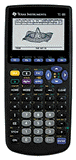 89/92/92 Plus
These are almost like handheld Macs (minus the Apple ROMs). They are based on the Motorola 68000 processor just like the fist Macs, have true pull-down menus, real dialog boxes, and about 512 KB of RAM on the new models. By standards of graphing calculators, that's a ton. These, in theory, might run Mac 128 software with some modification, but I'm not going to guarantee it. The people who buy these usually use them for complex scientific and math work, 3D graphing, or other really demanding tasks.
Linking
To link any of these to a computer, you need to buy the Graph Link package from Texas Instruments. There are three models. The first, the "gray" cable ($50), allows connection to Macs and PCs through the serial port. The second, the "black" cable ($20), allows connection only to Windows 95 or later computers. The third is a USB cable ($50) that allows connection only to USB Macs (as of now).
In each of these packages, you get the appropriate cables and a CD-ROM. The CD contains software for Mac and Windows, regardless of what cable you bought. The CD also contains miscellaneous utilities and some demo programs for your calculator.
Linking is pretty simple. You plug one end of the cable into the Mac, the other into the TI's link port (a 2.5mm stereo jack). Then open the software on the computer, select the port and model of calculator you have, and copy the files. It's relatively easy. The Mac version seems much better than the PC version in terms of usability.
You can also copy files from one calculator to another, provided they are in the same group (82/83/83+, 85/86, 89/92/92+).
Conclusion
It doesn't matter which model you get, just be sure to research and see which one best fits your needs and budget. I don't really recommend the TI-82, since this is a relatively limited model in terms of assembly programs (you're stuck with BASIC programs). Spend the extra $5 to get a TI-83 Plus.
If you want to see what kind of cool programs you can get, go to TIcalc.org's download section <http://ticalc.org/pub/>.
If you have any questions about the TIs, I'm always willing to
help and am working on setting up a Web site for these calculators.
Until next week, take care of yourselves and each other.

About LEM Support Usage Privacy Contact
Follow Low End Mac on Twitter
Join Low End Mac on Facebook
Favorite Sites
MacSurfer
Cult of Mac
Shrine of Apple
MacInTouch
MyAppleMenu
InfoMac
The Mac Observer
Accelerate Your Mac
RetroMacCast
The Vintage Mac Museum
Deal Brothers
DealMac
Mac2Sell
Mac Driver Museum
JAG's House
System 6 Heaven
System 7 Today
the pickle's Low-End Mac FAQ
Affiliates
Amazon.com
The iTunes Store
PC Connection Express
Macgo Blu-ray Player
Parallels Desktop for Mac
eBay