
The Low End Mac Mailbag
Slow Compact Flash, New Mac on Hold, Beige G3 and OS X, Bad OS Xperiences, and More
Dan Knight - 2003.04.22 - Tip Jar
- Compact Flash Is Slow
- New Mac Plans on Hold
- Beige G3
- Bad OS Xperiences
- Rant Against Complainers
- Angry Mac Users
- A More Positive Tone
- OS Allegiance
- It's the User's Fault
- Good News and Bad News
- Address Book
- Unsupported OS X Workhorse
Compact Flash Is Slow
In response to Flash Memory Really Boost PowerBook Performance (among other articles we've posted on the topic), Ron MacKinnon writes:
I've experimented with a CF card in my 3400. I've also upgraded the hard drive, and the memory is maxed at 144 MB. I tried a CF card in the PC Card slot as cache RAM for my browsers and was less than dazzled by the performance. My hard drive (a 4 GB IBM unit) says it can present data at 8.1 MB per second. I don't know how fast that Kanga owner's drive is, but I think it's safe to say that it's as fast as or faster than mine.
After seeing such a lack of improvement with the CF card, I did a little research. I discovered that most CF cards can present data at up to about 4 MB per second and can write at about half that. So cache (and, I presume, virtual memory) on a CF card is about half as fast as using my drive and tossing the CF card in the drawer.
As confirmation of the above, I also tried booting from the CF card. I copied my System folder to the card after initializing it as a drive. I then selected it as my boot device and let it go. Boot time from the card was about twice the boot time from my hard drive. Granted, it was quiet, but very slow. So my CF card is in the drawer awaiting some other use.
Hope this helps.
Yes, it helps a lot. I've got a CF card and PC Card adapter for my TiBook, but I haven't taken the time to boot into OS 9, turn the cache size down, and see how fast it is.
There are several factors involved here. First, there are three standards for that slot. PCMCIA is slow, PC Card is about 2.5x faster, and CardBus is faster yet. Then there's the CF memory itself, which ranges from roughly equal to a 4x CD-ROM to about the same performance as a 24x CD drive.
The third factor is important for comparison, the speed of your hard drive. Most of the people who have experimented with this were using much older PowerBooks with slower drives, so a CF card half as fast as your hard drive might be faster than their hard drive.
It's possible that faster, more costly CF might be faster than the card you used. I wish I had access to a couple dozen different CF cards to test....
All that said, the reasons for using CF as a solid state drive varies from user to user. Some use it so they can run the computer without ever spinning up the hard drive, which really increases battery life. Some use it as a way to use virtual memory when there isn't enough free space to use their internal hard drive. How well it works depends on a lot of variables, and it's not a solution that works for everyone.
New Mac Plans on Hold
Responding to the March 31 mailbag column, Ken Cavaliere-Klick writes:
Great articles. Maybe because I am new to the whole Apple "thing" by
way of a rescued Bondi
iMac I don't 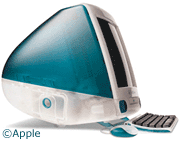 have the excitement,
enthusiasm or deep rooted devotion to the platform. It's a great
platform, to be sure, great enough for me to shelve my Windows
computer. (That says something right there - I shelved a Windows
computer in favor of a Bondi running 9.2.2.)
have the excitement,
enthusiasm or deep rooted devotion to the platform. It's a great
platform, to be sure, great enough for me to shelve my Windows
computer. (That says something right there - I shelved a Windows
computer in favor of a Bondi running 9.2.2.)
I've used and/or owned a lot of computers over the years. This one is "just right," to steal a line from Goldilocks.
I'm not fond of X. It's too "Windows." Too many gadgets, too many widgets, too many effects, too many "i's." It's not enough to sell me on Unix and virtual machines; I know about that kind of thing.
I do scratch my head wondering who thought of combining QuickTime and Acrobat to make a front end for fast, speedy Unix. But it is what it is.
I'm not sure what my next computer will be. I had planned a new Apple computer of some sort this past January, but the "no dual booting" put me off. The Jaguar reviews didn't light my lights either. This is no small investment, and I want to feel secure about this. At this point I plan to sit tight, maybe load up YDL3 for the experience, but I have no intention of going back to Windows.
Thanks for the great writing.
I gave up PCs in the pre-Windows 3.1 era. My few attempts to get around in the Windows systems at work (I work part-time in a camera shop) have been very frustrating. I can think of a lot of reasons to give that up for the Mac OS, either classic or OS X.
I've been using Jaguar for three months now, and I'm quite comfortable in it. It doesn't feel as speedy as OS 9 did, but I'm hooked on Safari, locked into Mail, and really appreciate the way it lets me move seamlessly between X-native and classic applications.
I'm in no hurry to replace my TiBook. It turns 3 next January, and I'd like to hold onto it that long. Quartz Extreme and a higher resolution screen would be nice. A faster CPU and internal CD burner would also be nice touches. At this point, I'm thinking a 667 or 800 MHz PowerBook G4 (DVI) would be just the ticket - and even boot into OS 9 if I ever had the need.
I wouldn't want to be running OS X on a Bondi iMac unless it had lots of memory and a faster hard drive. With a relatively slow CPU, very outdated graphics chip, and underperforming stock hard drive, it's just begging for some upgrades. (See Upgrading Your G3 iMac to get the whole picture.)
Use what you've got as long as it suits your needs or can be economically upgraded to do so. When that's no longer the case, the best value is probably a newer used Mac of recent vintage rather than something brand new.
Beige G3 and OS X
Will McAdams comments:
I have been following your beige G3 experience, and I feel your pain. I also have a G3/233, the desktop model. I purchased it in 1998. I have added a Newer Tech G4/400 ZIF upgrade (overclocked it to 433 MHz), added a 20 GB HD, and bumped up the RAM to 512. Then I added a USB & FireWire card to just make it more compatible.
I just made the switch to OS X. I went out and bought a FireWire HD enclosure and a second hard drive and loaded OS X on it via my Pismo laptop. I partitioned the HD to under 8 GB (thanks for that tip), then did my best to optimize OS X before I swapped the two hard drives. It was a risky move, but I went ahead, and it seems to be working fine.
Anyway, here is my problem. I have milked every penny out of my Beige G4. I am so wanting to get an actual G4, one with dual processors. However the prices are so high, I really can't justify it. The lowest Dual G4/500 are selling for $899, but when you bump that up to standards, it is almost worth getting the newer Quicksilver or the MDD. Sigh. So I went ahead and ordered an ATI Radeon 7000 PCI, 256 more RAM, and a SIIG ATA 133 controller card. That cost me under $250, which is way less than $1,400 for a new G4.
I am in the graphics industry and have managed to survive, but I also own a PC, and I know you are partial to Mac and against Windows (my Mac is Windows free as well), but you can't deny the fact that PC parts are soooo much cheaper. I can go out and build a multiprocessor PC for half the price of a Mac, and it will run even faster. The PC world is up to 8x AGP.
I guess the saddest thing is that I saw in a computer store flyer, an ATI PCI Radeon 7000 for a PC selling for $49. I bought mine for $119.
I hope that there is some light at the end of the tunnel. I am holding out until the Expo to see if anything will drop the existing prices of the G4s. My fingers are crossed, as my beige G4 is maxed out.
Yeah, those used dual G4 models remain expensive. I don't recalls seeing one as low as US$900 yet. Your best bet might be looking into the 1 GHz G4 upgrade from Sonnet. For $700, you just swap out the CPU and keep the rest of your investment in the beige G3 intact.
And your G4/400 upgrade might fetch $150-250 from the right buyer, further reducing the cost of the upgrade.
The PC world is a very different place. Everything is a commodity: motherboards, cases, drives, video cards, memory sticks, keyboards, mice, printers, etc. Fact is, it's sometimes possible to flash a PC video card and make it work in a Mac, although you have to perform the operation on a Windows PC. Some members of the SuperMacs list have been doing this with the Sapphire Radeon 7000 and saving a fair bit of money.
Much as a lot of us wish Apple would compete pricewise with Windows PCs, you've got to remember that BMW doesn't compete on price with KIA or Hyundai. Even a low-cost Mac wouldn't come close to those $200-300 Lindows boxes they sell at Walmart.
Bad OS Xperiences
In response to Angry About OS X, John Konopka writes:
I just read the mailbag column about people's bad experiences with OS X. I am sorry they have had such hard times. We have had almost nothing but great experiences with OS X on five different Macs from slot loading 400 MHz iMacs to a G4 867 tower. I don't know why there are problems with particular computers but it is wrong to generalize and say that OS X works poorly on all computers.
I don't mind paying for OS X upgrades once a year. In fact, I bought an extra copy of Jaguar for my mom. I could have just used my CD to upgrade her iMac but I thought it was worth it to pay Apple for a good product.
Also, looking back in time this is not the first time that older computers were not allowed to upgrade. I believe that the SE/30 and earlier computers had a cutoff at System 7 or there abouts. I think the 68000 CPUs were differentiated from 68030 and 68040 systems.
We also have a 300 MHz Wallstreet but I have not tried to upgrade that to OS X as I don't think it is reasonable. I have OS X on a Pismo 500 and I think that is about the minimum for running X.
There's a reason we include "Advice presented in good faith, but what works for one may not work for all" in our terms of service. Whether we're talking about cars coming off an assembly line, TVs built who knows where, or personal computers, despite the best attempts to create items of consistent quality, some end up much worse than average.
It is just as wrong to generalize that OS X is a nightmare from a single bad experience as to paint it as paradise based on a few installations. The truth is somewhere in between because every computer - even the same model built with the same components - ends up different once the end user starts using it. For a small number of people, OS X has been a nightmare.
For instance, back in October 1998, I had problems with the HFS+ file format available under Mac OS 8.1 on a couple computers - but not on most of the one I supported. But I didn't generalize and say 8.1 was bad or HFS+ was terrible; I looked for a solution. Readers provided a lot of feedback, and I eventually got to the point where I was able to use it.
We need to take the broader view and realize that no matter how hard Apple works on the Mac OS, there are going to be configurations that just won't work right, whether due to incompatible hardware, outdated drivers, or software conflicts. If Tony Torres needs some time away from a frustrating OS Xperience and is willing to try it again later, at least Apple hasn't lost him.
Rant Against Complainers
Jim Harris holds forth:
To those of you who find the need to complain about nothing:
Why is it that you people don't understand how the world works? You decide to upgrade. Apple is not forcing anyone to do anything... You don't want to pay $129 for a new OS? Then don't.
It is absurd to blame Apple for your cheapness. 10.1 was a free upgrade. The following smaller updates are free (i.e. 10.2.1, 10.2.2, 10.2.3, etc.) iTunes, iMovie, and iPhoto are free!!!
What is wrong with you people? Why does everyone have to complain about this? Since when does Apple owe you anything after you bought a computer?
You people think that somehow you own a part of the company after buying a Mac.
When you buy a Mac, you are buying it with the operating system that is installed, not the ones that are going to come after it. Never does Apple tell you that they will provide you with free software for life.
Get real please. Grow up. Blame yourself for your mistakes.
Don't like OS X? Why did you buy it then? You have an opportunity to use it at Apple retail stores and moreover, you have an opportunity to find out what works well, what doesn't, etc.
How can you get mad at Apple?
I assume that Apple should simply enslave all the people that work there so that you can have it your way and have a free lunch?
Think about the economics of it. There is only so much the company can just give you. Look at all the incredible technologies that are in OS X. They speak for themselves.
I have seen how people come from the Windows world in awe at what the Mac can do and how easily it does it.
I, for one, will gladly pay $129 and even more for Panther. Why? Because there are people hard at work to bring us incredible products.
I understand that I have to pay them in order to get the satisfaction that I do when I install an brand new OS. It is sad to see that people find a need to vent in the way you have, throwing blame at a company that supposedly you love, blah, blah, blah.
If you don't like Apple, it's OS, or its computers, there are plenty of other options for you: Microsoft and a ton of PC manufacturer's would be more than willing to accommodate you and charge you the same way or more for upgrades.
Please, for your own sake, listen to what you are complaining about and try to live happier lives.
Don't have a cow, man.
"Since when does Apple owe us anything?" Since we probably invested over a thousand dollars in Apple hardware and over $100 so we could install OS X on that hardware, we believe that Apple owes us reliable products, not eMacs plagued with video problems (a local school has a 30% failure rate during the first year) or buggy operating systems (like the "update" to 10.2.4 that forgot how to keep track of the time).
"Since when does Apple owe us anything?" Since Apple said they wanted to grow market share from their pathetic 3% to the 10% level. You can't do that by ticking off your existing customer base. People will not switch to a product with a lot of disgruntled users.
"Since when does Apple owe us anything?" Since Apple wishes to remain profitable and not go out of business, they owe us products worthy of our money and our loyalty. Anything less will get people to stick with the classic Mac OS, switch to Linux, or join the teeming masses of Windows users - none of which helps Apple's bottom line in the least.
"Since when does Apple owe us anything?" Since they made their first sale to a customer.
The question isn't whether Apple owes its customers anything, but what it owes them and what we deserve. If Apple wants to have the computer for the rest of us, Apple shouldn't treat us worse than the competition. If Microsoft offers discounted upgrades and Apple used to, Apple does itself no favors when it switches to a full price only program.
If Apple wishes to be perceived as the company worth the price of their computers, they had better offer the best quality components, best customer service, and lowest failure rates in the industry, not leave it to Sony.
Please, for your own sake, think about what you're complaining about and try to understand why people who pay more expect more.
Angry Mac Users
Rob Fairchild has this to say:
I'm a regular reader of Low End Mac and have been since discovering it during the summer of 2002. This site in particular was quite influential in feeding my newfound interest in Apple computers. I enjoy the insights that your articles provide, particularly for users of older computers.
I bought an old SE this
summer to get a sense of the Macintosh experience and was so impressed
by what such an old machine could 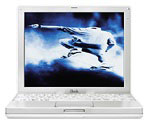 still do that I
vowed to make my next computer a Mac. I bought a G3 600 iBook this past fall and
never looked at computers the same way again. It is far and away the
best computer I have ever used.
still do that I
vowed to make my next computer a Mac. I bought a G3 600 iBook this past fall and
never looked at computers the same way again. It is far and away the
best computer I have ever used.
So I must say I am quite astonished to read as much as I do in the context of furious Mac users who feel outright betrayed by Apple. While Apple has not been a perfect company, it seems to be held to impossibly high standards. One of the letters I read in the March 31 mailbag went so far into hyperbole as to say that Apple was "far worse than even Enron" because it made the move from OS 9 to OS X and has decided to exclusively market, support, and develop X (and all the versions to come afterwards).
Perhaps my perspective is skewed because I am a new adopter and never had the opportunity to become attached to the older system (or invest heavily in software for it), but I think it's important to remain mindful of the things Apple has done right as well.
For myself, I was a longtime Windows user, and one of the many who was never well disposed towards Macs. My first job as a Web designer had me working on machines running what had to be OS 8 many years ago, and I hated it. Like anyone exposed to a new operating system, I found it cumbersome, counterintuitive, and slow. I was also a technically oriented user who preferred to muck about inside the machine and spent years swearing he'd never invest in an "out-of-the-box" computer - especially not a Mac.
Contrast this to the my experience in the summer past, when some articles and advertising about the new Unix-centred OS, the stylish iPod, the ease of networking, and (above all else) the fanatically devoted users persuaded me to give the Mac a second chance. The "switchers" campaign has been somewhat less intensive here in Canada, but the concept certainly made an impact.
I began reading up on the platform, the company, their shared history, and the modern state of Apple computers and its software. I played around on my old SE and admitted it was really an elegant concept.
I'd had enough of Windows and the attendant system failures, security holes, driver updates, and the inherent instability. I've never regretted the switch for a second. |
My computer is elegant, stable, simple, and beautiful. I have found OS X to far surpass any Windows environment in terms of security, stability, ease of use, and functionality, up to and including XP. While it is only 6 months old, it has never yet given me a bit of trouble, despite being used intensively at school and all the knocking about that entails.
This is far more than I can say about my Windows desktop machine. Within a few months of buying it, I had to have the power supply replaced, and now I have to replace the darn thing again. Let alone the nightmare of trying to add new hardware to the machine and wrestling for hours with drivers and software updates to get it to work properly (particularly when I can now simply plug my iBook into something and, well, it just works).
I feel like a walking advertisement for Apple in all my law classes, or wherever I go for that matter. People constantly want to touch, hold, and use the machine and have no end of questions about it. My school is a sea of Dells, and when colleagues complain about their computers because they're heavy, noisy, unreliable, drain the batteries too quickly, and the customer support at Toshiba or HP (or wherever) treats them like crap even in the face of a design flaw, I'm reminded again of why I made the right choice. More than one person has said they would have bought a Mac - except someone told them they were too expensive or weren't compatible with anything, and I like to set them straight on such points.
As much as my experience is limited and anecdotal, I felt like I had to speak up. I know that a lot of users are just frustrated and angry by Apple's about-faces on various policies (like .mac) and its overcharging for upgrades to the OS, but there are lots of happy users out there, too, and we shouldn't lose sight of that.
Well said, Rob. Windows users don't tend to get too concerned about Dell, Gateway, HP, Toshiba and the dozens of other companies that make Windows computers. So what if the manufacturer makes some boneheaded moves and goes out of business - there are still plenty of models to choose from.
In reality, of course, they are as wed to Windows as we are the Mac OS. As I see it, the only reason they don't get incensed at Microsoft is that they don't perceive themselves as Microsoft customers. For the most part Windows is something already installed when they buy the machine. They see themselves as Dell customers and Windows users.
There's no such dichotomy on the Mac side. We know Apple makes the hardware and the operating system. We know we have chosen to follow a different path than most computer users, acknowledge that it has made all the difference, and are personally invested in our decision to use a Mac.
I think that's why Mac users can get angry with Apple. We've paid a high price both for the hardware and for walking a different path; we do not want to be abandoned by the company that convinced us to diverge from the mainstream.
Sometimes we need to let off steam. Sometimes we need to get a different perspective. And sometimes we need to be reminded that despite the frustrations we have chosen the better way.
Thanks for that reminder.
A More Positive Tone
Kevin Bataille
It's always fun to see what people have to say on your site about OS X. I guess the people that still think OS 9 is faster than X only use one app at a time or are running it on underpowered systems. For those of your readers that are having speed problems with X, you should be telling them how to upgrade their systems to handle X.
I have an old 7500, and it runs X v10.2.4 fine. The key is that [OS X] likes to have lots of memory and drive space. I've been upgrading my system for years. Now it has 768 megs of RAM, a UW2 SCSI card with two 18 gig drives, an ATI Radeon card, and a 450 MHz G4 card.
If you want to run X on anything lower than a B&W G3 Mac and don't want to spend much money, load up on RAM.
I just wish your site had a more positive tone. It does no one any good to just bitch about performance issues without offering ways to help your readers overcome the issues. The facts are that OS X is the current Mac OS and all development is going into it and not OS 9. This is true with both Apple and other software developers. OS X requires more computer horsepower than OS 9.
OS X is far better than anything on the Windows side for a current Mac user. Apple software updates are far cheeper than Windows upgrades. No one but SJ knows how much Panther will cost. The IBM 970 won't run on anything lower than Panther V10.3.0
Low End Mac is not an OS X advocacy site, nor is it anti-X. We reflect the different experiences of our writers.
The hype led us to believe that OS X would be all things to all users - the ease of use of the Mac, the stability of Linux. That would have been fine, but then Steve Jobs decided it needs a Pixar-inspired horsepower-hogging interface. The underlying OS is efficient; the overlying interface is bloated.
You can tell when AppleScripts for classic apps can be far faster than they were in OS 9, and when Carbonized software (such as AppleWorks) is much pokier running in X. Mac OS X is a powerful OS hobbled by an overly demanding front end.
I love OS X, but it sacrifices the elegant simplicity of the classic Mac OS interface so it can look prettier than Windows. That would be fine as an alternate appearance for those who want it, but Apple has made sure that Aqua is the only interface available for OS X.
Of course, Apple is in the hardware business. A powerful OS with a lot of graphical overhead can help sell a lot of hardware.
We've done our part in helping people know how they can upgrade their old Macs, both desktops and portables, to best run OS X. When we looked at the G3 PowerBooks and the G3 and G4 Power Macs in Mac Daniel recently, one of the most important factors was whether these could be decent OS X platforms. Did they support enough memory? Was onboard video up to snuff? How much would it take to turn it into a decent OS X machine?
Some people are content with OS X on 233 MHz iMacs and WallStreets; I find it slow on a 400 MHz PowerBook G4 with a fast hard drive and 512 MB RAM. Of course, some users only run a few programs; I usually have 8-12 active at once, including several classic applications.
My writing is going to reflect my joys and frustrations with OS X. I am not a cheerleader. Apple has a great defense (customer loyalty) but is seriously lacking on offense (getting Windows or classic Mac users to switch). I call 'em like I see 'em, positive or negative.
Although I see myself as a Mac advocate, I'm not going to get into a dysfunctional relationship with Apple and refuse to see or speak about problems. We owe it to Apple and each other to be honest about the strengths and shortcomings of both Apple Computer and the company's products.
OS Allegiance
Christopher Iwane
I think a lot of the complaining about OS X would go away if people stopped trying to run it on anything less than a G4 and faced the truth that early adopters of technology always get burned.
When OS X came out, I loaded it onto my B&W G3. Three months later I'd sold my Mac and was using Windows 2000 on a home-built dual-PII/400. A few weeks ago I loaded 10.2 onto a G4 iMac at work, and within days it was my primary work computer. I'm even hankering for one at home, though I have no real need for it as my PC (now running Windows XP) is still more than capably handling what I throw at it.
The answer, ultimately, is to use whatever works for you and not be so silly as to pledge allegiance to a company.
Windows has given me less trouble than any flavor of Mac OS that I threw at my B&W G3 and gave me back the stability I lost when I upgraded to the B&W from a IIcx.
I see all of the Windows-bashing taking place and, for the most part, it's ridiculous. I started using Windows 2000 just weeks after it was released, and the improvement over Windows 98 or Windows NT Workstation was immediately evident; this was not the case in comparing Mac OS X to Mac OS 9 when most people couldn't stop complaining about issues such as speed and application compatibility.
At this point Windows vs. Mac is a toss-up. There's isn't a significant enough difference between the two platforms to make it worth arguing about. In both cases you'll get a stable, mature OS with a wide selection of applications running on hardware fast enough to almost always make the user the bottleneck.
Gotta run. All this thought about Macs has made me want to fire up my 128K.
I got into the Mac in 1986 and missed the era of the 128K. I'd love to find a nice clean 128K or 512K (not the enhanced version) along with an external 400K floppy just so I could live the experience that was so quickly eclipsed when the Mac Plus introduced double-sided floppies, SCSI hard drives, and expandable memory.
You're right in asserting that there is no right answer for everyone. What works best for me may not work best for you. Lots of Windows users are still content with Win95, and a small minority of Mac users still thinks System 6 was the best Mac OS ever. It's your tool; it has to work well for you.
For those unfamiliar with the Microsoft side, Windows 2000 was the third generation of Windows NT, much as Jaguar is the third generation of Mac OS X. The entire NT family was designed to compete with Unix, and it was not designed on a DOS foundation. It's far more stable than the consumer versions of Windows (3.1, 95, 98, and Me) and paved the way for Windows XP, just as Jaguar paves the way for Panther.
Comparing OS X and OS 9 is, pardon the pun, comparing apples and oranges. The classic Mac OS was conceived as a single user, single tasking operating system; the Unix which underlies OS X was conceived as a multiuser, multitasking operating system. As the classic Mac OS evolved to support multiple tasks, it sacrificed stability, just as consumer versions of Windows sacrificed stability when it moved beyond its single user, single tasking DOS foundation.
Today we have three stable, mature operating systems to choose from. Windows XP, the choice of the masses from a monopolistic company and laden with security holes. OS X, the choice of 5-10 million Mac users that's remarkably stable and has a bloated GUI. Linux and the other *nixes, which runs on more types of hardware but doesn't present a single user interface and has never been called user friendly.
Whether we're dealing with activation schemes, .Net, viruses, Trojans, so-called secure computing, Big Brother invasiveness, or just a nonconformist streak, I can't see pledging my allegiance to the Beast of Redmond no matter how stable or user friendly Windows has become.
But that's my choice. In a free society, we can each choose which way to go. And sometimes the majority follows a beast, as Germany did when their democratic system put Hitler in power.
It's the User's Fault
Good old anoymous (yes, it's always the same person) knows where to put the blame when OS X seems slow:
Mac OS X isn't slow, anymore than Mac OS 9 isn't slow after you rebuild the desktop. To learn what you need to do to make sure Mac OS X stays optimized, visit:
http://www.macmaps.com/Macosxspeed.html
I have a PowerBook G3/233 with 512k backside and an iMac G4 800 MHz. On neither machine is Mac OS X slower than Mac OS 9.
Obviously there is something wrong with the setup of the people whose machines is slowing to a crawl. They should look at the optimizing routines on the above website to make sure their machine doesn't go to a crawl.
Sarcasm on.
What a fool I've been for thinking that it might be Apple's fault that OS X is slower than OS 9. Thanks for setting me straight; it's my fault.
C'mon, get real. If Apple can't design an OS that runs fast when installed, why should that be the user's fault? Really, can the presence of a shared computer on my network or using a mousepad with too little texture make OS X slower? If that's true, why is my TiBook just as slow when it's not on the network and I'm using the trackpad?
If you honestly believe OS X is just as fast as OS 9 on your WallStreet, you must have the most bloated System Folder in OS 9 or be running third party hacks (like Shadowkiller, which speeds up Aqua but makes it hard to tell where some windows end), 16-bit video, and only native applications under OS X.
Nobody else on God's green earth has ever claimed that OS X is as fast as OS 9. You should publish a book. If you can prove your contention, millions of Mac users would gladly pay for the information needed to make OS X as sprightly as OS 9, especially on older hardware like your WallStreet.
Sarcasm off.
Good News and Bad News
After reading Good News and Bad News About the Jaguar Update and Other Thoughts on OS X, Jack Russell says:
As always, a great column. In reading your thoughts on the dock, I agree completely with your comments. Especially about similar shaped and colored icons. The best solution I have found to dock management is TinkerTool, which let's you place the dock at the top.
It pretty much keeps it out of the way for most all the applications I use and when it's hidden it's hard to accidently click it with the mouse. You might want to give it a try. I found it a little counter intuitive at first, but now I am very comfortable and efficient with the dock at the top.
It's a nice freeware option for the dock.
Thanks for the kind words. I'm now living with my dock on the right side and firmly rooted to the lower right corner - so the Trash is always where it's supposed to be.
I don't think I could live with the dock at the top of the screen. Too many programs have toolbars up there.
Regardless, I think everyone using OS X should experiment with the dock in different locations to find what works best for them.
Address Book
In response to the same article, Eric McCann writes:
Two things caught my eye - I can't afford a new (or recently-used) Mac - the economy where I am makes the rest of the country look fat and happy - but I had to comment on these:
iChat
I tried it. I didn't like it. Cartoon bubbles for chat text? What was Apple thinking?
This sounds suspiciously like Microsoft Chat - something MS (wisely) dropped by Win98. You would essentially go to IRC (you could possibly use it directly, like most IMs, but I really don't recall right offhand), and it would give everything in a cartoon-strip-like interface. The problem is, for other people using IRC (Internet Relay Chat) it would introduce some weird characters. And given how fast IRC chats can go, I couldn't see keeping up with it in a "Cartoon" interface.
My bet, don't plan on seeing it like that for long.
Address Book
If this is an application, I sure can't figure it out. I really like the idea of having a single address book used across various programs, but this feels like a beta.
Ever use BeOS? Something similar existed there - "People." Every person was a file, essentially, and given Be's searching capabilities, it had the potential to be very powerful. (Or cluttered.) Be was modularlized, something that makes me wish Apple had purchased it anyway instead of Palm (of course, if they'd buy Palm...) There were other addins that could be used across any application, such as a spell checker, as well.
The thing that will make this (or any "module" like this) is application support. If a good number of Mac developers (say, Qualcomm with Eudora, Apple's Mail, perhaps some enterprising Maczilla developer, etc.) decide to use it as a source for addresses and contact information, it could be very powerful. Or we could end up with it being roundly ignored, and every application (say, contact management, email, PDA sync. software) having its own address book and being thoroughly inconvenient. It'll have to at least have its data accessible for Classic apps as well, which I think will slow anything like this happening - they'd need to be rewritten (or updated) for that, and I don't see that happening.
Just my two (maybe six) cents.
I played around with BeOS at one point, and I'd love to have a copy of the latest Mac build, but that was an awfully long time ago. I wish Apple had bought BeOS instead of NeXT, because I think Apple would have been better served by a personal operating system than by a server OS - but that's territory I've covered several times in the past.
I think it would be brilliant for Apple to buy Palm, get BeOS in the bargain, and begin to incorporate elements of BeOS into OS X and of OS X into the Palm OS. Imagine the TabletPC killer they could develop....
Whatever, I think Address Book is great, but it doesn't have much of a front end. Given time it could grow into something really useful, something more than a repository for information. You know, like maybe it could print envelopes....
Unsupported OS X Workhorse
Mike Jarve
I must say that I thoroughly enjoy your site, and you are a credit to all Mac users everywhere. It is one of three sites that I always find time to visit every day, the others being StarTrek.com and Tom's Hardware Guide. I have been reading your piece on the unfortunate practice of Apple not fulfilling its obligations when it comes to OS upgrades and other readers' responses.
I own several fine specimens of Macintosh. I actually collect them as a hobby. Among them are a P'Book G3 WallStreet 233 (with lv2 cache), and the crown jewel and workhorse of my collection, a Power Macintosh 8600/200.
Here we have what I consider to be the last two great generations of Macintosh. These were, for lack of a better term, the "geek" Macs. The ones that are now disregarded as being old hat. The ones sitting in a closet or propping up a table.
Without further ado, here are my two cents: Now here is the disturbing part. The "officially unsupported" Power Mac 8600/200 actually runs OS X better than my "officially supported" P'Book G3! I do have to admit that some of the specs of the 8600 far surpass those of the WallStreet (480 MB RAM vs. 256 MB, 10,000 RPM SCSI HDD vs. 5400 RPM IDE, etc.), but that is not the point.
There is no sense in powerful 604 machines not being supported, at least in name, by OS X. Throw in a G3/G4 upgrade card and maybe an ATI Radeon 7000, and you have a six-year-old Mac that can run all the latest software - and competently at that. That is but for one little problem: "officially unsupported." Two little words that draw a stark line between the world of compatibility with the next generation OS and being an extinct dinosaur, trying to hold together a glorious era with patches and hacks (thank you XPostFacto!).
I also decided to forbid myself from making Wintel compairisons, but I may save that for another day ;-)
I may be one of the last Macintosh dinosaurs, clinging desperately to an existence that is no more. I am trying to squeeze out every last bit of life out of my poor Power Mac 8600. I do admit, if I squeeze much harder, it may break. But why not? I all but mortgaged my birthday to get it!
While the PM 8600 is not the oldest Mac in the book, it is from what I consider to be the heyday of Macintosh design. Much in the same way a classic car aficionado may prefer a 1948 Buick Roadmaster to a new Volkswagen Beetle, I prefer the almost 1920s sky-scraper design of the Power Mac 8600/9600/G3MT to the sleek, translucent, and soft-edged appearance of the new G4s and iMacs.
But that is not entirely it. I think that there is a certain pride to owning an older, high-end Mac.
There's a reason we declared the Power Mac 7500 a best buy years ago - it was the least expensive Mac to accept processor upgrade cards. We consider every Power Mac in that series a good buy because you can easily power them to 500 MHz G3/G4 and beyond, drop in a much better video card, and turn a workhorse into a racing horse.
I haven't yet used XPostFacto, but I'm tempted to give it a try on one of my SuperMacs, probably the one I use to run network backup. I run the UnsupportedOSX email list, and members of that list rave about the product and what they can do on their "unsupported" hardware.
Well, that's another dozen emails down. I'll try to do the same tomorrow.
Join us on Facebook, follow us on Twitter or Google+, or subscribe to our RSS news feed
Dan Knight has been publishing Low End Mac since April 1997. Mailbag columns come from email responses to his Mac Musings, Mac Daniel, Online Tech Journal, and other columns on the site.
Today's Links
- Mac of the Day: Quadra 950, (1992.05.18. This huge tower has 5 NuBus slots and runs a 33 MHz 68040 processor.)
- Support Low End Mac
Recent Content
About LEM Support Usage Privacy Contact
Follow Low End Mac on Twitter
Join Low End Mac on Facebook
Favorite Sites
MacSurfer
Cult of Mac
Shrine of Apple
MacInTouch
MyAppleMenu
InfoMac
The Mac Observer
Accelerate Your Mac
RetroMacCast
The Vintage Mac Museum
Deal Brothers
DealMac
Mac2Sell
Mac Driver Museum
JAG's House
System 6 Heaven
System 7 Today
the pickle's Low-End Mac FAQ
Affiliates
Amazon.com
The iTunes Store
PC Connection Express
Macgo Blu-ray Player
Parallels Desktop for Mac
eBay