
Zis Mac
Alan Zisman on the Mac
CodeWeavers Brings Google's Chrome Browser to Intel Macs
- 2008.10.02 - Tip Jar
Follow Alan Zisman on Twitter.
Windows users have been busily choosing sides in the new browser wars. The majority, inevitably, stick with Microsoft's Internet Explorer. It is, after all, the choice that requires no choice - just click on the blue 'e' that's already in a prominent place on the computer desktop.
But Mozilla Firefox - linear descendant of Netscape, victim of Microsoft in the first round of browser wars - has been coming on strong, especially with the recent release of Firefox 3, promising better performance and memory usage.
Other Windows-platform browsers such as Opera hover on the sidelines.
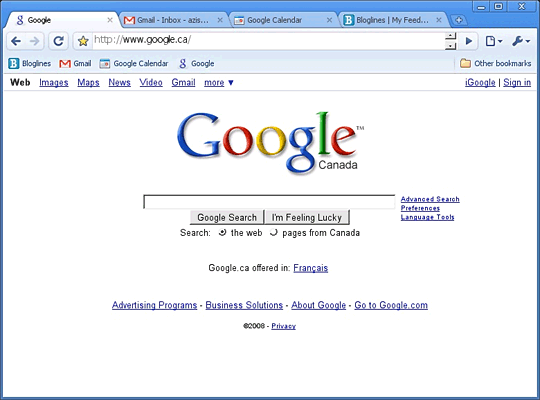
Suddenly, a new party was heard from, initially through the surprising medium of a comic book, sent out (printed on paper - not online) to Google developers. A few days later, the comic book appeared online with Google quickly following it up with the release of the actual product - a beta version of Google Chrome, a browser based (like Safari) on the WebKit rendering engine. It's only available for Windows at present (despite the presence of Google's Eric Schmidt on Apple's Board of Directors).
Within its first 24 hours online, enough copies of Chrome had been downloaded to account for 1% of all browser traffic, though that rate has slowed down since. Chrome offers a minimalist interface and fast performance, particularly when loading Javascript-heavy Web 2.0 services. And it runs each tab as a separate process, so if a Web-service stalls or crashes, it only affects that single tab, not the browser as a whole and not the whole computer.
While Google has promised versions for Mac and Linux as soon as possible, apparently it was built using Microsoft's open sourced Windows Template Library; this means it will require extra work to create versions for non-Windows systems.
Despite that, Mac (and Linux) users are not entirely unable to see what the fuss over Chrome is all about. Yes, if they've got a handy Windows system - or have a Mac capable of booting to Windows vis Boot Camp, or a Mac or Linux system with one of several virtual systems (Parallels, VMware Fusion, or VirtualBox on Intel Macs, for example), they could download and install the Windows version of Chrome and run it after booting to Windows.
But there's another way, a way that lets users install and run Chrome right on their Mac or Linux desktop - even though Google has (so far) not managed to release a version for those systems.
I wrote about CrossOver in February 2007. Building on the WINE project, it's a set of libraries that allows some (I repeat, "some" ) Windows programs to run on non-Windows systems without needing to boot Windows. It doesn't always work, but when it works, it's pretty cool.
The good people at CodeWeavers have put together a set of customized versions of CrossOver complete with the Chrome browser, which they are calling Chromium. There are free downloads for Mac OS X (about 50 MB, requiring an Intel Mac and Mac OS X 10.4 or later,), Ubuntu and Debian Linux (separate 32-bit and 64-bit installers), Red Hat, Madriva, and SUSE Linux, and a generic installer for other Linux distributions.
(Google itself has been known to do something similar - their so-called Linux version of their Picasa photo album application is really the Windows version bundled together with a customized set of the WINE libraries. With iPhoto included on all recent Macs, there's not much call for a Mac version of this).
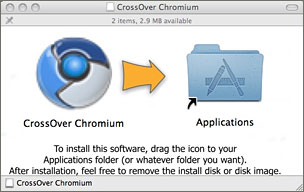 The Mac installation is straightforward; like most other Mac
applications, the downloaded .dmg opens as a drive image and suggests
you just drag the Chromium icon to the alias of your Applications
folder.
The Mac installation is straightforward; like most other Mac
applications, the downloaded .dmg opens as a drive image and suggests
you just drag the Chromium icon to the alias of your Applications
folder.
Starting it up for the first time takes a few moments, though, as it initializes the CrossOver/WINE faux-Windows settings it needs to start up. Luckily, this only happens once.
Once it's open, you've got the same minimalist user interface that Windows Chrome users get - complete with standard Windows minimize, maximize, and close icons in the top right-hand corner, instead of the coloured OS X-style left-corner gumdrops. Unlike the menu-less Windows version, there are a few menu items on the Mac's menubar - but these are for CrossOver settings, not for the Chrome browser at all. In fact, you can probably ignore them entirely.
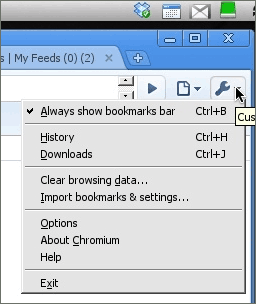 Since you're running a Windows
program, if you use keyboard shortcuts, you'll have to train your
fingers to use Windows ones rather than Mac ones: Command + T for a new
tab (in Safari or Mac-Firefox, etc) becomes Control + T in Chrome. And
Chrome has an option to import bookmarks and settings - but only from
the Windows version of Internet Explorer, which won't be of much
use.
Since you're running a Windows
program, if you use keyboard shortcuts, you'll have to train your
fingers to use Windows ones rather than Mac ones: Command + T for a new
tab (in Safari or Mac-Firefox, etc) becomes Control + T in Chrome. And
Chrome has an option to import bookmarks and settings - but only from
the Windows version of Internet Explorer, which won't be of much
use.
Rather than menus, there are two small icons in the upper right-corner; these give you the ability to save pages, print, set a few options, and so forth.
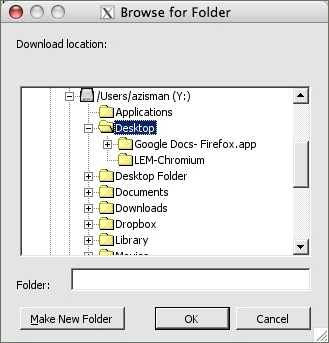 I've set Chrome to always display a
bookmarks bar. As well, be sure to check where it wants to store
downloads, . . . (using the Minor Tweaks options tab). One of
the things that that long pause when starting Chromiuim for the first
time does is set your Mac's Users folder as a mapped Windows Drive Y: -
if you browse in the Download Location option, you can find your usual
Mac location (I prefer my Desktop). But you'll have to fiddle a bit to
set it that way.
I've set Chrome to always display a
bookmarks bar. As well, be sure to check where it wants to store
downloads, . . . (using the Minor Tweaks options tab). One of
the things that that long pause when starting Chromiuim for the first
time does is set your Mac's Users folder as a mapped Windows Drive Y: -
if you browse in the Download Location option, you can find your usual
Mac location (I prefer my Desktop). But you'll have to fiddle a bit to
set it that way.
Chrome is a work in progress - I've been using it as the default browser on my (Windows XP) work computer and have been pretty happy with it, but your mileage may vary.
It may be a while before Mac and Linux-native versions of Chrome are
released. In the meantime, kudos to CrossOver for quickly providing
users a way to try out Chrome on these non-Windows platforms. If you're
at all curious, give it a try. 
Join us on Facebook, follow us on Twitter or Google+, or subscribe to our RSS news feed
Alan Zisman is Mac-using teacher and technology writer based in Vancouver, BC, Canada. Many of his articles are available on his website, www.zisman.ca. If you find Alan's articles helpful, please consider making a donation to his tip jar.
Today's Links
- Mac of the Day: Radius System 100, introduced 1995.03.27. An all-out system designed for graphics professionals.
- Support Low End Mac
Recent Content
About LEM Support Usage Privacy Contact
Follow Low End Mac on Twitter
Join Low End Mac on Facebook
Favorite Sites
MacSurfer
Cult of Mac
Shrine of Apple
MacInTouch
MyAppleMenu
InfoMac
The Mac Observer
Accelerate Your Mac
RetroMacCast
The Vintage Mac Museum
Deal Brothers
DealMac
Mac2Sell
Mac Driver Museum
JAG's House
System 6 Heaven
System 7 Today
the pickle's Low-End Mac FAQ
Affiliates
Amazon.com
The iTunes Store
PC Connection Express
Macgo Blu-ray Player
Parallels Desktop for Mac
eBay