
Mac Daniel's Advice
Adding a DIP Switch and Overclocking Sawtooth's Bus Speed
- 2005.11.30
- Pertains to: Power Mac G4 Sawtooth and possibly Mystic/Gigabit Ethernet
- Recommended tools: Low wattage (15W) grounded soldering iron
- Recommended parts: 4 switch DIP switch
Adding a DIP switch so you can overclock the Sawtooth Power Mac G4 is a lot easier than you probably thought - there are already holes on the motherboard for mounting a DIP switch! Apple probably had DIP switches installed on the motherboards when they were designing them and deleted them in the production model in order to save money.
Proceed at your own risk- it's possible you will damage your motherboard.
Apple put tiny 0 ohm resistors on the underside of the motherboard instead. The motherboard needs to be removed and these resistors need to be removed. Removing the resistors isnn't difficult. I melted and removed some solder so that the resistor wasn't held on as well. I then used a razor blade to pop the resistor off.
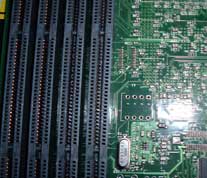 You
can also do it the standard way - melt the solder and then remove it
with a sucker or de-soldering braid. Just make sure you don't lose
that resistor. You don't want it attached to another part of the
motherboard.
You
can also do it the standard way - melt the solder and then remove it
with a sucker or de-soldering braid. Just make sure you don't lose
that resistor. You don't want it attached to another part of the
motherboard.
Also, don't splash solder on the motherboard. It's a ridiculously small amount of solder, but it could potentially damage or destroy your motherboard.
Installing the DIP switch is straightforward. The board uses a standard sized 4 switch DIP switch, so you simply place the pins through the holes and then fill the holes with solder. Install the DIP switch so that looking at the computer from the front, with the computer open, 1 is on the left and 4 is on the right. Here is what it looks like when it's done:
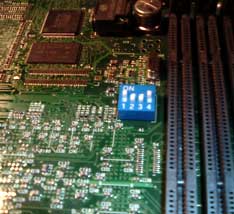
Here is the chart of the different bus speed settings (x=on):
   66 70 90 94.5 100 105 120 133
 1  x  -  x   -  x   -   x   -
 2  -  -  x   x   x   x   -  -
 3  x  x  x   x   -  -   -  -
 4  -  -  -  -  -  -   -  -

 1=R435, 2=R434, 3=R433, 4=R432
Note that 70 MHz, 105 MHz, and 133 MHz are in bold. These settings are apparently not supposed to be used under normal conditions. I have tried both 105 MHz and 133 MHz. 133 MHz results in 3 beeps with the power LED blinking 3 times. I believe that indicates a memory error. All of my memory is PC133, so I'm not exactly sure why it doesn't work. 105 MHz booted, but it seems to have resulted in loss of function of the USB ports, since my mouse and keyboard became unusable. I felt no reason to try 70 MHz.
That leaves 120 MHz as the only overclocking option.
It's also important to know that you will most likely need to change the multiplier on your CPU card. Those settings can be found at G4 Hardware Help. If you don't change the multiplier, a 350 MHz card will try to run at 420 MHz on a 120 MHz bus, a 400 MHz card at 480 MHz, a 450 MHz card at 540 MHz, and a 500 MHz card at 600 MHz.
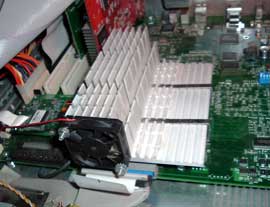 My
533 MHz G4 would not run at 600 MHz until I boosted the L2 cache
voltage. Any Apple OEM processor faster than 533 MHz when
installed in a Sawtooth requires the CD ATA connector to be removed,
modification to the heatsink or modification to the case to use the
newer heatsink, and 12V to be spliced to one of the mount points of
the new processor. That is why I chose the 533 MHz processor.
My
533 MHz G4 would not run at 600 MHz until I boosted the L2 cache
voltage. Any Apple OEM processor faster than 533 MHz when
installed in a Sawtooth requires the CD ATA connector to be removed,
modification to the heatsink or modification to the case to use the
newer heatsink, and 12V to be spliced to one of the mount points of
the new processor. That is why I chose the 533 MHz processor.
You will need PC133 memory, as PC100 will most likely not work reliably on a 120 MHz bus. Also, PCI speed is reduced slightly from 33 MHz to 30 MHz. This should have no effect unless you are using a RAID setup, Ultra320 SCSI, or some other PCI card that is actually faster than the PCI bus. Even then it may have little effect.
When I first did this mod, my 533 MHz processor card had a 4x multiplier (it was designed for the 133 MHz bus of the Digital Audio Power Mac G4). On the original 100 MHz bus, it ran at 400 MHz, and with the overclocked 120 MHz bus, it ran at 480 MHz.
I am using Mac OS X 10.3.5. After I installed the DIP switch and changed the settings, Apple System Profiler reported a 100 MHz bus and 400 MHz processor. I tried many different settings, and Apple System Profiler always reported 100 MHz bus and 400 MHz processor.
I then installed Linux. I tried many different settings, and Linux did the same thing. It always reported a 100 MHz bus and a 400 MHz processor. I was extremely disappointed. However, I benchmarked 4 different settings using XBench. Here are the results:
       266/66 400/100 480/120 600/120*
CPU     12.24  19.04   22.68   28.77
Memory   9.04  13.81   16.46   17.48

* required L2 cache voltage boost
I was ecstatic. All this time I thought the overclocking had failed, but in reality it was OS X and Linux which had failed to report the actual speeds.
Also, the data sheet where I got the info from had "0" represent a set jumper, and "1" represent no jumper set (beware - I think this is common), so at first I was trying all of the settings backwards. It's unfortunate that Apple System Profiler doesn't recognize the 120 MHz bus and actual speed of the processor on Sawtooth - but the bus overclock has successfully increased both CPU and memory speed.
It would be nice to get 133 MHz working, but I'm happy with 120 MHz. This modification will allow you to set Apple OEM processor cards that support an 8x multiplier to run at up to 960 MHz.
My system is extremely stable. If I ever learn more about the 133 MHz setting or why Linux and Mac OS X always report a 100 MHz bus speed, I will update this article.
All questions or comments are welcome. My email is
psycopunkn@aol.com. 
- Link: G4 Hardware Help
Join us on Facebook, follow us on Twitter or Google+, or subscribe to our RSS news feed
Not sure if you should upgrade your old Mac or replace it? Check the Mac Daniel index to see if we've already addressed your problem.
Today's Links
- Mac of the Day: WallStreet PowerBook G3, introduced 1998.05.04. WallStreet came in three screen sizes along with speeds from 233 to 292 MHz.
- Support Low End Mac
Recent Content
About LEM Support Usage Privacy Contact
Follow Low End Mac on Twitter
Join Low End Mac on Facebook
Favorite Sites
MacSurfer
Cult of Mac
Shrine of Apple
MacInTouch
MyAppleMenu
InfoMac
The Mac Observer
Accelerate Your Mac
RetroMacCast
The Vintage Mac Museum
Deal Brothers
DealMac
Mac2Sell
Mac Driver Museum
JAG's House
System 6 Heaven
System 7 Today
the pickle's Low-End Mac FAQ
Affiliates
Amazon.com
The iTunes Store
PC Connection Express
Macgo Blu-ray Player
Parallels Desktop for Mac
eBay