Blast From the Past
Byte, September 1990
Dan Knight - 2001.03.14
 1975 was the year
before the Apple I was created, before Apple Computer incorporated,
before Shugart invented the 5.25" floppy, the year Micro-soft
began, and the year Byte published its first issue.
1975 was the year
before the Apple I was created, before Apple Computer incorporated,
before Shugart invented the 5.25" floppy, the year Micro-soft
began, and the year Byte published its first issue.
As the editorial in this issue notes, "Byte was born along with the microcomputer industry, back when the idea of a computer of your own was a novel concept. In fact, small computers weren't even called 'personal computers' until Byte coined the term, in our May 1976 issue."
In the September 1990 issue, Byte looked back at the first fifteen years of personal computing - and into the future.
Claris
Apple reversed itself on Claris, which it had earlier decided would become a separate company. Instead, Claris would remain a full owned subsidiary of Apple - just as FileMaker is today.
Networking
Dayna was preparing to ship their DaynaPort ethernet cards for the Mac II and SE/30 at a retail price of $495.
PC Upgrades
TransComputer and Feith Systems both announced 25 MHz 486 upgrades for 386 computers. With CPU, the TransComputer upgrade sold for $1,686.
Computing at Chaos Manor
Always one of my favorite Byte columns, Jerry Pournelle was the first Byte staffer to write from the user's perspective. He discusses "Pournelle's Laws," which begin with "One user, at least one CPU" and "Silicon is cheaper than iron."
The first rule represents the battle for personal computers with their own processors, a war fought against the mainframe and minicomputer mentality of powerful servers and dumb clients. History repeats itself today as companies look at application servers and thin clients.
"Silicon is cheaper than iron" pointed to the fact that it's cheaper to upgrade a computer than replace it. "A large part of my original opposition to the Apple Macintosh was because the original Mac was an all-up [i.e., slotless] machine with a proprietary bus and operating system...."
The other aspect of Pournelle's Second Law was that solid state memory would eventually displace the hard drive. By 1990, Pournelle recognized that hard drives had become so affordable compared to any form of solid state memory, that this was unlikely to happen.
Macinations
The late Don Crabb asked if the Mac really was the best computer for desktop publishing, a market Apple and Aldus had created over the past few years. The consensus among DTP workers was that the Mac best suited the workflow, making it the best choice for design work.
Looking at Windows 3.0, Crabb declared it the first OS that could beat the Mac at its own game, giving users about 85% of what the Mac with System 6 did. Of course, it wasn't until Windows 95 that Microsoft came close to filling that 15% gap.
Word Processors That Build Character
This article examines 15 WYSIWYG word processors for Macs and PCs, including Word 1.0 and Ami Pro 1.2 (a serious competitor to Word in those days) on the Windows side, and FullWrite Professional, MacWrite II, Word 4.0, MindWrite 2.1, Nisus 2.11, QuickLetter 1.03, WordMaker 1.01, WordPerfect 1.0.4, and WriteNow 2.2 for the Mac.
Nisus is still with us, although Nisus Writer is just a niche player. WordPerfect for Mac reached version 3.5 and became freeware. And Microsoft Word clearly dominates the Mac market today. The others have fallen by the wayside.
The Mac at 40 MHz
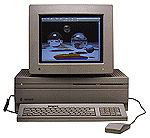 Tom Thompson took a look at the
"wicked fast" $10,000 Macintosh
IIfx, which had graced the cover of the April 1990 Byte.
Although Motorola unveiled the 68040 during 1990, it would be another
year before the first Quadras appeared.
Tom Thompson took a look at the
"wicked fast" $10,000 Macintosh
IIfx, which had graced the cover of the April 1990 Byte.
Although Motorola unveiled the 68040 during 1990, it would be another
year before the first Quadras appeared.
The state of the art on the PC side was 33 MHz 80486 "desktop supercomputers," demonstrating that such hyperbole was not born with the Power Mac G4.
Thompson writes, "No doubt PCs soon will run at this [40 MHz] speed, but that doesn't diminish the fact that the IIfx got there first, doing what Macs do best: providing a consistent user interface, seamless data exchange, and gorgeous 24-bit color graphics."
Application level tests showed the IIfx nearly doubled performance of the 25 MHz Mac IIci.
Just to remind you of the realities of the era, the IIfx ran System 6.0.5 and could only address 8 MB of RAM - unless you had a copy of Connectix Maxima, which would let the System use 14 MB, allocating any additional RAM as a RAM Disk. System 7, which enabled 32-bit addressing and use of virtual memory, wouldn't be available until May 1991.
Two Different Approaches to Mac Portability
Back in 1990, the only portable Mac was the 16 pound Macintosh Portable. A fine computer in many respects, the portable ran a 68000 CPU at 16 MHz, which really did provide nice performance under System 6. (I've even run System 7.5.5 on mine - not bad at all.)
This article looks at the Outbound, a lunchbox-style portable, and the Dynamac SE/30, a more traditional laptop design.
The lunchbox design was pioneered by Compaq. Everything but the keyboard was packed into a case with a screen on the front and a handle on top. I really did remind you of a lunchbox. The keyboard was separate; in the case of the Outbound, it also included their IsoPoint alternative to mice and trackballs.
Outbound owners had the same 16 MHz 68000 processor as the Mac Portable, but at a much lower price - $3,499 vs. $6,499. Outbound's workaround for not having a license to clone the Mac was clever: The user had to provide ROMs from a Mac Plus or SE.
The Dynamac SE/30 went one step beyond that - it contained an SE/30 motherboard. It also had a yellow-on-black gas plasma display, which meant it couldn't run off battery power.
For more on the Outbound, Dynamac, and other unauthorized Mac clones, see The Earliest Mac Clones.
Byte 15th Anniversary Summit
Byte convened a panel of 63 industry experts. These are brief excerpts from the summit.
Where is the microcomputer industry headed in the next 5, 10, 15 years?
Jim Manzi: I think the dominance of microcomputing - personal computing, workstation computing, desktop computing - will be so overwhelming five years from now....
Dick Shaffer: It's the dominant technology ... over the next several [years].
What about the power of the hardware? Will that increase significantly? Or have we gone about as far as we can?
Gordon Campbell: In the next decade, we're going to see microprocessors, basically, hooked up with more than one in a box. (Predicts 100-300 MIPS performance.)
Stewart Alsop: Bigger, faster, cheaper.
Gordon Bell: ...minimally giving them a factor of 10 or more.
Donald Knuth: ...computers are going to double in speed every year until 1995, and then they're going to run out of ideas.
To get a little more detailed, how do you expect semiconductors to evolve? And what will be the effect of that evolution?
Jack Kilby: ...we're on our way down to 0.7- and 0.5-micron lines, and we will see those happen. [By 1990, some chips were using 0.15 micron lines.]
Bob Noyce: You do see some barriers arising, but still, those barriers have been about a decade away for some time. So I think that it will last another 10 years or so.
What about the software side of the equation? Or are all the changes coming in hardware?
Brian Kernighan: Software, unfortunately, is not nearly as easy to make go better as hardware seems to be. And the software will not get better fast enough, and so you'll piddle away more and more of [the power] on stuff that doesn't quite work the way you want it to....
How about networks - what do you see as their future? How will networking change the industry?
Michael Slater: Networking, I think, will become standard in PCs, as it is standard on workstations today.
Paul Allen: ...everybody's going to have a super-powerful network machine on their disk, maybe 15 years out.
Terry Winograd: ...it will be odd to have a microcomputer in a work setting that isn't tied into a network. And, of course, we'll have other technology to tie into that - radio networks and cellular phone networks, etc.
Danny Hillis: ...and then those local area networks would one way or another be connected to a big network. So in some sense, the whole concept of the network will break down, and everything will be connected to everything in some software sense.
Jonathan Titus: I think that major advances . . . over at least the next five years, are going to come in communications, and the ability for people to have one computer talk to another computer almost anywhere in the U.S., and perhaps in Western Europe....
How will the evolution of microcomputers affect minicomputers and mainframes?
Tony Hoare: I think the microprocessor industry will come to dominate the whole of the computer industry.
Tom McWilliams: Basically, today, they've replaced the minicomputers. I see the microcomputer becoming more and more dominant and taking over all the computing except the largest machines'.
And how about user interface? How do you think we will interact with computers in 10 or 15 years?
Michael Slater: I think the character-mode applications will almost entirely go away, and everybody will make the transition into graphical user interface applications.
Terry Winograd: Rather than having a bunch of applications, we will have more of an integrated environment into an interface that lets me move smoothly into what I want to do, and it will organize what I want to do instead of organizing it by individual pieces of software.
David Evans: Surely, they'll understand the spoken language.
On software patents
Alvy Ray Smith: Patent issues. I think that's the number one problem. I thank that's the most serious problem confronting the software industry in the next decade. Really trivial ideas are going to be patented. [Like one-click shopping?]
What do you think a typical microcomputer will look like in 10 or 15 years?
Bill Joy: Ten years - very powerful, multiprocessor, enormous amounts of semiconductor memory, probably [will] not have a disk. Probably it will all be semiconductor, run on batteries, be portable, have a different metaphor than mouse/keyboard, probably involving voice input....
Ryoichi Mori: Ten or 15 years [from now], typical microcomputers will look like today's microcomputers. Here, "look like" means that the price and size of most packages will be typically the same. The contents will be improved 100 to 1000 times.
Dick Shaffer: Let's just think what you could do if you had today's R6000 or today's MIPS machines or today's Silicon Graphics - $100,000 personal, graphics supercomputers - available for about $1,000.
Stephen Wolfram: The most likely mechanism for connecting to peripheral devices would be some kind of an infrared-based thing. I mean, the whole idea of having wires and definite connections is clearly not a particularly good one.
Let's discuss the subject of portability. Do you think we'll have notebook computers or pocket computers? How do you think the size will evolve?
Mitch Kapor: We're going to see the next generation in portability, things that are smaller than today's laptops: clipboard sized computers and shirt-pocket-size computers. The stylus-based interface is going to be very, very important for that class of devices....
Gordon Bell: The computer will disappear by another 10 years in [its present form]. There will be zero-cost notebook-size computers with one chip in them that will have about 32 megabytes.
Doug Engelbart: Everyone's going to have a computer - carried around or surgically implanted, or sitting on your hat or your spectacles or whatever - and they're all going to be connected . . . and those networks will be wireless.
Steve Leininger: ...basically and 8-1/2 by 11 notebook with a . . . 1024 x 768 color LCD . . . cellular phone capability . . . voice capability....
This sounds more like a portable office than a portable computer. Do you really think cellular phones and faxes will enter the notebook arena?
Nicholas Negroponte: There will be a family of physical products that will range in size from things the size of your wallet or a cellular telephone to real bona fide laptops to desktops.
John Markoff: Right now most people have desktop computers as their principal computers, and they have a laptop as a secondary computer. And I think that all the innovation is going to be taking place in the smaller packages. We're all still trying to build a Dynabook . . . and we're going to get progressively closer to it.
Mitch Kapor: I think [the typical microcomputer is] going to look pretty much like the ones today, except that there are going to be new form factors like palmtop computers, desktop supercomputers....
On the next revolution
Alan Kay: To me, the second computer revolution is not just the computer on the desktop, but the Macintosh/Xerox PARC way of doing user interface. What the Mac did was to redefine the relationship of the user....
The third revolution that is going to come is one that is driven by networking - it's a pervasive technology - and I call [it] the intimate revolution.
What technological advances will we see in the 1990s that result in improved computer systems?
Bill Joy: We'll see 64-megabit RAMs, and we'll see flat-paneled high-res displays and portable machines, and ISDN, and fiber-optic networks, and 32-bit secure operating systems, graphical prototyping software, the beginnings of voice input, and all sorts of things that people have talked about for so long.
Dick Shaffer: We should see, toward the end of this decade, tens of megabytes of main memory.... We will not get much beyond 32 address lines, because there's no need to address that much physical memory....
Bill Gates: The address base now is this 4-gigabyte, 32-bit address base, and it will be fairly late into the nineties before that starts to pain us. We'll probably skip from a 32-bit to a 64-bit address space. That will last us a long time.
Jonathan Titus: I think we'll see advances in the ability to do things in parallel on the chip....
Dick Shaffer: My guess is that the AT design and the Intel architecture will still be dominant....
What kind of architectures do you think will dominate in the 1990s?
Gordon Campbell: ...we're going to see in the mid-nineties a reassessment, if you will, of the current architectural directions, and I don't think Intel will be able to push up a compatible product line much past 1995. And I think the RISC architecture and some of the other things are going to push for the fundamental changes on the processor.
Bill Gates: The Intel architecture will continue to dominate, there's no doubt about that.
Michael Slater: I think the RISC processors are going to wipe out CISC processors in the engineering workstation arena. I think they will be much, much slower to take over much of the business market.
Ken Sakamura: I'm not very optimistic about the future of RISC. It uses too much power.
What kind of storage devices do you think we'll see?
Michael Slater: A hard disk capacity of 00 MB is probably a base-level capacity that everybody will have, and a couple hundred MB for the more serious users. I think CD-ROMs will become important as a distribution and database medium.
John Warnock, John Caulfield, Dick Pick, Jim Manzi, Jay Miner, Charles Simony, Paul Carroll, Brit Hume, and Gordon Campbell agree that optical storage will be hot.
Steve Leininger: It would be neat to be able to record and play back compact disk kinds of things.
Rod Canion: People have been predicting the day when optical disk technology would replace magnetic disk technology. I don't think that's likely to happen.
Ken Sakamura: Disks are becoming obsolete... The real trend will be toward large solid-state memories that use less and less power. We need computers that can run on the power of a Walkman battery.
The whole area of optical computing is an interesting subject. What kind of future do you see for that?
John Markoff: Optical computing seems to still be a long way away.
Rich Malloy: Optical computing, that's probably something that will be 10, 15 years away before we start using it to any degree.
What is the biggest obstacle to major new breakthroughs in computing?
In a word, software, not hardware.
You mentioned the installed base. Does anyone else see that as an obstacle?
Bjarne Stroustrup: The more acceptance that technology gets, the harder it is to change. If enough people are stuck at the same level, they think it's the truth.
Bob Frankston: Actually, the biggest obstacle is marketing surveys, is people projecting from what we have now, the people trying to meet felt needs.
Rich Malloy: People get used to doing something in a certain way and have a great deal of difficulty trying to do something different, even if it's better. It has to be much, much better to get people to change products.
To what extent will computer literacy stratify society in the 1990s?
Rod Canion: ...computer literacy is going to be less of a factor as computers become more straightforward and a simpler mechanism to use.
Mitch Kapor: I believe that those people who are comfortable in the operation of computers are going to enjoy certain advantages....
What do you think will be the next "big one," the next huge success in the software world?
Doug Engelbart: Multimedia hypertext. I think it's going to be the way in which the electronic document, so to speak, is going to emerge, and it's going to be hyperdocuments. That's going to put a tremendous amount of pressure on standards for intercommunicating....
John Markoff: I don't think I could name the exact application, but I think it's going to have to be in the communications area. It's going to be something that can make communications extremely transparent.
Bill Gates: In this client/server thing, the idea of seeing corporate data graphically, being able to browse around it very easily, and have it sort of remember what stuff you like to see and make it easy to call up.
1975-1990
15 years of Bits, Bytes, and Other Great Moments
1975
- MITS Altair 8800, the first microcomputer
- Zilog announces Z80 microprocessor
- IMSAI 8080, first clone, improves on MITS Altair
- MOS Technology announce 6502 microprocessor
- Byte, the small systems journal, launches with September issue
- IBM 5100, 50 pound briefcase computer, is industry's first portable
- Bill Gates and Paul Allen write BASIC compiler for Altair, form Micro-soft
1976
- Hewlett-Packard and Atari turn down personal computer proposed by Steve Wozniak and Steve Jobs
- Steve Jobs and Steve Wozniak create the Apple I, Apple Computer formed
- Dr. Dobb's Journal begins publishing
- Electric Pencil, the first word processor, created
- Adventure released, first text adventure for microcomputers
- Shugart announces 5.25" "minifloppy" disk drive
1997
- Apple II introduced at $1,298 with 16K of memory
- TRS-80 introduced
- Commodore PET introduced
- Ohio Scientific Instruments (OSI) ships first computer with Microsoft BASIC in ROM
- Computer Shack (later ComputerLand) opens first franchise store
- Gary Kildall of Digital Research develops CP/M operating system, which established a pattern MS-DOS is later built upon
1978
- Dan Bricklin and Bob Frankston develop VisiCalc, the first spreadsheet
- Atari enters market with 400 and 800
- Epson introduced MX-80, a low-cost dot-matrix printer
- WordMaster, precursor to WordStar, soon to be the industry standard word processing program
1979
- Hayes introduces their Micromodem 100, which supports 110 to 300 bps speeds, autodial, and autoanswer
- Wayne Ratliff develops Vulcan, which evolved into dBase II, which became the de facto database standard for the fledgling industry
- Texas Instruments introduces TI-99/4, first 16-bit personal computer
1980
- Commodore VIC-20 brings personal computing below $300.
- Sinclair introduces $200 kit computer
- Apple III introduced, the first "Road Apple"
- Radio Shack announces TRS-80 Color Computer
1981
- Osborne 1 Portable puts a CP/M computer in a suitcase-sized package, the first portable microcomputer
- IBM introduces the PC, which cost $3,005 for a 64K, single-floppy system
- Epson HX-20, perhaps the first laptop computer, used microcassette for data storage
1982
- Columbia announces MPC, first IBM compatible computer
- Compaq announces the Compaq Portable, one of the first IBM clones and definitely the first portable DOS computer
- Commodore 64 released at $595, eventually drops below $200
- Kaypro competes with Osborne in portable CP/M arena
- David Bunnell starts PC Magazine
- Lotus 1-2-3 introduced, the first spreadsheet to take advantage of the IBM PC's huge RAM potential (most earlier PCs could use no more than 64 KB of RAM)
- Intel announces 80286 CPU
1983
- Apple unveils the Lisa, its second "Road Apple", but it paves the way for the Macintosh
- Radio Shack releases TRS-80 Model 100, a 4 pound laptop
- IBM announced the PCjr, which was a big a fiasco as any Road Apple
- Novell introduces NetWare, the first file server LAN operating system
- Microsoft announces Word
- IBM introduces XT, its first PC with a hard drive
- Canon display 300 dpi laser printer engine, which HP adopts in 1984's LaserJet
- Microsoft announces Windows - but doesn't ship it for 2 more years
- Iomega (yes, the Zip folk) introduces the Bernoulli Box, an innovative removable media drive
1984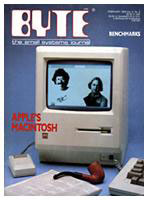
- Apple releases the Macintosh and the famous 1984 TV ad
- First HP LaserJet ships
- WordPerfect released; it will come to dominate the personal computing industry
- IBM introduced 80286-based AT with 6 MHz CPU
1985
- Amiga 1000, Atari ST introduced
- MacCharlie adds 5.25" floppy, 8088 CPU, extra keys to Macintosh, making it PC compatible
- Toshiba introduces T1100, a "fanatically successful" DOS laptop
- Apple introduces LaserWriter, AppleTalk networking
- Aldus releases PageMaker
- Microsoft announces Excel (just for the Mac)
- Intel announces 80386 CPU
- Microsoft Windows 1.0 finally ships
1986
- Mac Plus introduces SCSI, upgradable memory to Mac lineup
- Apple IIgs, pinnacle of the Apple II line, introduced
- IBM PC Convertible, IBM's second failed attempt at a laptop
- Motorola announces 68030 CPU
1987
- Compaq introduces "lunchbox" design with Portable III
- Apple unveils Mac II and SE
- Microsoft ports Excel to Windows, making it the first real Windows application
- IBM rolls out PS/2 line, introduces micro-channel architecture, makes switch to 3.5" floppies
1988
- NeXT Cube introduced
- Compaq introduces SLT/286, their first laptop
- IBM announces plans to license NeXTstep from Steve Jobs
- ARPANET worm created by Robert T. Morris Jr infects 6000 sites on what later soon be known as the Internet
1989
- Apple releases IIcx, SE/30, IIci, Mac Portable - three hits and a miss
- Poqet Computer introduces one pound pocket-sized DOS computer for $1,995
- Intel announces i486 CPU
1990
- Motorola unveils 68040 CPU
- Microsoft releases Windows 3.0
Ads
Hewlett Packard was promoting the LaserJet III, which had "Resolution Enhancement Technology." It was the first laser printer to use variable dot size, which made 300 dpi quality comparable to 600 dpi.
A two-page ad for the IBM RISC System/6000, a predecessor to PowerPC architecture, featured Hagar the Horrible and his Viking crew. The computer ran at 42 MIPS and 13 MFLOPS. (Today's G4 performance is measured in GFLOPS.)
The Ergo Brick, a 3" x 8" x 11" totable PC, was billed as the "cure for the common computer." With a keyboard and monitor at home, another at work, it gave desktop power in a portable package. Today you could fit three PowerBook G4/500s in almost the same amount of space as the $2,495 16 MHz 386sx-based Brick.
Insignia promoted SoftPC 1.3, which even ran on a Mac Plus and let Mac users run DOS software. (I used it on my Plus way back when. It was slow, but it was definitely the DOS I cut my computing teeth on.)
About LEM Support Usage Privacy Contact
Follow Low End Mac on Twitter
Join Low End Mac on Facebook
Favorite Sites
MacSurfer
Cult of Mac
Shrine of Apple
MacInTouch
MyAppleMenu
InfoMac
The Mac Observer
Accelerate Your Mac
RetroMacCast
The Vintage Mac Museum
Deal Brothers
DealMac
Mac2Sell
Mac Driver Museum
JAG's House
System 6 Heaven
System 7 Today
the pickle's Low-End Mac FAQ
Affiliates
Amazon.com
The iTunes Store
PC Connection Express
Macgo Blu-ray Player
Parallels Desktop for Mac
eBay