
Microsoft Word began life as Multi-Tool Word for Xenix in 1983. It was renamed Microsoft Word and ported to MS-DOS in 1983, the Macintosh in 1985, and Windows in 1989. It has been the dominant word processing program on the Mac since 1988 and on Windows since 1993.
When Apple introduced the original Macintosh in January 1984, it also introduced two programs so Mac users could do something with the new computer, MacWrite and MacPaint. With these essentially free apps bundled with the computer, it would be an uphill battle to sell alternative word processing and paint programs – but that didn’t stop anyone.
Word was rooted in Bravo, the GUI word processor created at Xerox PARC. Microsoft hired Charles Simonyi, Bravo’s “father”, in 1981, and Multi-Tool Word was released for Xenix in 1983. It was ported to MS-DOS later in the year, where the name was simplified to Word. Word was the first WYSIWYG (or semi-WYSIWYG) word processing program for DOS – it could display bold, italic, and underlined text, although it could not display different typefaces or sizes. Word for MS-DOS was designed to work with a mouse, and Microsoft even offered a bundle that included Word and the new-fangled input device. The mouse and semi-WYSIWYG display gave Word two big advantages over Wordstar, then the most popular word processing software in the world, and WordPerfect, the rising star in the DOS world.
Word for MS-DOS had been written to support high-resolution displays, even though DOS computers didn’t yet have them, which made it easier to port the program to the Macintosh. The first version of Word for Mac was released in 1985, and Word 3.0 in 1987. (There was no Word 2.0 for Mac. The second version was called 3.0 to match the numbering of the current DOS version.)
Unfortunately, Word 3.0 was “plagued with bugs”, and within a few months Microsoft fixed them and mailed free Word 3.0.1 disks to all registered Word 3.0 users. Word 4.0 came to market in 1989, the same year that Apple spun off its software to its Claris subsidiary and MacWrite stopped being free. By this time, Microsoft already owned the Mac word processing market with over 50% of market share. MacWrite II peaked at just over 30% market, quickly dropping off until Apple discontinued MacWrite Pro in 1994.
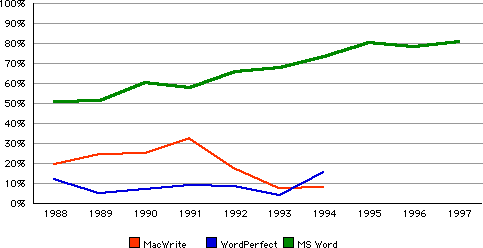
Mac word processor market share by units, 1988 to 1997.
Many Mac users consider Word 5.1a to be the best version ever released. The original Word 5.0 for Mac reached the market in 1991, and the upgrade to 5.1 in 1992. After all those years, Word still worked very well on compact Macs with their 9″ 512 x 342 pixel black and white displays.
Word 6.0, launched in 1993, is widely considered to be the worst version of Word ever for the Mac, as it was based on the same codebase as Word 6.0 for Windows. That meant that it looked and worked more like Windows software than a Macintosh program. Mac users were so up in arms that Microsoft actually released a Word 5.1 downgrade to unhappy Word 6.0 owners.
It was five years before Microsoft unleashed another version of Word for the Mac, and at that point Microsoft adopted a new numbering scheme: Henceforth versions of Word would be identified by the year of release, so the new version was Word 98 (Microsoft began this in 1995 with Word 95 for Windows). Subsequent versions of Word were 2001, v.X (the first version for Mac OS X, also released in 2001), 2004, and 2008, which is the current version.
Word 98 was the first version of Word that was not only file-compatible with Word 97 for Windows, but also compatible with macro viruses.
Mac Version History
This article is a work in progress dusted off from 2008 and is in need of updates.
Word 1.0
1985
Word 3.0
1987
Word 4.0
1989: Last version that can be run using a daul-floppy Mac.
Word 5.0/5.1
1991 (5.1 – 1992): Requires System 6.0.2, 512 KB of RAM (1 MB for 5.1, 2 MB to use spell check and thesaurus), 6.5 MB available hard drive space. Last version to support 68000-based Macs.
Word 6.0
1993: Requires System 7.0, 4 MB of RAM (8 MB recommended), at least 10 MB available hard drive space, 68020 CPU. 68000-based Macs not supported.
Word 98 (8.0)
1997: Requires System 7.5 or later (7.5.5 recommended), PowerPC processor (120 MHz recommended), 16 MB of RAM installed, 640 x 480 8-bit color or 4-bit grayscale display, CD-ROM for installation. Part of Microsoft Office 98 Macintosh Edition.
Word 2001 (9.0)
2000: Last version for Classic Mac OS, runs in Classic Environment of Mac OS X. Requires Mac OS 8.0 through 9.2.2, 8.5 or later recommended. Application requires 10 MB of RAM with virtual memory enabled, 17 MB without it.
Word v.X (10.0)
2001: First version written for OS X
Word 2004 (11.0)
2004: First Mac version to use XML format.
Word 2008 (12.0)
2008
Word 2011 (14.3)
2011
Sources/Further Reading
- Microsoft Word, Wikipedia
- Word Refuseniks: Never Upgrade, Leander Kahney, Wired, 2006.17.05
- Why I Love Microsoft Word 5.1a, Erik Thau-Knudsen, 2006.09.13
- Goodbye, Cruel Word, Steven Poole, 2007.09.02

The latest version for the Mac is Office 2011 not Office 2010. Since Office 97 for the PC came out, the Mac version comes out about a year later and has a similar feature set to the PC version. For example Office 97 for the PC is roughly equal to Office 98 for the Mac. Or Office 2003 for the PC is roughly in features to Office 2004.
Thanks for your note. We have updated the page. This is very much a work in progress, and it will take some time for us to get everything up to date.
Hello Dan! Probably you should look not only at the outside of the packaging of Word/Office but at the “About Word”-menu item. There is still a version number. It reads 12.3.6 for my fully upgraded Office 2008-Word and something like 14.x.x for my Office 2011-version (which I do not actively use for now).
Why I’m still using Word and Powerpoint is (near) perfect document-compatibility in collaborative work situations. Everybody who has to exchange complex documents with embedded graphs, charts and pictures, and has to work colaboratively with others cannot afford the hassle with layout errors and application-crashing documents. My girlfriend once had to take part on a project (at Vienna University of Technology) where she was forced to use OpenOffice, while nearly all her project partners used Microsoft Office. She spent many, many hours correcting the layout errors, not to speak of the program crashes, when she opened documents saved by different programs and versions. Even if you take her meager hourly salary into account she wasted hundreds of Euros correcting this problems.
Please, don’t be arrogant and thinking (all) IT-Managers are dumb. It makes economically sense to use standard software. I really have no affection for Microsoft or this software, it is just the solution that gives you the least amount of trouble in a standard work situation.
Regards, Th.
Theo, I used to be an IT guy, and I fully understand the importance of using the same software throughout a company when possible – we used Macs running System 7 and later Mac OS 8.1, Word 5.1a, whatever was the version of FileMaker Pro, etc.
I do not love Microsoft Office, and I avoid using it as much as possible. I prefer Bean for quick-and-dirty Word-compatible writing, and I still use AppleWorks for most of my personal work. Then again, writing almost exclusively for the Web, I don’t have to worry about the things high-end Word users do with graphics, embedded spreadsheets, etc.
I do have LibreOffce and have used it a few times. I’m not impressed at it’s performance, but it is a viable free option for many users.