

Would Apple Have Thought Different in 1983?
Eric Schwarz - 2001.06.22
I figured I'd give you all a little entertainment for the weekend. Rather than talk about Apple's future, bash Windows, or talk about Mac accessories, I decided I'd share a little story with everyone about what if...
I got the idea for this from the movie Back to the Future and a Macworld article from January 1998 (Desktop Critic) where Mac history was combined with a movie plot. (Obviously, this is fiction.)
It all started in 2001 when I got a new indigo iMac with OS X. A friend of mine had built a special card for his Apple IIGS laptop (a IIGS motherboard put in a laptop case) that included a flux capacitor which allowed time travel. Since it actually worked, I figured, "Hey, wouldn't it be cool if we took the new iMac back to 1983 and showed it to the Mac team then? I wonder what they would think of it."
So it started. We went back to 1983 in Cupertino, California. Of course, Apple wasn't located at 1 Infinite Loop, but at 20525 Mariani Ave. We carried the iMac in a nondescript box, so no one would see it until we got inside. Once inside, we made an appointment to talk to the Mac design team, saying we had something they might find interesting.
We carried the box over to where the development Macs were being worked on. We set the iMac down on the table and got a bunch of puzzled looks. We heard from one side of the room, "What the..." and, "Interesting!" not to mention, "I didn't know we made those."
Suddenly everyone was around the iMac. I turned it on, and they realized instantly it was like their prototypes, but strangely different. OS X started up, and they were amazed with the high-power graphics. They wanted to know where we stole this thing from. They wanted to know why it was blue and why the Apple logo on it was one solid color. They wanted to know where the ball on the mouse was and why the keyboard was like a PC keyboard. The final question before I could talk was, "Why does it have a 5.25" floppy drive?" (The slot-load CD-RW does look like a old floppy drive.)
I finally got a chance to talk. I told them, "We are from the future. This is a product of Apple in the year 2001. This a refined Macintosh after many years of evolution. At this time, many of the components this computer uses are expensive or nonexistent. But in 2001, they are cheap, and this computer costs only $1,199."
The crowd went crazy. Why are these so cheap? Is Apple making money?
Is there a blue Apple //e in the future? 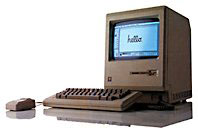 What kind of printer works with it? Why are we
going to charge $2,500 for the Macintosh?
What kind of printer works with it? Why are we
going to charge $2,500 for the Macintosh?
I let them dismantle the iMac and look at it. I mean, if Apple of 1983 broke it, could Apple of 2001 cancel the warranty?
They carefully wrote down everything like a group of people inspecting a captured spy-plane. But then the hard drive died, so my friend, the iMac, and I had to head home.
So my friend fired up the IIGS laptop. The dreaded "Check Startup Device!" message appeared. He had lost the boot disk!
"You idiot! Now we have to wait three years for the IIGS to be introduced!"
About the same time I said that, a Macintosh engineer picked up a diskette and inserted it into his 128k. The "This is not a Macintosh disk" message appeared on his Mac. He was ready to click "format" when I ran over and told him to stop. I got the disk out and put it in the IIGS. It started up and loaded GS/OS. We were ready to go.
I got the iMac, and we were back in 2001 - I think. My SE looked like a mini-iMac. My PowerBook 540c, Performa 475, and other Quadra-class Macs were missing. In their place were strange boxes that looked similar to the iMac, but had slot-loading CD-RW drives that used 3" CDs. They had ports that looked like USB and FireWire, but were oddly shaped. The keyboards were like that of the iMac (the Apple Pro Keyboard). The mice were optical. I turned one on. It was running OS VIII, but it looked like an evolved OS X. Everything worked well and fast. The computers all had their respective names on the case, but they were indigo, and my PowerBook looked like a thick iceBook.
I looked at a Club Mac catalog. All the Macs were different, but also the same. It was very quasi-futuristic! OS X was the current OS, but Aqua was gone. In its place was a theme called Platinum (surprising?).
Then I went into the other room, where we have our IBM PC. It looked the same, but it also had the 3" CD-ROM, along with a 3.5" floppy drive. I turned it on and noticed it had Unix. This was puzzling. Where was Windoze? It turns out Apple protected the Mac like they should have. Microsoft wasn't able to copy the Mac, and now they made a Unix-like OS. Of course, it was one of the worst implementations of Unix.
Obviously, even seeing something that futuristic in 1983, Apple was still innovating and developing, rather than sitting back and waiting for the competition to catch up. Sadly, the beige Macs were never made. Instead, every Mac had been translucent and rounded. Even my ImageWriter II was translucent graphite!
Of course, we all know how this ends. My friend and I go back to 1983 and stop ourselves from showing the iMac to Apple in 1983. We return to the current time and everything is back to normal.
Although this is better, I would've liked to see how those 3" CD-RW
drives work. ;-) 
About LEM Support Usage Privacy Contact
Follow Low End Mac on Twitter
Join Low End Mac on Facebook
Favorite Sites
MacSurfer
Cult of Mac
Shrine of Apple
MacInTouch
MyAppleMenu
InfoMac
The Mac Observer
Accelerate Your Mac
RetroMacCast
The Vintage Mac Museum
Deal Brothers
DealMac
Mac2Sell
Mac Driver Museum
JAG's House
System 6 Heaven
System 7 Today
the pickle's Low-End Mac FAQ
Affiliates
Amazon.com
The iTunes Store
PC Connection Express
Macgo Blu-ray Player
Parallels Desktop for Mac
eBay