

Apple Design in the MacBook Air Era
- 2008.02.25
My Turn is Low End Mac's column for reader-submitted articles. It's your turn to share your thoughts on all things Mac (or iPhone, iPod, etc.) and write for the Mac web. Email your submission to Dan Knight .
Design in the Age of Intel
Macworld San Francisco in January 2006 was an intriguing time. The Intel transition was the talk of the Mac Web - and much of the media beyond. Expectations had risen that we would see the first models of the new platform that very show, despite Apple's earlier promise they would arrive by summer.
Expectations were right. Steve Jobs unveiled with typical panache the first Intel powered desktop and notebook Apple had ever made and dared to call a Mac! He showed off their performance before an eager audience. There was just one strange surprise: the Intel Macs looked eerily similar to their PowerPC predecessors.
Two models moved to Intel that day. The Core Duo powered iMac was essentially identical to its G5 ancestor in outer appearance. The Core Duo successor to the PowerBook G4 was a little easier to tell apart - it had a built in iSight camera for the first time at the top edge of its display - and it had a name change to MacBook Pro.
However, this was still less ado than Apple had made with previous generation changes between G3, G4, and G5. Despite the move to Intel being a far greater technical challenge and accomplishment, it was as though their industrial design was playing it down.
As the year progressed, the entire Macintosh line made the leap to Intel. The Mac mini was next and looked identical save for an artfully placed remote control receiver and a more liberal selection of ports on the back. Then came the iBook, which like its aluminium brother, had a name change to now be called the MacBook. Unlike the MacBook Pro, the MacBook was a new design and easy to tell from its predecessor - more on that later.
But it was back to business as usual when the Power Mac came to Intel the last of all, picking up a second optical drive slot (and a wealth of useful changes hidden inside) and its new title of Mac Pro. The server oriented relative to the Mac - the Xserve - received a similar treatment although without a name change, completing the Intel transition in surprisingly speedy time.
So, to recap, there was only one new design in 2006: the MacBook. Every other Mac had been transformed on the inside, but on the outside there was as little change as possible.
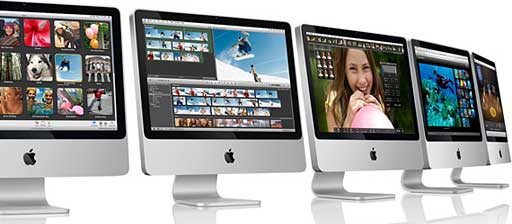
2007 brought the iPhone - an entirely new product and an area where Apple have great ambitions - and then a whole new generation of iPods. The iMac received its first major industrial design change since the G4 "sunflower" model was replaced with the minimalist "where's the computer?" G5 some three years earlier. That G5 iMac, incidentally, was considered to bear a lot in common with the iPod in terms of style. The new aluminium and glass iMac in turn shared its design in similar ways to the iPhone.
Once the iMac joined the MacBook in the short list of new designs, there were no more changes. None of the other Macs were altered on the outside. Hardware evolved on the inside as 64 bit became universal across the entire platform with the Core 2 Duo, but once again the outer design was kept untouched.
There's Something in the Air
Then, on the second anniversary of the first Intel Macs at Macworld 2008, Steve Jobs unveiled the MacBook Air, causing a storm of interest and debate which clearly carries on today. The Air was clearly a new class of portable for Apple with no direct ancestors at all. Its industrial design made this very clear: It looks quite unlike any other computer.
So much has been written about the MacBook Air - controversies rage about its many tradeoffs and where precisely it fits among its MacBook siblings - so much that I needn't add any more to it. Instead, I'd like to compare the external design of the Air to Apple's other recent changes as I've listed above.
Perhaps we can get a sneak peak of the future?
A Picture Speaks a Thousand Words
Have a look at the high quality photos AppleInsider took of the MacBook Air compared to the MacBook Pro. Everyone knows that the Air is thin; but seen side by side with Apple's well respected flagship professional portable, we can see the immense design shift for what it is. As usual, I'm writing from my 12" PowerBook, which had a reputation for being tubby compared to its aluminium peers. The Air is probably about as thick at its front as the curved lip of my own laptop's battery, creeping round the edge! (The cell itself is far chunkier than that.)
Also note the MacBook Air's keyboard. Look familiar? It should. This style was brought in with the first MacBook in 2006. Rounded, separate "chiclet" keys, which despite some initial concerns have proven to be well regarded for typing and general use. Last year's aluminium iMac brought the same thinking over to Apple's long untouched desktop keyboards, its new wireless keyboard having particularly strong ties to the MacBook. The Air's black keys come with backlighting . . . I expect this will spread to other models in time as well.
There is no guessing required when it comes to the MacBook Air's display. Apple have stated that they will remove mercury from all of their products: This means a transition from traditional CCFL to LED backlights. Steve Jobs also pointed out that a key design goal with the Air was to maintain a full size keyboard and display in as thin a package as possible. This sounds like an implicit warning that we'll see no sub-13" Macs, and therefore no direct successor to the 12" PowerBook. I think Apple are likely to concentrate on tablets like the iPod touch for smaller sizes.
Lessons for the Leery
Back in 2006, I had not expected Apple to reuse their designs. As much lesser generational leaps like those between G3, G4, and G5 had brought new cases, materials, and geometries in turn; I really anticipated brand new shapes and forms. If the glass and aluminium iMac of 2007 had come out at Macworld 2006 instead, I would have actually been less surprised than I was with the G5 iMac's doppelgänger!
Since the move to Intel, the MacBook, iMac, and MacBook Air are new designs. This leaves the Mac Pro, Mac mini, and MacBook Pro waiting for their overhaul.
What are they likely to look like?
MacBook Pro
The aluminium PowerBook design, which the MacBook Pro still bears, dates back to the start of 2003 and my own rather quaint laptop. It has worn well - often considered a true classic among notebook designs - but the MacBook Air's sudden arrival has given it something of a dent. I know it is controversial to suggest that the professional oriented MacBook Pro take a diet as radical as produced the Air, but I think looking forward a few years it is inevitable. The Air shows that the compromises needed right now are still too steep for its bigger brothers. I am certain, however, that this is precisely the direction they too will go in good time. Flash storage replacing hard disks, as it has done in all but one iPod now, optical drives becoming external peripherals, replaceable batteries exchanged for iPod-like integration, and ports being selectively culled or delegated to USB. Such changes aren't necessarily as harsh as the Air itself has taken: there will be more room by definition on a 17" notebook, and professional machines may well hold on to select ports the Air has boldly dispatched. Thin, though, is certainly in. MacBook Pros today will look as oversized to their descendants as the Air does against them now.
Mac mini
Reports of the Mac mini's demise are - fortunately - greatly exaggerated. This most minuscule of Mac desktops appears to be with us for the long haul. It's difficult to imagine just what Apple might have in mind for it next, as the Mac mini, uniquely, has never been redesigned since its inception in 2005. There are G4 minis and Core Solo, Duo, and Core 2 Duo models; but their appearance is unchanging. Having been inside of one myself - upgrading its 1.6 GHz Core Duo for a 2.0 GHz 64-bit Core 2 Duo - the only obvious space to be reduced would be the omission of the optical drive; though it's hardly as appealing a proposition for a desktop! Apple could really do anything with the mini. It has long been speculated that it could be merged with the thinner but wider Apple TV. Unlikely, I think: the set top box has a very different purpose in mind.
Mac Pro
And then, lastly, the Mac Pro. Like the MacBook Pro, it still wears the outer design of the well established PowerPC model it replaced: the Power Mac G5, also introduced back in 2003. Popular opinion has it the Mac Pro is too large, a sentiment often shared quite naturally about the G5 Power Mac. History suggests the Mac Pro may well borrow from the iMac in appearance, as did its distant ancestor the Blue & White G3. The Power Mac line did not, however, take on the snow white style of G4 and G5 iMacs, so it's not necessarily so! Again, Apple have quite the opportunity for a new design in the headless desktop Macs. Aluminium is a favourite to still have some part in it.
Twists and Trends
In summing up: Apple are a great example of evolving industrial design. In many ways they are conservative and reuse a great idea wherever they can once it has succeeded. The great brushed aluminium tide of 2003 is a prime case in point: Even today the Mac Pro and MacBook Pro utilise what was made then, some five years back.
Balancing this is a drive for new design, which emerges as a great surprise whenever it is ready and soon enough takes over from the last major change. The iPhone was just such an innovation in form as well as function.
The iMac's subsequent shift from a white iPod to glass and aluminium iPhone-inspired design is the natural consequence. This is why I expect the MacBook Air to be a seminal work, influencing future models just as the first aluminium PowerBooks did, and indeed the original iMac. Apple design in waves. Once again, on such a crest, we are in most interesting times.
This was originally published as Where the MacBook Air Fits in Apple's Design on John Muir's blog. It has been edited for use on Low End Mac with his permission. dk
Share your perspective on the Mac by emailing with "My Turn" as your subject.
Join us on Facebook, follow us on Twitter or Google+, or subscribe to our RSS news feed
Today's Links
- Mac of the Day: PowerBook 500 Series, introduced 1994.05.16. 'Blackbird' includes a 25 to 33 MHz 68040 along with smart batteries and grayscale or color displays.
- Support Low End Mac
Recent Content
About LEM Support Usage Privacy Contact
Follow Low End Mac on Twitter
Join Low End Mac on Facebook
Favorite Sites
MacSurfer
Cult of Mac
Shrine of Apple
MacInTouch
MyAppleMenu
InfoMac
The Mac Observer
Accelerate Your Mac
RetroMacCast
The Vintage Mac Museum
Deal Brothers
DealMac
Mac2Sell
Mac Driver Museum
JAG's House
System 6 Heaven
System 7 Today
the pickle's Low-End Mac FAQ
Affiliates
Amazon.com
The iTunes Store
PC Connection Express
Macgo Blu-ray Player
Parallels Desktop for Mac
eBay