
Miscellaneous Ramblings
Looking Back at the Power Mac G4 Cube Ten Years On
Charles Moore - 2011.07.05 - Tip Jar
Sunday, July 3, was the 10th anniversary of Apple's announcing that it had decided "to suspend production of the Power Mac G4 Cube indefinitely." The company said there was a small chance it would introduce an upgraded model of the unique computer in the future, Steve Jobs apparently reluctant to pull the plug definitively on his "silent supercomputer" that packed "the performance of a Power Mac G4 in a 7.7" wide, 7.7" deep, and 9.8" tall, 14 pound enclosure."
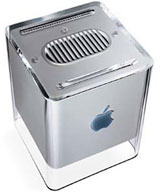 It had been in production
less than a year.
It had been in production
less than a year.
Being a Cube owner at the time, I could appreciate his reluctance. The Cube was a very cool (albeit flawed) machine, the sheer audacity of which Apple has never quite matched with any subsequent Apple product. No official Cube discontinuation notice has ever been issued, but with the passage of a decade, it's safe to say that "suspension" of production is now permanent.
The Cube was a pleasure just to sit and look at.
I had purchased my Cube, an open-box 450 MHz unit with a respectable (in those days) 20 GB hard drive and 576 MB of RAM from Low End Mac's Dan Knight, who had used it lightly, for about $1,300 in May 2001. Unboxing the Cube, it struck me that it was most visually striking computer I'd ever seen - a feast for the eyes. Why these machines didn't sell better on aesthetics alone is a mystery to me. The Cube was a pleasure just to sit and look at.
Marketing Problems
But there were definitely marketing problems. Apple never publicly explained its marketing target strategy for the Cube, but a broad consensus held that it was aimed at upscale professional types as a sort of functional objects d'art for their tony offices.
 If so, that was not a winner
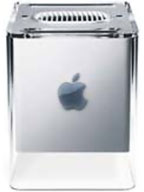
of a plan. The Cube's crystal polycarbonate-encased CPU module was
strikingly attractive and compact in dimensions, but that had been
achieved only by shifting the power supply to a huge power brick that
was as homely as the Cube was handsome, and audio-out to a couple of
Harman-Kardon satellite speakers with a 4" x 2" x 0.5 " external
amplifier, housed in three more crystal-encased modules that were
attractive enough to look at, but added to the clutter, as did the
necessary external monitor, keyboard, mouse, and attendant spaghetti
tangle of cables to connect everything. The total amount of desktop
real estate required not that different from a typical desktop or tower
computer of the day.
If so, that was not a winner
of a plan. The Cube's crystal polycarbonate-encased CPU module was
strikingly attractive and compact in dimensions, but that had been
achieved only by shifting the power supply to a huge power brick that
was as homely as the Cube was handsome, and audio-out to a couple of
Harman-Kardon satellite speakers with a 4" x 2" x 0.5 " external
amplifier, housed in three more crystal-encased modules that were
attractive enough to look at, but added to the clutter, as did the
necessary external monitor, keyboard, mouse, and attendant spaghetti
tangle of cables to connect everything. The total amount of desktop
real estate required not that different from a typical desktop or tower
computer of the day.
The literally brick-like power supply could be banished to the floor or elsewhere out of sight, but the rest of the stuff had to pretty much remain in plain view. Today, with wireless peripherals, much of the spaghetti could be dispensed with, but ten years ago wires were obligatory.
Expensive
Apple's pricing didn't help either. At $1,799, the base 450 MHz Cube cost more than the $1,599 price of the cheapest professional Power Mac G4 (also 450 MHz, but with three PCI expansion slots and multiple internal drive bays), and the 500 MHz version of the Cube that was sold only through the online Apple Store (this in the days before there were brick-and-mortar Apple Stores) was priced at $2,299. And those prices were without a monitor. If you added a 15" Apple Studio Display LCD flat screen monitor (the most thematically appropriate choice) for $999, you were up to $2,798.
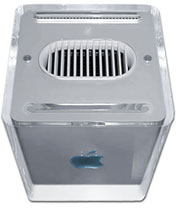 By the first calendar quarter
of 2001, Cube sales were down 59% from what had been less than
spectacular performance in the fewer than five months of 2000 that it
had been available, to a miserable 12,000 units sold. (compared with
55,000 iMacs and 250,000 G4 Towers in Q1 2001).
By the first calendar quarter
of 2001, Cube sales were down 59% from what had been less than
spectacular performance in the fewer than five months of 2000 that it
had been available, to a miserable 12,000 units sold. (compared with
55,000 iMacs and 250,000 G4 Towers in Q1 2001).
A price reduction was announced at Macworld Tokyo 2001, with the entry-level 450 MHz DVD Cube cut to $1,299, and the 15" Apple Studio Display to $799, reducing sticker shock to a more manageable $2,098 for the combo, still not a rip-roaring bargain, but at least more reasonably priced. Unfortunately, it was too little too late. The "Cube is too expensive" image had become conventional wisdom.
Steve Jobs put a brave face on it, declaring that there were no plans to discontinue the Cube, but the proverbial handwriting was on the wall.
I always thought the storm of criticism over the Cube's price was more than a bit overblown. At the the original $1,799 price point for the 450 MHz unit, the Cube was no bargain, but it wasn't just another computer either. I think the real problem wasn't so much the price of the Cube itself, but the price of Apple's LCD monitors. It seemed ridiculous to get a tiny (by the standards of the day), jewel-like Cube and then pair it with one of the hulking great Apple Studio Display 17" CRTs, the latter being the only reasonably priced monitor Apple sold in those days.
Other reasons the Cube didn't sell included the "expensive toy for yuppies" perception. Many didn't take it seriously.
Perhaps it was also because the Cube was a bit of a jack of several trades and master of none. It was reasonably powerful for general computing chores, but not suited for really high-end work because of its lack of PCI expansion potential. It was sort of portable, but not in the same way that a PowerBook is portable.
It was not super-expensive, but not bargain priced like an iMac either. In short, the Cube had an identity crisis, and even people who liked it were inclined to admire it and then move along and buy something with more precise market focus. "Cube owners love their Cubes, but most customers decided to buy our powerful Power Mac G4 minitowers instead," Phil Schiller, Apple's vice president of Worldwide Product Marketing, commented at the time.
The Cube's Closese Successor
In practical terms, the closest analog Apple makes to the Cube today is the Mac mini, which it's made in various iterations since 2005, and which has has been a lot more successful than the Cube was - for good reason. It's much more versatile, genuinely minuscule, and development of wireless peripherals and data connectivity technology has helped, as has the mainstream shift to reasonably-priced flat screen monitors, which were just beginning to gain traction in the desktop world a decade ago - and, as we've noted, they were still prohibitively expensive during the Cube's short time on the market.
The Cube concept was seductive, but it left a fair bit to be desired in practical execution. For me, while I admired my Cube, I soon determined that it wasn't quite what I needed - not the compact desktop laptop substitute I'd been hoping for, and of course it didn't have the option of battery power. I ended up swapping it after about six months for a year-old but immaculate Pismo PowerBook. A good decision as it turned out. I still have that Pismo in regular use. I wonder if the Cube is still in service?
Join us on Facebook, follow us on Twitter or Google+, or subscribe to our RSS news feed
Charles Moore has been a freelance journalist since 1987 and began writing for Mac websites in May 1998. His The Road Warrior column was a regular feature on MacOpinion, he is news editor at Applelinks.com and a columnist at MacPrices.net. If you find his articles helpful, please consider making a donation to his tip jar.
Links for the Day
- Mac of the Day: PowerBook 500 Series, introduced 1994.05.16. 'Blackbird' includes a 25 to 33 MHz 68040 along with smart batteries and grayscale or color displays.
- Support Low End Mac
Recent Content
About LEM Support Usage Privacy Contact
Follow Low End Mac on Twitter
Join Low End Mac on Facebook
Favorite Sites
MacSurfer
Cult of Mac
Shrine of Apple
MacInTouch
MyAppleMenu
InfoMac
The Mac Observer
Accelerate Your Mac
RetroMacCast
The Vintage Mac Museum
Deal Brothers
DealMac
Mac2Sell
Mac Driver Museum
JAG's House
System 6 Heaven
System 7 Today
the pickle's Low-End Mac FAQ
Affiliates
Amazon.com
The iTunes Store
PC Connection Express
Macgo Blu-ray Player
Parallels Desktop for Mac
eBay