
Mac2Windows
Apple's Product Line: Hiding Complexity Behind Elegant Simplicity
- 2006.08.28 - Tip Jar
The story goes that a decade or so ago, Apple was a mess. The media routinely attached the adjective "beleaguered" to the company name. Apple was bleeding market share, losing sales to PCs running Windows - and even to Apple-licensed Mac clones.
The company's product line was littered with models with obscure names and numbers, confusing potential consumers. Each seemed to be on the market for only a few months, replaced by another with a slightly different name and number.
Take the Quadra 630 series - according to the very useful free Mactracker software, a database of Mac models, this was the first Mac to adopt the PC-style IDE bus for its internal drives when it was released in June 1994.
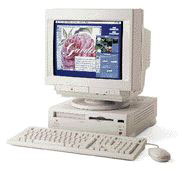 The 68040-powered Quadra 630 was also sold (with different
software bundles) as the LC 630 (primarily to the education market)
and the Performa 630 (primarily to the home market). Models
included (under each of Quadra, LC, and Performa names) 630, 630CD,
631 CD, 635CD, 636, 637CD, 638 CD, and 640CD (whew!), which
Mactracker notes were differentiated, along with different software
bundles by different accessories, monitors, and hard drives. (As
well, some home-oriented Performa models used the less-expensive
68LC040 CPU). The whole collection was discontinued about a year
later in July/August 1995.
The 68040-powered Quadra 630 was also sold (with different
software bundles) as the LC 630 (primarily to the education market)
and the Performa 630 (primarily to the home market). Models
included (under each of Quadra, LC, and Performa names) 630, 630CD,
631 CD, 635CD, 636, 637CD, 638 CD, and 640CD (whew!), which
Mactracker notes were differentiated, along with different software
bundles by different accessories, monitors, and hard drives. (As
well, some home-oriented Performa models used the less-expensive
68LC040 CPU). The whole collection was discontinued about a year
later in July/August 1995.
You're allowed to be confused.
In 1996, Apple bought Steve Jobs' NeXT, and the following year, following a boardroom coup, he was named interim CEO. One of his early acts was to clean up the messy product line.
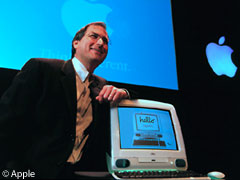 At the 1998 Macworld keynote where he introduced the iMac, a slide illustrated a vastly
simplified field of Macs: there was going to be a
professional-level desktop, the Power Mac, and a pro-level
notebook, the PowerBook. The just-released iMac would fill a niche
for consumer desktop. And there was a hole in the space for
consumer notebook, which would soon be filled with the iBook.
At the 1998 Macworld keynote where he introduced the iMac, a slide illustrated a vastly
simplified field of Macs: there was going to be a
professional-level desktop, the Power Mac, and a pro-level
notebook, the PowerBook. The just-released iMac would fill a niche
for consumer desktop. And there was a hole in the space for
consumer notebook, which would soon be filled with the iBook.
By 1999, it looked brilliant. Four product niches, four models. Simple and elegant, yet meeting everybody's needs.
Of course, reality is more complicated, even then. Each model came in several configurations with different speed CPUs, different hard drives, and/or different optical drives. In the bad old days, each of these configurations would have received its own model number, but now it was just an iMac or iBook.
In fact, if we look more closely, there are about as many models today - and with about as short a life-span as a decade ago.
The More Things Change
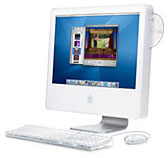 As an
example, let's look at the iMac G5,
released in August 2004 and aimed at about the same midlevel
consumer market as summer 1994's Quadra/Performa/LC 630 series.
When initially released, there were models with 17" and 20" LCD
screens, and 1.6 and 1.8 GHz CPUs, and over the product's short
life-span, options for 40, 80, 160, and 250 GB hard drives.
As an
example, let's look at the iMac G5,
released in August 2004 and aimed at about the same midlevel
consumer market as summer 1994's Quadra/Performa/LC 630 series.
When initially released, there were models with 17" and 20" LCD
screens, and 1.6 and 1.8 GHz CPUs, and over the product's short
life-span, options for 40, 80, 160, and 250 GB hard drives.
In May 2005, these original G5 iMacs were replaced with what Mactracker refers to as the iMac G5 ALS (also available in a variety of models), which had somewhat upgraded graphics and processors. In October 2005, these were replaced with the iMac G5-iSight models; a sleeker case than the ALS models with an iSight camera built into the top.
And these were discontinued in January 2006, replaced with 17" and 20" Intel-powered models in identical cases.
You're allowed to be confused. Over a total life span of about a year and a half, the G5 iMacs had three major model releases in each of two sizes (17" and 20") with versions with and without DVD-burning SuperDrives, different CPU speeds, and hard drive sizes.
A decade previous, each different configuration of each different model (and each different screen size) would have sported a slightly different model number. Now they're simply marketed as G5 iMac 17" or G5 iMac 20", giving the appearance of a simple product line.
Change Is Good
I'm not complaining about the pace of change. It would make little sense for Apple to hold off on upgrading its products while CPU speeds and hard drive capacities improve. And consumers are equally well served by being able to choose between differently priced configurations of basic models.
And Apple's relatively small number of choices for each model is much more straightforward than the ever-changing configurations offered by, say, Dell. (I've counted as many as three different Dell ads in a single newspaper issue, each offering slightly different configurations of the same base-model laptop at different "sale" prices).
But (as we saw) the G5 iMac had multiple configurations of two different models and three upgrades all within an 18-month time span - all with a single product name. I've got a 17" G5 iMac; maybe you have a 17" G5 iMac purchased at about the same time, but they're different.
Confusion Is Bad
I'm not convinced that consumers are better served by hiding the differences than a decade ago when each of these slightly different configurations sported its own slightly different model number.
A decade later, Apple is still selling a multiplicity of models,
each of which has a short shelf life. It's just hiding the reality
by giving them all the same product name. Of course, Apple has
often been noted for hiding complexity behind what appears to be
elegant simplicity. 
Join us on Facebook, follow us on Twitter or Google+, or subscribe to our RSS news feed
Alan Zisman is Mac-using teacher and technology writer based in Vancouver, BC, Canada. Many of his articles are available on his website, www.zisman.ca. If you find Alan's articles helpful, please consider making a donation to his tip jar.
Today's Links
- Mac of the Day: PowerBook 5300, introduced 1995.08.25. The first PowerPC PowerBook was known for 'flaming' performance.
- Support Low End Mac
Recent Content
About LEM Support Usage Privacy Contact
Follow Low End Mac on Twitter
Join Low End Mac on Facebook
Favorite Sites
MacSurfer
Cult of Mac
Shrine of Apple
MacInTouch
MyAppleMenu
InfoMac
The Mac Observer
Accelerate Your Mac
RetroMacCast
The Vintage Mac Museum
Deal Brothers
DealMac
Mac2Sell
Mac Driver Museum
JAG's House
System 6 Heaven
System 7 Today
the pickle's Low-End Mac FAQ
Affiliates
Amazon.com
The iTunes Store
PC Connection Express
Macgo Blu-ray Player
Parallels Desktop for Mac
eBay