
Macintosh History
2007: Santa Rosa 'Books, iPhone, Aluminum iMac, and Leopard
Dan Knight - updated 2008.02.12 - Tip Jar
Apple added an 8-core build-to-order option for the Mac Pro on April 4. The new top-end model had two 3.0 GHz quad-core Xeon CPUs.
On May 15, Apple improved MacBook speed to 2.16 GHz at the top, doubled RAM on the base model to 1 GB, and moved to larger hard drives.
The MacBook Pro models were updated on June 5, adopting the Santa Rosa chipset, an 800 MHz system bus, and Nvidia GeForce 8600M GT graphics. The 15" MacBook Pro ran at 2.2 GHz or 2.4 GHz, and a 2.6 GHz build-to-order option was available for those who needed the extra power. The 17" MacBook Pro normally ran at 2.4 GHz, and a 2.6 GHz option was also available for it. Once 4 GB modules became available in 2008, users discovered that the Santa Rosa notebooks could work with up to 6 GB of RAM.
The biggest problem with the 2007 MacBook Pro models had to do with the GeForce 8600 graphics processors, many of which were defective. According to some sources, every production run for the GPU had defective chips.
iPhone
The biggest tech event of the year was the introduction of the original iPhone on June 30. People lined up for hours to buy Apple's first mobile phone, a smart phone that combined a cell phone, an iPod, and an OS X computer. (Note that Apple calls it OS X, not Mac OS X.)
The Mac mini was updated on August 7, the last Mac to move from Intel Core Duo processors to the improved Core 2 Duo, which includes 64-bit support. Clock speeds were 1.83 GHz for the entry-level Combo drive model and 2.0 GHz for the SuperDrive version. As of February 2008, this is still the current model.
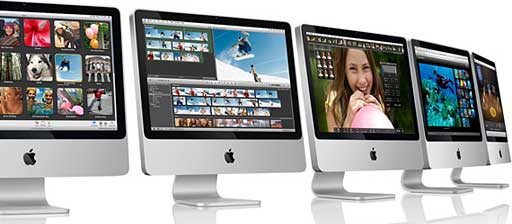
At the same time, Apple introduced a redesigned iMac. The new models came in 20" and 24" sizes (no more 17" iMac), were built using aluminum and glass, and had a glossy display. At the top of the line was a 2.8 GHz build-to-order 24" iMac.
Apple introduced the iPod touch on Sept. 5, in most respects an iPhone - but without mobile phone or camera capabilities. The iPod touch runs the same iPhone version of OS X as the iPhone.
At the same time, Apple rolled out a redesigned iPod nano, shorter and wider than earlier models. The traditional hard drive iPod was updated and renamed at the same time: The iPod classic had an aluminum face and came in 80 GB and 160 GB capacities. The tiny iPod shuffle was updated with a new range of colors.
The MacBook received another update on October 31, when it adopted Intel's Santa Rosa chipset and an 800 MHz system bus. The new models ran at 2.0 and 2.2 GHz, scarcely faster than the models they replaced. This also marked the MacBook's move to Intel X3100 graphics - more powerful than the earlier GMA 950, but also more memory hungry. The new GPU used 144 MB of system memory.
Leopard
For Mac users, the biggest event of the year was the release of Mac OS X 10.5 "Leopard" on October 26. Where Mac OS X 10.4 "Tiger" had been available in different versions for PowerPC and Intel Macs, Leopard was a universal release that supported both hardware platforms.
New technologies included Time Machine (automated backup), a new Finder, and a 3D Dock.
For the first time, there was no Classic Mode in OS X - not even with PowerPC Macs. Where Mac users dependent on Classic apps had avoided Intel Macs, which never had Classic support, they now avoided Leopard as well. (For those who need access to Classic apps and the Classic Mac OS, Sheepshaver emulates a PowerPC Mac and supports Mac OS 7.5.2 through 9.0.4. It works, although it gives you an emulated Mac in a fixed window, not the same experience users are accustomed to with Classic Mode.)
Unsupported OS X 10.5
Hardware requirements for Leopard include 512 MB of RAM and an 867 MHz G4 or better. Users have discovered several ways to install OS X 10.5 on unsupported hardware, including G3 Macs with G4 upgrades and AGP graphics. In some instances, they have even scrounged up the kext files from a developer release and hacked Leopard to work with Macs with PCI graphics, such as the Beige Power Mac G3 from 1997.
Low End Mac provided reader reports on successes, failures, and glitches within days of Leopard's release, and in December Dylan McDermond shared his Open Firmware hack that allowed users to run an unmodified Leopard installer on a Mac slower than 867 MHz. This information was used by the folks at iCode to create LeopardAssist, a free program that automates the process and eliminates the need to fiddle with OpenFirware on your own.
Next - 2008: Mac Pro with 4-core Xeon, MacBook Air, Unibody MacBook and MacBook Pro
About LEM Support Usage Privacy Contact
Follow Low End Mac on Twitter
Join Low End Mac on Facebook
Favorite Sites
MacSurfer
Cult of Mac
Shrine of Apple
MacInTouch
MyAppleMenu
InfoMac
The Mac Observer
Accelerate Your Mac
RetroMacCast
The Vintage Mac Museum
Deal Brothers
DealMac
Mac2Sell
Mac Driver Museum
JAG's House
System 6 Heaven
System 7 Today
the pickle's Low-End Mac FAQ
Affiliates
Amazon.com
The iTunes Store
PC Connection Express
Macgo Blu-ray Player
Parallels Desktop for Mac
eBay