
Macintosh History
2002: G4 iMacs, eMac, iPod for Windows, MDD Power Macs, and Mac OS X 10.2
Dan Knight - updated 2008.02.05 - Tip Jar
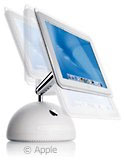 At Macworld Expo in
January 2002, Steve Jobs unveiled the flat panel 15" G4 iMac at
speeds of 700 and 800 MHz, as well as the OS X-only iPhoto software.
Apple also announced that from this point forward new Macs would ship
with Mac OS X 10.1 as their default operating system, although they
would also include the Classic Mac OS for those who needed to boot into
it or use it for Classic Mode.
At Macworld Expo in
January 2002, Steve Jobs unveiled the flat panel 15" G4 iMac at
speeds of 700 and 800 MHz, as well as the OS X-only iPhoto software.
Apple also announced that from this point forward new Macs would ship
with Mac OS X 10.1 as their default operating system, although they
would also include the Classic Mac OS for those who needed to boot into
it or use it for Classic Mode.
Better iBooks
On January 7, Apple introduced a 14" iBook, essentially the 12" 600 MHz iBook with a larger screen. It had the same white look, the same design, the same CPU, the same graphics processor, and even the same resolution, just scaled up for the larger LCD.
On May 20, Apple boosted the iBook to 700 MHz. The new 12" iBook and 14" iBook were the first iBooks to include Mobility Radeon graphics and the first with 16 MB of video memory. In addition to a faster CPU, the new PowerPC 750fx had a larger cache as well (512 KB vs. 256 KB).
The iBook took another step forward in early November, when the 12" iBook and 14" iBook were introduced at 800 MHz. This revision also included the Mobility Radeon 7500 graphics processor and 32 MB of video memory (16 MB on the low-end 700 MHz 12" model).
Improved Power Macs
On January 28, Apple launched the 'Quicksilver 2002' line of Power Mac G4 models, the fastest using a pair of 1 GHz G4 processors, the first time Apple had achieved that level of performance.
In late February, Mac OS X reached version 10.1.3.
iPod News
Apple introduced a 10 GB iPod on March 20 and began shipping a Windows-compatible iPod (it shipped with MusicMatch software - iTunes for Windows was a ways off yet) on July 23.
At the same time, Apple moved to a touch-sensitive scroll wheel, replacing the spinning scroll wheel in the 1G iPod, and also introduced a 20 GB model. The new iPod proved so popular that even Dell sold them.
Improved PowerBooks
The next generation PowerBooks arrived at the end of April. Although they looked like earlier versions at a glance, the new 'Ivory' PowerBooks included a higher resolution display (1280 x 854 instead of the older 1152 x 768) and a DVI port for use with digital monitors. A 1 GB level 2 cache plus 667 MHz and 800 MHz CPUs gave very perky performance.
The new design included Mobility Radeon 7500 graphics with 32 MB of video memory, and this is the oldest PowerBook to fully support Quartz Extreme graphics (part of OS X 10.2 and later).
The PowerBook G4 was further improved in November, with the introduction of 867 MHz and 1 GHz models, the latter being the first PowerBook available with a built-in SuperDrive. The new PowerBooks had Radeon 9000 graphics and were the last version of the Titanium PowerBook series. These are the oldest PowerBooks officially supported by Mac OS X 10.5 "Leopard".
The Education Mac
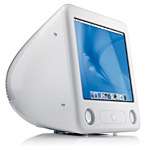 The G4 iMac turned a lot of heads with
its novel design and flat panel display, but it was also beyond the
budget of many schools that had used the far more affordable G3 iMacs
for years. To meet the needs of this market, Apple introduced the
"great white Mac" in late April.
The G4 iMac turned a lot of heads with
its novel design and flat panel display, but it was also beyond the
budget of many schools that had used the far more affordable G3 iMacs
for years. To meet the needs of this market, Apple introduced the
"great white Mac" in late April.
Known as the eMac (for education Mac), the new desktop computer used a traditional CRT display along with front-mounted speakers, just like G3 iMacs had. Improvements included a 17" flat CRT and a G4 CPU. It was available in a 700 MHz CD-ROM configuration with no modem for under US$1,000, and the 800 MHz version included a Combo (CD-RW/DVD-ROM) drive. Although only a bit larger than the original iMac in its dimensions, the eMac was a heavy beast at 50 pounds.
The "education only" eMac got a lot of attention outside of the education market, and Apple began offering it to the consumer market five weeks after its introduction. We used a 700 MHz eMac at Low End Mac for a few years, then migrated to 1.25 GHz. The display worked nicely at 1280 x 960 resolution, but the speakers tended to buzz at even moderate volumes - solved with a cheap pair of external speakers.
Growing the iMac
In July, Apple introduced a 17" version of the G4 iMac with a 1440 x 900 display and a SuperDrive as a standard feature. It ran at the same 800 MHz speed as the top-end 15" iMac G4.
A New Power Mac Design
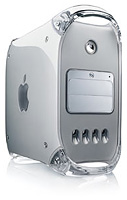 Apple once again changed the
appearance of the Power Mac G4 when it introduced the 'Mirrored Drive Doors' models in
August. All of the new models had dual processors: 867 MHz, 1 GHz, and
a new high of 1.25 GHz. This would prove to be the last model to boot
into the Classic Mac OS, and it would be reintroduced as a single CPU
1.25 GHz model in June 2003.
Apple once again changed the
appearance of the Power Mac G4 when it introduced the 'Mirrored Drive Doors' models in
August. All of the new models had dual processors: 867 MHz, 1 GHz, and
a new high of 1.25 GHz. This would prove to be the last model to boot
into the Classic Mac OS, and it would be reintroduced as a single CPU
1.25 GHz model in June 2003.
The biggest drawback of the MDD design is that the faster models used a 167 MHz system bus instead of the 133 MHz bus of earlier Power Macs and slower MDD models. While this allowed for faster memory access, few upgrade vendors made CPU upgrades to work on the faster bus. From the viewpoint of someone who wants to upgrade the CPU for maximum performance, Power Macs with a 133 MHz bus are the better choice.
With the redesign, Power Macs once again had a maximum RAM capacity of 2 GB, just like the first two generations.
A 1 GHz dual MDD Power Mac has been the workhorse production machine at Low End Mac headquarters for several years now, replacing a 1.25 GHz eMac. We bought it second-hand with a SCSI card installed, and we've upgraded it with two USB 2.0 cards, 2 GB of RAM, two 400 GB 7200 rpm hard drives, and a second SuperDrive (16x vs. the original's 4x speed). We still have one free PCI slot, and we're using to original Radeon 9000 Pro video card, something we'll probably replace someday. We usually run Mac OS X 10.4.11 "Tiger" on this baby, as we're dependent on Classic Mode to run Claris Home Page, but we've also played with Mac OS X 10.5 "Leopard" on it, and it handles Leopard well - although a better video card would definitely help.
Mac OS X 10.2 'Jaguar'
Apple's new operating system took a big leap forward with version 10.2, which was unleashed on August 23. Apple streamlined the look, improved performance, and added Quartz Extreme, which worked with any Mac that had AGP video and at least 16 MB of video RAM. Quartz Extreme uses OpenGL commands and offloads processing from the Mac's CPU to the Radeon or Nvidia GeForce graphics processor.
New features included iChat, Apple's instant messaging client for .mac and AOL users, and Address Book, a system-wide repository for contact information. In all, Apple claimed over 150 improvements in Jaguar, and it was the first version of OS X to reach a wide audience.
Jaguar marked the end of the "happy Mac" at startup, replaced by a gray Apple logo.
Next - 2003: First OS X Only Macs, iBook G4, Power Mac G5, iMac G5, and Mac OS X 10.3
About LEM Support Usage Privacy Contact
Follow Low End Mac on Twitter
Join Low End Mac on Facebook
Favorite Sites
MacSurfer
Cult of Mac
Shrine of Apple
MacInTouch
MyAppleMenu
InfoMac
The Mac Observer
Accelerate Your Mac
RetroMacCast
The Vintage Mac Museum
Deal Brothers
DealMac
Mac2Sell
Mac Driver Museum
JAG's House
System 6 Heaven
System 7 Today
the pickle's Low-End Mac FAQ
Affiliates
Amazon.com
The iTunes Store
PC Connection Express
Macgo Blu-ray Player
Parallels Desktop for Mac
eBay