

Macintosh History
2000: Pismo, the Cube, Dual Processor G4s, Slot-load iMacs, and New iBooks
Dan Knight - updated 2008.02.03 - Tip Jar
At Macworld Expo in January 2000, Steve Jobs announced he would no longer be interim CEO, that Mac OS X Client would be finished before Macworld Expo in January 2001, and no new hardware.
We did see new portable Macs in February, notably the 'Pismo' PowerBook. Pismo came in 400 and 500 MHz models, added FireWire ports, and eliminated the SCSI port found on all previous PowerBooks. It was the first PowerBook to support up to 1 GB of RAM, and there have even been G4 upgrades for it. Many consider Pismo the pinnacle of PowerBook design.
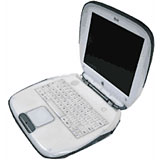 Apple also boosted base
memory in the iBook
from 32 MB to 64 MB and introduced the graphite 366 MHz iBook Special Edition.
Apple also boosted base
memory in the iBook
from 32 MB to 64 MB and introduced the graphite 366 MHz iBook Special Edition.
But perhaps the biggest news in February was the availability of the 500 MHz Power Macintosh G4, a product first announced in August 1999.
Macworld New York
 There were no
new product announcements until the July Macworld Expo in New York,
where Apple made no changes to the portable line while overhauling the
desktop line.
There were no
new product announcements until the July Macworld Expo in New York,
where Apple made no changes to the portable line while overhauling the
desktop line.
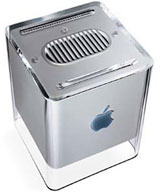
The big news was the Cube, properly known as the Power Mac (not Macintosh) G4 Cube. Inside a transparent 581 cubic inch case Apple stuffed a DVD-ROM drive, a hard drive, an AGP video card, space for 1.5 GB of memory, an AirPort antenna and room for an AirPort card, a v.90 modem, USB and FireWire ports, a 450 or 500 MHz G4 processor, and a brand new connector to both power and display images on Apple's newest monitors.
Two Brains Are Better than One
The 'Sawtooth' Power Macintosh G4 was discontinued at 450 and 500 MHz, replaced by the dual-processor 'Mystic' model (often called 'Gigabit Ethernet' models, they were the first Macs to support 100 Mbps ethernet) with no increase in price.
Although Apple pomoted the new Macs using the slogan "two brains are better than one", the reality was the the Classic Mac OS was unable to take advantage of the second CPU - and very few programs could either. (Photoshop was an exception.)
 The
biggest changes were reserved for the iMac. Apple abandoned "fruity"
blueberry, grape, strawberry, lime, and tangerine for a new spectrum of
colors. The basic iMac
had the same specifications as the 350 MHz blueberry entry level
model, but came in indigo and sold for $799, $200 less than the old one
(it didn't ship until September).
The
biggest changes were reserved for the iMac. Apple abandoned "fruity"
blueberry, grape, strawberry, lime, and tangerine for a new spectrum of
colors. The basic iMac
had the same specifications as the 350 MHz blueberry entry level
model, but came in indigo and sold for $799, $200 less than the old one
(it didn't ship until September).
The new iMac DV ran at 400 MHz, just like the earlier iMac DV, but it no longer included a DVD-ROM drive. The DV had a CD-ROM drive and came in indigo or ruby at a $999 price.
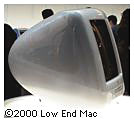 Next up the line was the iMac DV+, which replaced the
previous iMac DV feature-for-feature, but with a 450 MHz processor. In
addition to ruby and indigo, the $1,299 DV+ was also available in sage.
It was the only iMac ever available in that color.
Next up the line was the iMac DV+, which replaced the
previous iMac DV feature-for-feature, but with a 450 MHz processor. In
addition to ruby and indigo, the $1,299 DV+ was also available in sage.
It was the only iMac ever available in that color.
At the top of the iMac line was the new iMac Special Edition. The 500 MHz processor was 25% faster than the previous generation iMac SE, and it was available in both the older graphite and a new white finish called snow.
Mac OS X Public Beta
The biggest change since Apple returned to profitability was the better-late-than-never public beta release of Mac OS X (billed as a "preview" release) on Sept. 13. Mac users could pay $30 and get an advance look at Apple's next generation OS - and report bugs, make suggestions, etc.
I bought a copy of the Beta and installed it on an external drive attached to the Power Mac G4 at work. I dabbled with it a bit just to see what it was about, but never used it for production. Minimum hardware requirements for the Beta include a G3 CPU, 128 MB of RAM, and 1.5 GB of hard drive space. It expired on May 15, 2001, and purchasers were entitled to a $30 discount when buying the release version of OS X from Apple.
We never really covered it on Low End Mac. The best review of the Public Beta came from John Siracusa at Ars Technica, who warned, "for $29.95 you get an unfinished, buggy version of Apple's next generation operating system." It was definitely rough around the edges, and Apple paid attention to many user suggestions in creating the first commercial release of OS X in 2001.
Clamshell, the Next Generation
On the same day it announced the Beta, Apple unveiled new versions of the clamshell iBooks. The new models used the PowerPC 750cx CPU, which has an onboard 256 KB level 2 cache. In terms of features, the big addition was a FireWire port. The new models included an entry-level 366 MHz iBook in indigo or Key lime and a faster 466 MHz iMac SE in graphite or Key lime. The latter also included a DVD-ROM drive.
The Competition
This was the year the PC world reached the 1 GHz mark, first with the AMD Athlon and later with Intel's Pentium III. Windows 2000 shipped in February.
Next - 2001: OS X, Titanium PowerBook, Spotted iMacs, Faster Power Macs, White iBooks, and the iPod
About LEM Support Usage Privacy Contact
Follow Low End Mac on Twitter
Join Low End Mac on Facebook
Favorite Sites
MacSurfer
Cult of Mac
Shrine of Apple
MacInTouch
MyAppleMenu
InfoMac
The Mac Observer
Accelerate Your Mac
RetroMacCast
The Vintage Mac Museum
Deal Brothers
DealMac
Mac2Sell
Mac Driver Museum
JAG's House
System 6 Heaven
System 7 Today
the pickle's Low-End Mac FAQ
Affiliates
Amazon.com
The iTunes Store
PC Connection Express
Macgo Blu-ray Player
Parallels Desktop for Mac
eBay