
Blast From the Past
MacUser, April 1993
Dan Knight - 2001.03.21
Just look at the cover, and you'll  immediately know this is a seminal
issue:
immediately know this is a seminal
issue:
- Best Buy! 100 Superfast Accelerators Tested
- New Macs
- Color Classic: The Mac you've been waiting for
- Color PowerBook 165c: Is it worth it?
- Centris Macs: Power you can afford
- Quadra 800: Apple's best value ever
Review: Microsoft Word
Remember Word 5.1? MacUser rated the $495 program four mice. A lot of us still consider this the best version of Word for writers.
Review: Lotus 1-2-3
Lotus 1-2-3 for Macintosh? They hoped for market share against Excel, version 1.1 received a four mouse rating, but the $495 program never really made a dent in the Mac market.
Review: Conflict Catcher and Other Innovative Utilities
Today many of us consider Conflict Catcher an invaluable tool for detecting and eliminating software conflicts. But the first version earned only 2-1/2 mice.
Compact and Colorful
"The Color Classic may be the Mac of your dreams, and the LC III is the fastest LC yet."
The first two of six new machines reviewed in this issue, the Color Classic and LC III were consumer machines. The Color Classic offered a 16 MHz 68030, expansion to 10 MB of memory, and an 80 MB hard drive. It was also the first compact Mac with an LC expansion slot and the first Mac with a slide-out motherboard. All this for $1,389 - and you didn't have to add a monitor.
The LC III provided roughly twice the performance of the LC II at a reasonable price: $1,349 for a 4/80 setup, and just $320 more for an 8/160.
This was 1993, six years after the Mac II became the first 16 MHz Macintosh and three years after the 16 MHz LC was introduced, yet Apple introduced the Color Classic as a 16 MHz compact Mac with a color monitor. It had the same design compromises as the LC: a 10 MB RAM ceiling and a 16-bit data bus for a 32-bit CPU. A nice enough computer, but it should have been better.
The LC III was the "better" version of the LC II, which also shared the original LC's compromises. With the LC III, Apple ran a faster processor (25 MHz) on a wider bus (32-bit), which gave it roughly twice the performance of the LC, LC II, and Color Classic. It also supported up to 36 MB of memory and a faster, wider version of the LC expansion slot.
In our opinion, the Color Classic should have been built around the LC III board, just as the later Colour Classic II would be. But it wasn't, earning the cute and compact Color Classic a Road Apple rating.
Mainstream Marvels
"The new Centris Macs bring 68040 power to mainstream users. The Quadra 800 may be the most elegant Mac yet."
My first Mac was a Plus; my second was a Centris 610, which I bought after the second price reduction and at a student price of about $1,350. That was for a 4/80 configuration, a nice step up from my 4 MB Plus. The price included a mouse and compact keyboard; the monitor added about $350 to the price.
The Centris 610 introduced a new case design, one just 3" high with room for an internal CD-ROM drive (optional and expensive). It ran a 20 MHz 68LC040 processor, which smoked the 25 MHz 68030-based IIci I used at work. It had an ethernet port and limited expansion - one 040 processor direct slot (PDS) that needed an adapter to support a NuBus card or PPC accelerator (this was not an option on the pre-Power Mac era).
With a VRAM upgrade, the Centris 610 supported up to 1152 x 870 resolution at 8 bits and 832 x 624 at 16 bits. Memory could officially be expanded to 68 MB with a pair of 32 MB 72-pin SIMMs. (The LC III, C610, C650, and Q800 were the first Macs to use 72-pin SIMMs.)
The Centris 650 was far more expandable than the 610. It had three NuBus slots, the same 040 PDS as the 610 (lined up with a NuBus slot, so only one of the two could be used), and four SIMM sockets for memory expansion. It had the same video options as the 610, but could support 132 or 136 MB of memory (depending on whether the motherboard had 4 or 8 MB installed).
The Centris 650 also introduced a new case design, one a bit larger than the IIci. The 650 case, later used for the IIv-series and Power Mac 7100, measures 6" tall, 13" wide, and 16.5" deep. The 650 ran a full 68040 CPU at 25 MHz, providing even better performance than the 610. It replaced the 25 MHz Quadra 700.
The Quadra 800 almost killed off the Quadra 950, which offered the same speed in a much larger, much more expandable, much more expensive package. The 800 has a minitower design, just 14.25" tall compared to the monstrously tall 20.6" high Q950.
The 800 had a floppy drive and three other drive bays, making it a great little server. Like the Centris 650, it had three NuBus slots. The Q800 became a pretty popular choice in the graphics world.
No Mac is perfect, and the 800 had its flaws, none of which impacted performance. The design itself was flawed. Getting a Q800 case open is a bear, and it's even more troublesome to put back together. Adding insult to injury, to upgrade the RAM or VRAM, you need to completely remove the motherboard from the case. Not user friendly, but an otherwise excellent computer.
Color To Go
"Finally, a color PowerBook. But is it the one you've been waiting for?"
The PowerBook 165c was the first color PowerBook, and Henry Bortman said it had "the best-looking passive-matrix color display I've seen on a notebook computer." The 165c was essentially a 33 MHz PowerBook 180 with a color screen.
However, the color screen was also its downfall - it was simply slow compared with the screens on the b&w PowerBooks. In fact, Bortman suggested waiting for a PowerBook with an active-matrix screen, which would look even better and be more responsive.
Supercharging Your Mac: 100 Accelerated Systems
I was still using a Mac Plus when this issue came out, so I was especially interested in the seven accelerators reviewed for that computer. As a student, it was disheartening to find all but two at $550 and up. I finally settled on the least costly, the Brainstorm Accelerator Plus, which turned my 8 MHz Mac into a 16 MHz powerhouse. Not only did it seem that way in 1993, but even last year when I reacquired my first Mac, performance was quite comfortable.
Macintosh SE owners had a
lot more options: 19 accelerators ranging from 16 MHz to an amazing 50
MHz. Most of 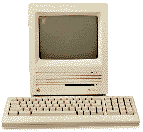 these also provided for memory expansion
beyond 4 MB. Prices ranged from $250 to $1,100.
these also provided for memory expansion
beyond 4 MB. Prices ranged from $250 to $1,100.
Remember the Mac Classic? It had no expansion slot (neither did the Plus, for that matter), but MacUser found seven third-party accelerators to test. These provided 16-50 MHz CPUs and ranged in price from $550 to $1,100.
The SE/30 was the first fast compact Mac, starting out with a 16 MHz 68030 CPU. It had a 68030 PDS for expansion and upgrades. Six models were listed, ranging in price from $725 to $1,600 and in performance from 33 to 50 MHz. The fastest was the 50 MHz DayStar PowerCache; the best value was DayStar's 33 MHz model.
Not counting a replacement motherboard, there were eight upgrades listed for the Macintosh LC. The performance champion was the Fusion Data TokaMac LC with a 25 MHz 68040 and a $1,600 price tag. Other upgrades ranged in price from $675 to $1,450.
Upgrades for the LC II were more limited; MacUser only lists six models. The bargain entry was the Total Systems Enterprise 030 with a 32 MHz 68030 for $675; the fastest and most expensive was the DayStar Universal PowerCache with a 50 MHz 68030 at $1,450.
For both LC and LC II owners, Apple offered a $599 upgrade to the LC III motherboard, which made the 33 MHz third-party accelerators less attractive.
The first modular Mac, the Mac II, had a 16 MHz 68020 CPU and 16 MHz 68881 FPU from the factory. Accelerators ranged from 32 MHz 68030 through 50 MHz 68030 - and then into the '040 range. The fastest accelerator tested was the 33 MHz Radius Rocket, which sold for $2,225. (Intrigued? Click here for a deal on 40 MHz Rockets.)
There were several options for the Mac IIcx, including IIci and Quadra 700 motherboard upgrades. MacUser again found the 33 MHz Radius Rocket the fastest accelerator.
The Mac IIsi sat between the LC and IIci in features and size. It had a 68030 PDS, and MacUser found nine accelerators for it. Their bottom line pick was the Logica LogiCache with a 50 MHz 68030 for $1,050.
The IIci, which replace the IIcx in September 1989, has 13 upgrade options, including a Quadra 700 motherboard. Again, the Radius Rocket won the speed crown, but the same Logica LogiCache picked for the IIsi won the value prize.
The undisputed king of the Mac II line was the Mac IIfx, which started life with a 40 MHz 68030 CPU and a $10,000 price tag. It was just three years old when this issue was published, and MacUser found only three accelerators for it: two from Applied Engineering (25 and 33 MHz 68040) and one from Fusion Data (a 33 MHz 68040). The cheapest was $1,825, and the fastest sold for $2,900.
It's too bad the Radius Rocket wasn't compatible with the IIfx back then. I've run three of the newer 40 MHz Rockets in my IIfx and been very impressed. (To pick up 40 MHz Rockets for US$40, click here.)
Breaking the Bottlenecks
Fast computer, slow screen? Slow scrolling? Slow loading?
This article looks at different ways to speed up the computing experience.
Max Out Your Memory
You can't have too much memory. My Centris 610 with 4 MB was fast, but virtual memory made it absolutely crawl. Upgrading to 8 MB, and later to 12, really helped things along. MacUser recommended a minimum of 8 MB if you wanted to have more than one program open at a time. (Today, we recommend nothing less than 128 MB for really decent performance under Mac OS 9 or later.
MacUser also considered memory "fairly inexpensive" by 1993 standards. That meant Memory and More was selling 4 MB SIMMs for $115 per stick and 16 meggers for $489 each. (I recently put a pair of 256 MB modules in my TiBook for under $180.)
The Cache Advantage
A RAM cache, now commonly called a Level 2 cache, can boost performance. With a cache card, the Mac IIci was 10-55% faster, depending on exactly what was being measured. The IIfx was so fast in part because of a 40 MHz CPU and in part because the 32 KB cache was built in.
Quadras could be upgraded with 128 MB caches, which are sometimes still available today. They were an inexpensive alternative to accelerators when all you needed was a bit more speed. (Today's Macs include 256 KB, 512 KB, and 1 MB caches to optimize performance.)
Quicker Draw
Really want to see some speed on your screen? Upgrade the video with an accelerated video card. The recently discontinued Apple Display Card 8•24GC was mentioned as the only card to speed up all QuickDraw routines. For more on accelerated video cards, see our Guide to NuBus Video Cards.
Faster Photoshop
Then as now, Photoshop was one of the most intensive things a Mac could do. Not only could you accelerate your CPU and video, but there were also Photoshop accelerator cards available to speed up some Photoshop function 500-2000%.
Speedier Storage
Newer drives are faster than older drives. Repeat. Newer drives are faster than older drives. It was true in 1987. It was true in 1993. And it remains true in 2001. Newer drives are faster than older drives.
MacUser mentioned SCSI-2 cards and RAID arrays as ways to really tweak drive performance. Today we'd be looking at Ultra66, Ultra100, UltraSCSI, and fast FireWire drives, but the principle is the same. A faster drive makes for a faster computing experience.
Pumped-Up Printing
"Printing is often the slowest part of using a Mac." That's especially true if you're not using a Postscript laser printer, since the Mac has to tell the printer where to put each dot of ink on the page.
3.5-Inch Magento-Optical Drives
Remember these? MacUser tested over two dozen different brands and found the varied greatly in speed and compatibility with each other. MO drives were expensive, slow, fairly archival, and still haven't caught on.
Out on the Internet
This was 1993, so MacUser had to explain. "The Internet is an electronic forum without walls, a place where netters from all around the world can meet in a cyberspace of connected computers to find colleagues and friends, share ideas, exchange E-mail and data, "talk" in real time, log on to remote computers, access vast amounts of public-domain software, and become addicted to a network-based news service called USENET."
Web? What Web? There were newsgroups, but the word "web" doesn't appear once in the entire article.
What's Up? Docks!
A whole article dedicated to dock for the PowerBook Duo? Yep, and it covered docks from Computer Care, Envisio, E-Machines, and RasterOps.
Ads
Microsoft was promoting their upgraded family of programs: Excel 4.0 and Word 5.1 by version, plus PowerPoint, Project, Mail, and Works.
Mobius had a full-page ad for their Mobius 030, which provided 25 or 33 MHz 68030 speed and video support for an external monitor - to a Macintosh SE.
Apple's LaserWriter Pro 630 got a two-page spread and showed itself a better value than the Hewlett Packard LaserJet 4M.
"The latest gains in word processors isn't the Word." WordPerfect for Macintosh.
APS was selling an internal 42 MB hard drive for $185, 85 MB for $229, 127 MB for $329, and 170 MB for $369. Their biggest drive was a 2 GB Fujitsu for $2,399.
Mac Express was selling 4 MB 30-pin SIMMs for $115 and IIfx SIMMs for $117. 16 MB 30-pin SIMMs were $470 and IIfx SIMMs were $495.
About LEM Support Usage Privacy Contact
Follow Low End Mac on Twitter
Join Low End Mac on Facebook
Favorite Sites
MacSurfer
Cult of Mac
Shrine of Apple
MacInTouch
MyAppleMenu
InfoMac
The Mac Observer
Accelerate Your Mac
RetroMacCast
The Vintage Mac Museum
Deal Brothers
DealMac
Mac2Sell
Mac Driver Museum
JAG's House
System 6 Heaven
System 7 Today
the pickle's Low-End Mac FAQ
Affiliates
Amazon.com
The iTunes Store
PC Connection Express
Macgo Blu-ray Player
Parallels Desktop for Mac
eBay