
Blast From the Past
Byte, April 1995
Dan Knight - 2001.02.14
 The more things
change, the more they remain the same. The April 1995 issue of Byte
covered the forthcoming Intel P6 (later known as the
Pentium Pro), a huge 133 MHz processor that drew 20 watts, and the
new PowerPC 603e, a small 100 MHz chip that drew a paltry 3 watts.
The more things
change, the more they remain the same. The April 1995 issue of Byte
covered the forthcoming Intel P6 (later known as the
Pentium Pro), a huge 133 MHz processor that drew 20 watts, and the
new PowerPC 603e, a small 100 MHz chip that drew a paltry 3 watts.
Other features included 30 best notebooks, setting up your own World Wide Web server, and the first Macintosh clones.
Intel's P6
The next generation Pentium was the cover chip for this issue. Tom R. Halfhill wrote a very detailed article looking at the P6 and comparing it with competing chips from AMD, Cyrix, and NexGen.
At this time, the fastest PCs ran 100 MHz Pentiums on a 66 MHz bus. (For those keeping score, the fastest Mac was the 110 MHz Power Mac 8100.) The Pentium Pro's biggest improvement was probably the 256 KB level 2 cache running at CPU speed. Between that and five execution units, a 14-stage superpipeline, out-of-order execution, dynamic branch prediction, and speculative execution, the new CPU promised one-third faster performance than the original Pentium at the same clock speed.
Better yet, the Pentium Pro would start at 133 MHz, giving it about a 70% advantage over the 100 MHz Pentium. Primary competition would come from the AMD K5 and Cyrix M1. The article concludes:
Intel commands such a dominant market share that it's unlikely the P6 will ever be seriously threatened by its rivals . . . But it's now clear that AMD, Cyrix, and NexGen no longer lag four or more years behind Intel with derivative clone designs.
Six years later, the AMD Athlon has unseated the Pentium III as the performance champion in the Wintel world. Intel's latest CPU, the Pentium 4, may sound fast at 1.5 GHz, but the Athlon outperforms it at a lower clock speed. On the low end, the AMD Duron is taking on the Celeron.
Like the innovative Pentium Pro, almost all of today's CPUs have at least a 256 KB level 2 cache running at full CPU speed.
Sidebar: The P7 and Beyond
"Last year, Intel formed a much talked-about partnership with Hewlett-Packard to design a new microprocessor that is expected to appear in 1997 or 1998."
It's 2001, so where is Merced, er, Itanium? (See Itanium or Itanic? for more on our favorite no-show CPU.)
PowerPC 603e
Tom Thompson took at look at two new PowerPC chips, the 602 and 603e. The 602 was intended for embedded applications, not personal computers, so we'll ignore it.
The 603e addressed a serious problem: The original 603's 8 KB two-way data cache was too small to provide good performance when running legacy 680x0 code - which included not only applications, but a good deal of the Mac OS as well. The 16 KB two-way data cache of the 603e solved that problem; the low power consumption paved the way for PowerPC-based PowerBooks.
Benchmarks put a 100 MHz 603e at 120 SPECint92 and 105 SPECfp92. Compare this with 112 SPECint92 and 82 SPECfp92 for a 100 MHz Pentium! (The P6/Pentium Pro was projected at 200 SPECint92 and 113 SPECfp92 at 133 MHz.)
The 603e drew just 3W at 100 MHz, compared with 20W for the thenforthcoming P6. Today the G3 and G4 sip energy (no more than 14W) while Intel's flagship Pentium 4/1.5 GHz requires 55W.
30 No-Compromise Notebooks
With one exception, all these DOS/Windows notebooks had 75 MHz or faster CPUs. Prices ranged from $2,600 to $7,599. The fastest laptops had 90 MHz Pentium processors. Most had 8 MB of memory and 500 MB or larger hard drives.
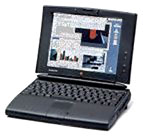 A sidebar looked at "The Cat's
Pajamas: The PowerBook 540c." The
innovative PowerBook had a color screen, a built-in ethernet port, and
ran for 5-1/2 hours on a pair of batteries. Innovative features
included a trackpad, automatically going to sleep when you closed the
lid, and the ability to replace the 33 MHz 68LC040 CPU with a PowerPC
processor when it became available.
A sidebar looked at "The Cat's
Pajamas: The PowerBook 540c." The
innovative PowerBook had a color screen, a built-in ethernet port, and
ran for 5-1/2 hours on a pair of batteries. Innovative features
included a trackpad, automatically going to sleep when you closed the
lid, and the ability to replace the 33 MHz 68LC040 CPU with a PowerPC
processor when it became available.
Using special low-power versions of the Pentium, Wintel laptops have now reached 800 MHz, although they usually run at a lower clock speed (SpeedStep) when using battery power. Apple's $1,500 iBook has a single battery rated at six hours, 64 MB of RAM, and a 10 GB hard drive. The $2,600 to $3,500 PowerBook G4 has a five-hour battery, includes at least 128 MB of memory and a 10 GB hard drive, and can run circles around laptops based on mobile Pentium III processors.
One Box, Two Computers
"With a PC inside it, Apple's DOS Compatible Power Macintosh offers the best of both worlds."
This was Apple's second entry into the world of DOS compatibles; this time it was a Power Mac 6100 with a 66 MHz 486 processor - a big step up from the 25 MHz Quadra 610 DOS Compatible and its 25 MHz 486SX on a card.
This was the age of DOS 6.22 and Windows 3.11; both came with the DOS card, which could accept a whopping 32 MB of memory.
Apple produced one more DOS card, a PCI card that was bundled with the Power Mac 7200. Then Apple got out of that business. Although DOS cards had been part of the Mac scene since 1987, by the end of 2000 Orange Micro, the last to make a Mac DOS card, left the business.
Mac Clones - Finally
More than ten years after the first Mac, the first licensed Mac clones were ready to debut. These included models from Radius (its Power series, based on a modified Power Mac 8100 motherboard), Bridgette (its Quatro series, based on a Centris 650 motherboard), and Power Computing, a brash new startup. The Power Computing clones would be assembled by CompuAdd at the rate of 2,000 to 3,000 per month.
By mid-1996, Radius sold its clone business to Umax, which adopted the SuperMac name for the line. Power Computing went on to become the best known Mac clone maker. Steve Jobs saw it as such a threat that Apple invested $400 million to buy out Power Computing and shut it down. For more on the clone era and its demise, see Apple Squeezes Mac Clones Out of the Market.
I don't know what ever became of Bridgette.
Build Your Own WWW Server
In 1995, a lot of businesses weren't even connected to the Internet. This article explains that serving up HTML pages on the local network can be beneficial. And it explains how to set up a Web server.
Today's Macs come with Personal Web Sharing. The Web is ubiquitous.
Barricading the Net
Following the Web server piece are two articles on firewalls: what they are, why you might want one, and how to set policies.
Perhaps the most interesting part is a sidebar on security policy, which lists four security levels:
- Paranoid: No Internet connection. No outside access.
- Prudent: Everything is blocked unless specifically allowed.
- Permissive: Everything is allowed unless specifically blocked.
- Promiscuous: Everything is allowed; nothing is blocked.
Firewalls and "filtering" are at the center of the access vs. censorship debate. Apple's KidSafe (discontinued later in 2001) takes the prudent approach and limits access to a range of approved sites, blocking access not only to porn, but also to a lot of good material.
Ads
One of the most interesting things about old magazines is looking at the ads. For instance, on page 155 is an ad for a 2x CD-ROM burner from dataDisc, claimed to be the fastest and most reliable on the market.
On page 199 is an ad for "The Worlds First Personal SuperComputer" from BTG. This baby ran a 275 MHz Alpha 21064A processor to achieve 555 MIPS. It also ran Windows NT.
MicroSolutions offered CD-ROM to PC users - their backpack 4x drive could attach to the parallel port every PC had. Their slogan: plug - play.
About LEM Support Usage Privacy Contact
Follow Low End Mac on Twitter
Join Low End Mac on Facebook
Favorite Sites
MacSurfer
Cult of Mac
Shrine of Apple
MacInTouch
MyAppleMenu
InfoMac
The Mac Observer
Accelerate Your Mac
RetroMacCast
The Vintage Mac Museum
Deal Brothers
DealMac
Mac2Sell
Mac Driver Museum
JAG's House
System 6 Heaven
System 7 Today
the pickle's Low-End Mac FAQ
Affiliates
Amazon.com
The iTunes Store
PC Connection Express
Macgo Blu-ray Player
Parallels Desktop for Mac
eBay