
Zis Mac
Alan Zisman on the Mac
Another Hard Drive Disaster Ends Happily (Thanks to Time Machine)
- 2009.10.29 - Tip Jar
Follow Alan Zisman on Twitter.
Back in August, in Computer Disaster Ends Happily, I wrote about how my wife was complaining that her iMac was running very, very slowly. When I took a look at it, I suspected the hard drive needed replacement.
Because it's hard to access the guts of that model, I let my local Mac dealer install a new drive and OS X. The happy-ever-after part, though, was how easy Apple had made it to use the Time Machine backup on an external USB drive and get everything back - but working quicker than ever and with lots more free space on a replacement drive with twice as much room as the original.
Less that three months later, another hard drive failed.
No, not the new drive on my wife's iMac, but the drive on my Unibody MacBook. That machine's only 10 months or so old, but the drive isn't on warranty - I had replaced the original 160 GB hard drive in April with a 500 GB drive sent to me for review by a manufacturer. Besides lots more room, that drive promised speed, running at 7200 rpm compared to the 5400 rpm of the original drive, and it added shock resistance.
Despite the promises, it stopped working with no warning the middle of one day; the Mac wouldn't boot up. I booted to an OS X install disc and ran Disk Utility - it claimed it couldn't repair anything on the drive.
(I'm apparently not the only one with multiple hard drive failures - recently Christina Tynan-Wood wondered on InfoWorld "Have Hard Drives Become Less Reliable?")
When I popped the 500 GB drive into my MacBook, I put the original drive in a drawer - and so I was able to pop it back in. Nicely, the aluminum MacBook makes it very quick and easy to replace the hard drive in less than 5 minutes:
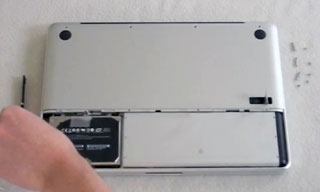 turn the laptop over and flip the switch to
open the cover over the battery
turn the laptop over and flip the switch to
open the cover over the battery- unscrew one little plastic bracket that holds the drive in
- pop out the hard drive and disconnect the SATA connector
- unscrew four little mounts from the drive - plug them into the new drive, reconnect the SATA connector and pop the new drive into place.
- replace the plastic bracket, and put back the battery cover
Easy! Too bad Apple's newer models - the ones with the long-life but unremovable batteries - don't make it this easy.
The drive was just as it had been when I'd replaced it last April - ready to boot up and go, though missing six months worth of data and software updates - making my computer immediately usable, if a bit tight for space compared to what I'd become used to.
(I was able to put the old, failed drive into an external USB case; when I connected it to the MacBook, the system noted that it could read the drive but not write to it and suggested I format it as soon as possible - but this let me access my last six months worth of data. Now that I'm done with it, I've formatted it - it seems to work, but I'm not going to trust it.)
I went to my corner clone PC store - Vancouver is blessed with a large number of small stores that home-build PCs. While they don't deal with Macs directly, now that Apple uses standard RAM, hard drives, and the like, my local shop can provide usable upgrades for my Macs.
It took them a few days to get me another 500 GB laptop drive, but they shared their experience - lots of people, they reported, are having issues with 7200 rpm laptop drives. Their suggestion, which I followed: stick with 5400 rpm drives. Cost of a 5400 rpm 500 GB Toshiba drive: CDN$108 plus tax.
I was able to pick it up after work yesterday. Once again, installing it into the MacBook was quick and easy. From there, I went on to boot to my Mac OS X 10.6 "Snow Leopard" installation DVD and run Disk Utility to initialize the new drive, letting me install OS X onto it. Total time: about 45 minutes.
When the system restarted, it asked if I wanted to restore from another Mac or from a Time Machine backup - before the drive crash, I had been backing up regularly over WiFi to a drive connected to my AirPort base station (see Things You Must Know to When Connecting a USB Hard Drive to AirPort Extreme).
What I had never had to do, though, was actually restore from one of those backups.
Working across a WiFi network was going to be much slower than working with a drive directly connected to my Mac - or even connected by wired networking. (In retrospect, I suppose I could have plugged the MacBook into one of the base station's ethernet ports for better performance.) I don't think the backup created across the network would have been usable if I'd plugged the USB drive directly into my Mac - Time Machine stores backups created across a network differently than those created on a directly connected drive. (If I'm wrong about this, I hope a reader will correct me - I didn't try it to find out.)
But nicely, the Migration Assistant had the option to connect to a networked Time Machine drive - it asked for the name and password for my AirPort Extreme (luckily I knew these!), then showed my backup disk.
To actually access it, I had to know the password for my networked backup disk - again, I knew this one, too.
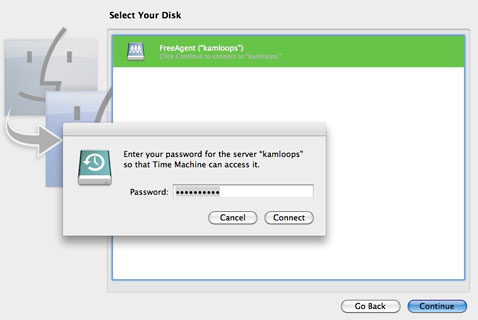
Migration Assistant needs your password to access a remote disk.
After that, it was easy, if not particularly speedy. It took about 5 minutes for the software to identify what was available - user accounts (and associated documents, etc.), applications, settings, and "other" - much of the time, I think, is in adding up the space required for all the various sets of files, especially since Time Machine keeps multiple copies as the system evolves over time.
It's not granular - you can choose to restore Applications, for instance, but not which applications you want to restore. Note: I did all this the first time my MacBook restarted with the new hard drive and its fresh Snow Leopard installation, but you can use the Migration Assistant (in the Applications/Utilities folder) to do the same thing at any time.
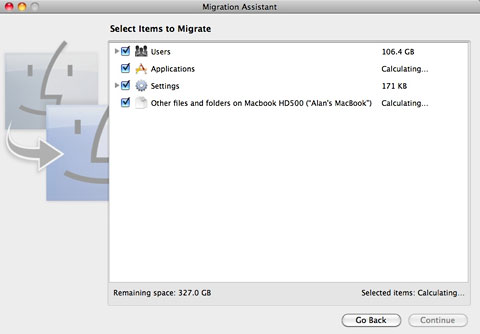
Migration Assistant lets you choose which users and settings to
restore.
Like I said, not particularly speedy. About 100 GB of documents, music, videos, and such, another 17 GB of applications. Settings and "other", a mere trifle. First estimate - about 8 hours to install. Soon it was claiming 11 or 12 hours. I went out for the evening and came back with it promising just 4 more hours, so I went to bed.
When I woke up, it was done - just the way everything had been the day before the crash five days earlier.
But to the guy who emailed me after last June's article about connecting a USB hard disk to an AirPort Extreme base station, I now know that you can restore a drive backed up that way. I learned the hard way. But thanks to good design on Apple's part, it wasn't too hard.
Still, I hope I don't have to do it too often.

Join us on Facebook, follow us on Twitter or Google+, or subscribe to our RSS news feed
Alan Zisman is Mac-using teacher and technology writer based in Vancouver, BC, Canada. Many of his articles are available on his website, www.zisman.ca. If you find Alan's articles helpful, please consider making a donation to his tip jar.
Today's Links
- Mac of the Day: PowerBook 500 Series, introduced 1994.05.16. 'Blackbird' includes a 25 to 33 MHz 68040 along with smart batteries and grayscale or color displays.
- Support Low End Mac
Recent Content
About LEM Support Usage Privacy Contact
Follow Low End Mac on Twitter
Join Low End Mac on Facebook
Favorite Sites
MacSurfer
Cult of Mac
Shrine of Apple
MacInTouch
MyAppleMenu
InfoMac
The Mac Observer
Accelerate Your Mac
RetroMacCast
The Vintage Mac Museum
Deal Brothers
DealMac
Mac2Sell
Mac Driver Museum
JAG's House
System 6 Heaven
System 7 Today
the pickle's Low-End Mac FAQ
Affiliates
Amazon.com
The iTunes Store
PC Connection Express
Macgo Blu-ray Player
Parallels Desktop for Mac
eBay