
Welcome to Macintosh
A Talk with Macworld
Macworld's Jason Snell on Apple's Fervor for Great Products
- 2007.08.21
Bong! . . . :-) . . . Welcome to Macintosh!
When the Macintosh was released in 1984, it quickly developed a following by consumers and professionals alike. Of the written publications devoted to the Macintosh over the years, only one has always been regarded as the source for all things Macintosh. That, of course, is Macworld magazine.
 In a new
series on Welcome to Macintosh called "A Talk with Macworld", I'll
be interviewing most of the Macworld editorial staff. And what
better way to start out than with the VP and Editorial Director,
Jason Snell:
In a new
series on Welcome to Macintosh called "A Talk with Macworld", I'll
be interviewing most of the Macworld editorial staff. And what
better way to start out than with the VP and Editorial Director,
Jason Snell:
Tommy: What drew you to Apple and the Mac?
Jason: I actually got an Apple IIe when I was in high school, so I've been an Apple user since 1984. When I was a sophomore in college I started working at my college newspaper, which had just transitioned from physical paste-up to a system where we wrote in Word and designed the paper in PageMaker. We were using a bunch of Mac SEs (with Radius full-page displays) and fought over the one Mac IIcx with the two-page display.
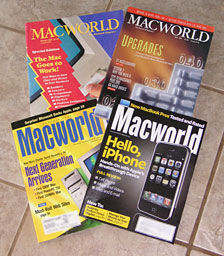
Macworld in 1986, 1991, 1997, and 2007
Anyway, I found myself coming in and using the Macs in the office more and more, to the point that I basically didn't use my Apple II. So in the spring of 1990, I went to the university bookstore and bought my own Mac SE, and that was it. I've been a Mac user ever since.
Tommy: Many people equate words such as eloquent, seductive, even wow, to describe Apple and their products. How would you describe them?
Jason: Apple is a company devoted to using high technology to build products for regular people to use, to solve the problems of regular nontechnical people living their regular lives. That would seem to be simple and obvious, but very few companies do this. Most tech companies are driven by what technologies exist, not by how the lives of regular people could be improved or made easier via the technology.
Apple has a fervor, a belief that a good product should be a pleasure to use.
The end result is that most technology products are complicated and lousy. People use them, sure, but only reluctantly. Apple has a fervor, a belief that a good product should be a pleasure to use. It goes a long way toward explaining why the users of Apple's products feel an emotional attachment to them, while the users of many lesser tech products feel an animosity or, at best, a begrudging acceptance.
Tommy: Each person working at Macworld has a story to tell of how they found themselves there. What lured you?
Jason: I started as an editorial intern at MacUser, back in the day. I was a big Mac fan and was the teaching assistant in grad school for a MacUser editor. I convinced her to let me be a summer intern, they hired me on a few months later, and the rest is history. I came over to Macworld in 1997 as a part of MacUser-Macworld merger.
Tommy: One can only imagine how cool it is to work for Macworld. What's the best part of your job?
It's a huge amount of fun to be able to try this stuff out for a living.
Jason: Tough question. So many things to choose from, but overall I'd just say that we get to play in the toy store. We are paid to spend our time trying out the latest new technology from Apple and other tech companies. This is something that many Mac users - including many of us, let's face it - would probably do on our own anyway. It's a huge amount of fun to be able to try this stuff out for a living.
Tommy: What's the worst part of working for Macworld?
Jason: It's a lot of hard work. We're a relatively small staff, and we're putting out a monthly magazine, posting something like 15 stories per day to Macworld.com, running several other websites, publishing e-Books . . . we all work pretty hard.
Tommy: What does Macworld bring to the table in the modern Mac age when compared to other publications?
Jason: In terms of the competition, I guess what we bring to the table is the largest group of editors and writers devoted to covering Apple and the Mac anywhere on the planet. The result is the leading Mac magazine in the US and a website that covers the Mac more broadly (news, reviews, opinion, podcasts and videos, feature stories, message boards) than any single other Mac website.
Tommy: Your opinion of Microsoft: How do you feel about them, past and present?
Jason: I have great respect for the people at Microsoft's Mac Business Unit. I have used Microsoft Word almost every day since the fall of 1989. (Although to be fair, I write almost everything in BBEdit these days.) Their Mac products are good, especially considering that it's very hard to make any radical changes to a product with that much of an installed base.
As for Microsoft in general, my feelings are much more ambivalent. I don't think, in general, it does a very good job with its products. It has all the money in the world, yet Apple's operating system development team has run rings around it. With Zune, I thought we might finally see Microsoft figure out how to give Apple a run for its money, but the Zune has been nothing but a reinforcement of the general opinion of Microsoft: Their products come later and aren't as good.
...Microsoft as a company has completely lost its way.
Frankly, the travesty of the Longhorn/Vista launch - the fact that it became so delayed and lost so many of its "core" features before it even shipped - convinces me that Microsoft as a company has completely lost its way. At this point if I had to predict, I'd say that Microsoft will still be in business 20 years from now (sheerly from the volume of PCs who use Windows and Office), but over time it will wane in importance. And in 2020 or 2025 we'll be amazed that Microsoft used to be so big and important, sort of like IBM or Digital.
I will say this: Microsoft was really smart to buy Bungie Studios. I bought an XBox (and will probably buy an XBox 360) because of the Halo series. And all those years inside the beast hasn't diminished the quality of the work Bungie does, bless 'em.
Tommy: Has Windows improved and become more innovative over the years or not so much? Your thoughts?
Jason: Better, absolutely. More innovative, sure. I do feel that Microsoft is actually trying to innovate now. They see themselves as innovators. I think they're generally wrong, but I do believe they see themselves that way.
Tommy: What's the greatest thing about Apple nowadays?
Jason: They're taking everything that made the Mac such a great product - the design philosophy and even some of the technology - and going full-bore into consumer electronics. The iPod was the first example, but there's more to come. The iPod's success shows that Apple's approach really can be a success when it comes to CE.
Tommy: What do you see as the future of the Mac, the future of Apple as a company?
Jason: Apple's going to expand its offerings, bringing high-tech products with innovative physical designs and user-interfaces to regular people, in ways that regular people will actually appreciate.
Tommy: What are your favorite commercial, shareware, and freeware apps for OS X?
Jason: Commercial: BBEdit, LaunchBar, Parallels, DragThing, VisualHub. Bundled: Safari, iCal, iChat. Other: MenuCalendarClock, HandBrake, Google Earth.
Tommy: The iPod: How will it evolve in the upcoming years?
Jason: I think there will still be standalone iPods, but they'll look more like the iPhone. The iPhone design will probably influence numerous similar products, the most obvious one being a hard-drive-based, video-playing, touchscreen-style iPod. It's only a matter of when.
The future of the shuffle is interesting. I think at some point the shuffle's going to become embedded in a pair of Apple earbuds.
Tommy: Do you agree with some columnist's opinions on Apple becoming, in effect, this generation's Sony? Is there a parallel?
Jason: I've touched on this already, but to restate: I think Apple has always been about bringing high tech stuff to regular people in the real world. The whole "Computer for the Rest of Us" philosophy - it's still what drives Apple. It's in Apple's DNA. And it turns out that the perfect place for Apple to exercise that philosophy is in the consumer electronics market.
So there's some Sony parallel, but it's not a direct parallel.
Tommy: Will Apple dominate the living room?
Jason: Will Apple be a player in the living room? Yes, But domination is such a strong word. And the realities of cable and satellite companies, and their control over their set-top boxes, will make it impossible for Apple to be dominant in the next five years.
Tommy: Will the iPhone do for the cell phone industry what the iPod has done for the MP3 player industry?
Jason: Well, that depends on what you think the iPod has done for the music player industry. The iPod came into a weak market populated by lousy products nobody wanted, and turned it into a huge category that it dominates.
The phone market is different. It's not a weak market. And I don't think the iPhone is going to have iPod levels of market share. But I do think that the iPhone will have a transformative effect on the phone market, in the sense that it will force the makers of other phones to really rethink what they're doing with their products. I'm sure there are some more consumer-focused interface designers and hardware designers at Nokia that are very excited about the iPhone, because the iPhone's presence will give them more to innovate in response.
Tommy: What would you like to see Apple do differently, if anything?
Jason: They should tell me about the products they're going to announce in advance - under NDA, of course - so that I can have more time to think about them and write about them before the announcements are made. That would sure be swell.
Tommy: What do you want those who read this article to know about Macworld they may not already know?
Jason: We all use Macs and love Macs, most of us for more than a decade. And that we're a pretty friendly, casual workplace - sometimes I think people believe we're wearing silver jumpsuits and working in mahogany-covered offices in high-rise buildings somewhere. Or that we're all Silicon Valley people who hang out next to the Apple campus and tool around in our Porsches. The fact is, we're on the fifth floor of an office building in San Francisco, fairly close to the ballpark. Most of us are in our 30s. And very, very few of us drive luxury cars or wear silver jumpsuits.
Tommy: Will the Mac's market share grow looking down the road?
Jason: Yes. Maybe not to massive proportions, but I do believe that the Mac will continue to grow in popularity, now that it can claim Windows compatibility as well.
Tommy: Your thoughts on Linux and the open source movement? Will it help or hurt Apple?
Jason: It's already helped Apple massively. Mac OS X would not be possible were it not for the open source movement, because so much of OS X is based on open source. To its credit, Apple has gotten very good at taking advantage of open source software to improve its products. Microsoft hasn't, largely because its management knows that locking people into its proprietary systems is the best way to keep those customers from abandoning Microsoft's products.
Tommy: What kind of Mac horsepower gets put to use in the offices of Macworld?
Jason: Well, we buy at least one of everything so we can test it. We generally stay pretty current. A bunch of editors got Mac Pros a couple months back. Most of us are using laptops these days, though - a bunch of MacBook Pros and MacBooks. I've got a dual 2 GHz Core 2 Duo MacBook (in black) as my main system these days.
It's great to have the latest(ish) hardware, but it's also necessary for us. It'd be hard to write about Intel Macs if we were still using PowerPC Macs! Same for software. We'll upgrade to Leopard immediately, because there's no other way for us to write about Leopard. We've got to use it.
Tommy: Each of you no doubt has a Mac you use at home and/or on the road. What's yours?
Jason: So my work system, which I also take home every night, is the aforementioned top-of-the-line Core 2 Duo MacBook. I've also got a dual 2 GHz Power Mac G5 at home.
Tommy: What's the funniest thing that's happened to you in your time at Macworld?
Jason: I don't know if this counts as funny, but once in a press conference I asked Steve Jobs if AppleScript would make it into OS X. His response was, "Of course," which was frankly news to me. And I heard rumblings later that it was actually news to some of the other people who were working on AppleScript at Apple. I had no idea that so many people were waiting for the answer to that question! ;-)
Tommy: The future of Macworld - how do you see it evolving?
Jason: More on the Web. More multimedia, audio and video. Modifying the magazine over time to reflect the changes in how people will use a print magazine in a Web-connected era. Getting everyone to stop referring to Macworld as a magazine and start thinking of it as the trifecta: website, magazine, and trade show.
Tommy: Thanks, Jason!
Stay tuned for the next installment when I interview Peter Cohen, senior editor and Game Room columnist.
If you have any thoughts, feel free to drop me a line at thomas
(at) lowendmac (dot) com. 
Join us on Facebook, follow us on Twitter or Google+, or subscribe to our RSS news feed
Today's Links
- Mac of the Day: PowerBook 500 Series, introduced 1994.05.16. 'Blackbird' includes a 25 to 33 MHz 68040 along with smart batteries and grayscale or color displays.
- Support Low End Mac
Recent Content
About LEM Support Usage Privacy Contact
Follow Low End Mac on Twitter
Join Low End Mac on Facebook
Favorite Sites
MacSurfer
Cult of Mac
Shrine of Apple
MacInTouch
MyAppleMenu
InfoMac
The Mac Observer
Accelerate Your Mac
RetroMacCast
The Vintage Mac Museum
Deal Brothers
DealMac
Mac2Sell
Mac Driver Museum
JAG's House
System 6 Heaven
System 7 Today
the pickle's Low-End Mac FAQ
Affiliates
Amazon.com
The iTunes Store
PC Connection Express
Macgo Blu-ray Player
Parallels Desktop for Mac
eBay