
Bong! . . . 🙂 . . . Welcome to Macintosh! For this article, I decided to take a little detour and write about what’s become of computers and computing in the modern age. This was a little rant I wrote up earlier this year in the hopes that one day I’d be able to share it.
While the article isn’t really Mac-specific, I’m sure what it contains will bring an Amen or two from many Low End Mac readers and fans of older computers out there!
In this modern age of computing with flash drives, mega loads of memory, and the Internet, things have somehow gotten more complicated along the way. We’ve gotten accustomed to using word processors that takes up one-third to one-half gig of hard drive space. We’ve gotten caught up in having to have the latest and greatest. Anything less than a 3 GHz processor, a gig of RAM, and a 100 gig hard drive is unacceptable.
We replace computers every one or two years because they’re “old”. Many people won’t keep a computer longer than a couple of years, because in their mind it’s “obsolete”.
‘It’s Obsolete’
Just what is “obsolete”? To most people, it’s when the computer gives one problem and when it can’t load the Internet in less than a second.
When I was your age, we didn’t have all this fancy stuff you see on computers nowadays! We had Apple IIs, DOS, and kilobytes of RAM – and we didn’t need no stinkin’ hard drive!
At first we had cassette recorders, and later on came floppy drives. And Winders? The only Windows we saw were the ones we looked out of.
But lemme tell ya something, those were the good ol’ days of computers! You better believe we were dang proud to have what we did! And if Grandpa were still alive, he’d tell you about ENIAC with its huge vacuum tubes….
Home Computing Circa 1993
My first experience with a computer in the home came back in 1993. At that time, I got in on the tail end of the old school of computing. Back when there was no such thing as an iPod or an MP3 player. Back when hard drives had only been out for a few years and were just barely pushing the 100 MB mark. Back when 2 MB of RAM would take you anywhere, and you were really something if you had 4 MB. Back when the 386 was on it’s way out and 486s were king. Back when 5.25″ floppy drives were starting to fade away, CD-ROM drives took their place, and 3.5″ floppy drives were commonplace. Back when 2400 bps modems were standard fare and 9600 bps modems were coming into play. Back when the Internet was considered a “feature” of commercial online services. Back when commercial online services and BBSes (Bulletin Board Services) were king, and that’s how you got your information. Back when DOS started it’s long, slow phasing out process. Back when Windows started growing in popularity with version 3.1, which would eventually catapult Microsoft to the monopoly it is today. Back when . . . <sigh>
Back then things were limited, but you were more creative. If you were a programmer, you had to think about what you were programming and focus on making the best possible program you could within the system’s limitations.
When you were using the computer, there were times that you had to watch out and not load too many programs at the same time because of limited memory, but the beauty is, you could concentrate on what you were doing and your mind didn’t go in 20 different directions like it does today.
Online services and BBSes offered true value, because they offered great content and great topics of interest. Yes, even within the limits of older computers, you could still do great things.
Way Back When…
I can go back even farther than that. I remember the first computer I ever worked with was an Apple IIe when I was five years old. No hard drive, dual 5.25″ floppy drives, and a green screen (later color). You typically had 48 or 64 KB (yes, that’s kilobytes, not megabytes) of memory.
To load a program on the Apple IIe, you didn’t double-click on anything (there wasn’t even a mouse!). You put the floppy disk in the drive, booted the machine, and then listened for the cluck, cluck, cluck of the floppy drive as it started your program. You were never to take the disk out while the red read/write light was on or it would damage the disk.
I’ll tell you, though, while waiting for the program to load, in my mind it was like riding in a car just about a minute away from arriving at your destination. And all the while, you’re anxiously awaiting what’s around the next turn on the way to getting there.
Change
Things have changed many times over. Everything’s instant. The floppy drive is on it’s last leg as it’s being phased out in the PC industry (Macs started to lose them in 1998). CD and DVD burners as well as USB flash drives have taken the floppy drive’s place.
We’re now past the 3 GHz mark in CPU speed, and the latest processors have dual cores. Nowadays, the minimum RAM requirement is 256 MB or even 512 MB, and the sweet spot is 1 GB.
There are still traditional phone modems, but dialup is being abandoned in favor of DSL and cable modem Internet access, which can provide information instantly.
Hard drives that come with even low-end computers are often over the 200 GB mark, and hard drives you buy separately are over 300 GB.
Online services have all but disappeared. Sadly, Apple’s eWorld died in 1996, only having been around for two years. Prodigy and GEnie both died in 1999. AOL and CompuServe are still around, but CompuServe was bought by AOL in 1998 and was turned into a regular ISP (Internet Service Provider). (I should take the time to mention that I’m a SysOp for three forums on CompuServe.) AOL is transitioning to become an ISP. BBSes are still around, but the number of them is dwindling every year.
The Internet offers more content, and some of it is of the same quality that the online services once provided, but it’s not nearly as centralized and easy to find. In a lot of ways the community atmosphere has all but ceased since the Internet became the de facto standard. In other words, it’s every man for himself on the “information superhighway”.
Somewhere along the way, while the train of progress forged ahead, we left behind the simpler times. We’ve forgotten what it’s like to be content with what we have.
These days, when you buy a new word processor, or an Office suite, you need at least a half gig of hard drive space and at least 256 MB of RAM to even run it! Word processors, as well as most software today are way too bloated. Word processors try to automate everything for you – and most of the time it just gets in your way.
Now, I’m not knocking all of the progress that’s been made. I like the idea of the flash drive because it’s small, dependable, and cheap. I like the idea of the flash-based MP3 player, as it has no moving parts to jostle around (unlike a hard drive based MP3 player). I figure that sometime in the future, the flash drive will completely replace hard drives.
I like the fact we can make our own CDs. It’s good for music, pictures, video, and backup.
Some of the changes we’re seeing are for the better.
I guess what I’m getting at is this: Do you remember the last time you took a Sunday drive in your car? Hardly any cars on the highway. You can take your time and enjoy driving. You can see the scenery, feel the power under the hood, and not have to worry about getting run over in a mess of traffic. In other words, taking a Sunday drive is a pleasure, instead of it being a chore.
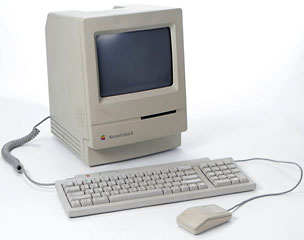 As I sit here typing this article on my old, but lovable, dependable and simple Macintosh Classic II from 1991, I can take my time and just enjoy the “Sunday drive”. The fan is a little noisy, it doesn’t have an MP3 player or a CD burner, it doesn’t have GHz processing, a load of RAM, or lots of hard drive space, but that’s okay with me.
It hums along on it’s 16 MHz 68030 Motorola processor, with 4 MB of RAM, a floppy drive, and a 500 MB hard drive. (I had been using a 40 MB hard drive, which I was perfectly content with. This 500 MB hard drive was given to me by my best friend, Sean – to borrow a phrase from one of my favorite comedians Lewis Grizzard, “A great American.”)
My black and white Classic II can even get on the Internet for a “Sunday drive” at 28.8 kbps using an external modem if I so choose.
It’s like a VW Beetle: It’s small, and it’s old, but it has a fun factor to it. The Classic II has a built-in 9″ black and white screen (the whole computer is in an all in one case) and can even speak what you type and read aloud emails you receive. Yes, my ‘lil Mac Classic II does what I want, even within it’s limitations. It’s a fun computer despite the fact that most people would consider it “obsolete” or “ancient” today.
Somehow, we need to get back to simpler machines like my ‘lil Classic II. Then maybe we all could take a Sunday drive! 🙂
Sadly, I received no new stories on how reader’s first joined the Apple world. If you’d like to have your story featured in an upcoming Welcome to Macintosh column, email it to thomas (at) lowendmac (dot) com.
Short link: https://goo.gl/9ABZfl
