
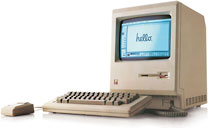
1997 – Surprising to many, the first Macs didn’t have SCSI. The Apple design team created a compact, closed box with a disk drive, CPU, monitor, 128 KB of RAM, keyboard and mouse ports, a floppy drive port, and two serial ports. The serial ports were the secret – they could support a 230.4 Kbps network and be used for system expansion. Apple called the latter their high speed serial bus. It never caught on as a general purpose expansion bus.
SCSI
In 1986, Apple released the Mac Plus. Not only did it come with 1 MB of RAM (expandable to 4 MB!), there was a new hard drive connector called SCSI. This was far, far faster than the older serial hard drive. And SCSI allowed adding one, two – up to seven – devices to the Mac in a single chain.
Over time Apple improved its SCSI implementation. The Mac Plus topped out at 2,104 Kbps, but the 1987 Mac II and Mac SE offered improved throughput of 11,200 Kbps and 5,248 Kbps, respectively. Over the years, both Apple and third-party vendors offered Fast SCSI, Wide SCSI, Fast-Wide SCSI, and Ultra-SCSI.
However, SCSI is running out of steam in the era of digital video. For a more detailed overview of SCSI, read SCSI Throughput.
ADB
With the Mac II and SE, Apple eliminated the dedicated keyboard and mouse connectors of the past for a new peripheral bus that Apple had introduced with the Apple IIGS in September 1986. Like SCSI, you can daisy-chain devices using ADB (Apple Desktop Bus). The earliest ADB Macs came with two ports, although Apple sometimes reduced that to one.
- Time to make a personal plug for the MicroSpeed KB101M keyboard. Not only does it provide identical layout to Apple’s Extended Keyboard with superior components to the current keyboard, but it has 4 ADB ports. One ties the keyboard to the computer; others can be used for a mouse, a trackball, or some other ADB device. Highly recommended.
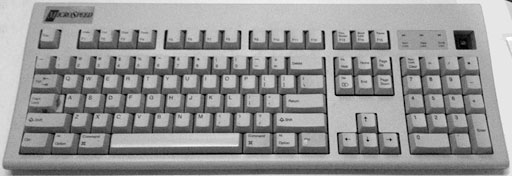
For a time, ADB was so cool that one company (Global Village, if I recall correctly) made an ADB modem. There was enough bandwidth to comfortably support 2400 bps. But over time the 10 Kbps throughput of ADB became a bottleneck. It was enough for a mouse or keyboard, but it was insufficient for touch tablets and faster modems.
FireWire
The next hot technology from Apple is IEEE 1394, commonly known as FireWire. Faster and more flexible than SCSI, FireWire offers several advantages.
- 100 Mbps minimum bandwidth, with 400 Mbsp available today and 1 Gbps expected by 2000
- devices automatically negotiate the fastest mutually supported data transfer speed
- capable of supporting 63 devices (vs. SCSI’s seven)
- can be used between computers, not just peripherals (FireWire speed should put 100 Mbps ethernet to shame)
- devices can be hot plugged, eliminating need to power down CPU and peripherals
- high speed serial protocol requires just 6 wires, allowing small connectors and thin, flexible cabling
- can provide up to 60 watts of power to peripherals, often eliminating need for separate power
- auto configuration eliminates the need to set device IDs
Sony has already adopted FireWire on its digital video cameras, which it calls i.Link. Musicians are discovering FireWire as an option for wiring together electronic instruments, making it a replacement for MIDI.
For hard drives, digital video, high speed networking, and scanning, FireWire will eventually supplant SCSI.
USB, the Universal Serial Bus
This standard came from the other side of the tracks, Microsoft and Intel. USB has become common in the Wintel world and it could soon become the de facto keyboard and mouse port.* But with a bandwidth of 12 Mbps and typical speeds of 6-8 Mbps, it’s also fast enough for digital audio and modems. It is especially in the latter realm that USB is promising.
Mac serial ports have limited throughput, especially if LocalTalk is active (see Macintosh Serial Throughput). With DSL and cable modems just around the corner promising 1 Mbps and higher throughput, we need another way to connect them. One option is the 10 Mbps ethernet port. Another is using a PCI-based modem on a card, just like the Wintel world has done for years with internal modems.
USB provides sufficient throughput for ADSL and cable modems. It should be much less expensive to implement than FireWire, especially if it replaces ADB for mouse and keyboard connections.
For more on USB, read USB, Adequate at the Low End.
The Future
While SCSI and ADB were adequate a few years ago, they are showing their age. Over the coming years, expect FireWire and USB (or some similar technology) to replace both.
Further Reading
- Introduction to FireWire, Low End Mac Tech Journal
- Termination Explained, Low End Mac Tech Journal
- SCSI History, Low End Mac Tech Journal
- SCSI Termination Power, Low End Mac Tech Journal
- SCSI Throughput, Low End Mac Tech Journal
- USB cPort Speed Compared to Other ports, Mac Speed Zone
* USB didn’t take off in the PC world, which stuck with the PS/2 mouse and keyboard connectors for many more years. The iMac, unveiled in 1998, only had USB and included a USB mouse and USB keyboard. This was the beginning of the end for ADB.
Keywords: #usb #firewire #adb #appledesktopbox #scsi
Short link: https://goo.gl/AEVrJX
