
2000 – It’s a common question on our Compact Macs email list: Can I use an SE card in the SE/30? The short answer is no. This article provides the long answer.
No Slots
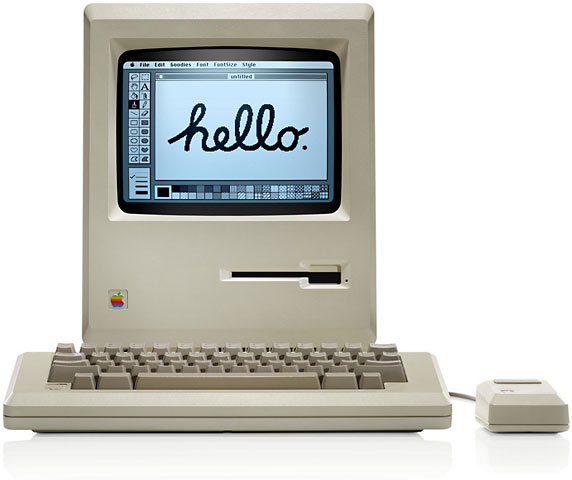 The Jobsian ideal was achieved with the first four Macs. Each was a compact beige computer with virtually no possibility for internal expansion. The lone exception was the Mac Plus, which could be upgraded from 1 MB of memory – all the way to a mind-numbing 4 MB (remember, this was the era of the 640 KB limit on DOS computers).
Of course, you have to remember the timeline here. The Mac 128K was announced in January 1984 (with the infamous Big Brother ad on the Super Bowl) and Apple introduced the Mac 512K that August, when higher capacity memory chips became affordable.
Steve Jobs left Apple in September 1985. He had always maintained that the computer should be a sealed box; hence, models produced during his tenure had no internal upgrades.
Come January 1986, Apple introduced the first expandable Mac. The Plus had a SCSI port for attaching a fast external hard drive and used memory SIMMs, which made RAM upgrades fairly easy.
Apple was breaking from the Jobsian ideal.
The First Slots
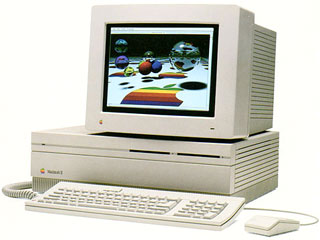 In March 1987, they shattered it. Not only did the Mac II look more like a PC than the early Macs, it had six NuBus expansion slots and no internal monitor. Even the new compact model, the SE, had an expansion slot – it was the first Macintosh with a Processor Direct Slot (PDS).
The central processing unit (CPU) in a computer has a certain number of connections to the system board. By creating a slot that duplicates each of these, it is as though the card were directly connected to the processor. This explains the name processor direct slot.
The 8 MHz Motorola 68000 used in the SE called for an 8 MHz processor direct slot. The SE was the only Mac to use the 68000 PDS.
The next Mac with a PDS was the SE/30, a compact Mac that shared the SE’s case but pumped to the beat of a 16 MHz 68030 CPU. Because the 68030 had more connections than the 68000, the 68030 PDS was born in January 1989 with more pins. That’s why SE and SE/30 cards are not interchangeable.
That September, Apple introduced the Macintosh IIci, a 25 MHz workhorse. The first use of the 68030 PDS in the IIci was for a 32 KB Level 2 (L2) cache, which used fast static memory that the CPU could access much more quickly than memory on the system board. (Except for the size of the cache, little has changed since then.) The 68030 PDS in the IIci would later accept lighting fast 68030, 68040, and even PowerPC upgrades.
Apple got a lot of use out of the 68030 PDS. The one in the SE/30 ran at 16 MHz, the one in the IIci at 25 MHz, the one in the IIsi (Oct. 1990) at 20 MHz, and the one in the IIfx (March 1990) at a blistering 40 MHz. Except for bus speed, these were electrically identical, so it was often the case that the same card would work in the SE/30, IIsi, and IIci.
- If 40 MHz doesn’t sound fast, remember that it was only two years ago that Apple sold the Power Mac 6500 with a 40 MHz system bus.
The Third PDS
 In October 1990, Apple introduced three new computers. The 8 MHz 68000-based Classic displaced the Mac Plus and SE, the 20 MHz IIsi provided a slower, less costly alternative to the IIci, and the 16 MHz LC sat between them.
I have long believed that Apple made too many compromises in the design of the LC so it could keep the price down and keep it from competing with the IIsi. These included using the 68020 CPU that had been retired with the original Mac II in September 1988, putting that 32-bit processor on a 16-bit data bus, and forever limiting memory expansion to 10 MB. The LC was the oldest Macintosh to merit the label Road Apple.
 To match the 16-bit data bus of the LC, Apple created the LC PDS, which matched neither the 68000 PDS nor the 68030 PDS. This slot was later used in the LC II and Color Classic, both of which used a 16 MHz 68030 CPU.
Going a step further, Apple adapted this to the 25 MHz LC III, which ran a 68030 on a 32-bit data bus. The LC III could accept 16-bit 16 MHz cards, but it also has an extra set of connectors for 25 MHz 32-bit cards. Outside of accelerator cards, enhanced LC PDS cards were relatively rare – it was easier for manufacturers to make just one LC PDS card that would work in all models.
Besides the LC III, the enhanced LC PDS can be found in the Colour Classic II, the Quadra 605 (LC 475, Performa 475), and the 630 series (sold as Quadra, Performa, and LC models). Finally, the enhanced LC PDS made one last appearance in the x200 series of Performas and Power Macs. (For more on these, see our Road Apples report.)
1, 2, 3, Quadra
Of course the Quadra line, based on a different processor, had its own processor direct slot. The Quadra PDS ran between 20 MHz (in the Centris 610) and 33 MHz (in the Quadra 650, 800, and 950) depending on the speed of the CPU.
Apple used a similar PDS in the first generation Power Macs. With an adapter, the 601 PDS matched the 68040 PDS, allowing the use of the same DOS cards in both series of computers. For instance, Apple’s card for the Quadra 610 DOS Compatible fits in the 6100, just as the card designed for the Power Mac 6100 DOS Compatible fits in the Quadra 610.
Of course, the PDS card ran at system bus speed on the Power Macs, not CPU speed, making the connection a little less than direct. (First generation Power Macs had a maximum bus speed of 40 MHz, just like the Quadra 840av and the far earlier Mac IIfx.)
Good-Bye, PDS
Processors eventually got so fast that Apple decided to dispense with the PDS with the second generation Power Macs. Sure, those x200 models used a slot called the LC PDS, but it really wasn’t anything close to processor direct any longer.
However, there were two places on most of these models that came close to a processor direct slot. On the 7500 and other models (including clones) that accepted a daughter card, the entire CPU could be replaced. This was just the opposite of the earlier scheme; it allows those computers to accept 500 MHz G3, 450 MHz G4, and even dual-processor 400 MHz G4 upgrades today. The bus here was typically 50 MHz, so it was nowhere near the speed of the CPU, but it worked.
The other slot that acts a lot like a PDS is the Level 2 (L2) cache slot on most second-generation Power Macs and many clones. Clever designers have figured out how to replace the cache module with a faster processor – all the way up to the G4 level.
ZIF
Pioneered on the Windows side of the computer world, the Zero Insertion Force (ZIF) socket came to the Mac world with the Umax SuperMac C500 and C600 in November 1996. Although nobody else used the 603e ZIF socket, Phase 5 announced a G4 upgrade for it.
Far more common is the ZIF socket used in the Power Macintosh G3, both Beige and Blue, as well as the Power Mac G4, both Yikes! and Sawtooth versions.
The ZIF socket, like the daughter card, turns the PDS paradigm on its head – it’s how the CPU connects to the system board.
With CPUs running several times faster than the system board, the day of the processor direct slot is behind us. It was a great way to couple a fast card to a fast processor until the 40 MHz mark, but since then CPUs have so outstripped system board speed that the two speeds are essentially decoupled. The same system board can support a 350 or 500 MHz CPU with no changes, so there’s no way to tie any sort of expansion card directly to the CPU’s bus.
And now you know why the SE/30 and SE take different cards – and that Apple shared one PDS between the Quadra and Power Mac families.
Keywords: #macpds #processordirectslot #lcpds #68030pds #68040pds
Short link: https://goo.gl/9BrWEu
searchwords: pds, processordirectslot
