
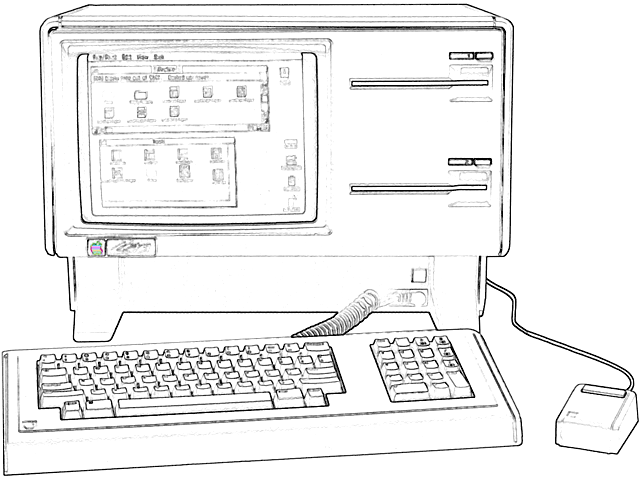
If you think the original Macintosh was an impressive piece of design and engineering, you may find Apple’s Lisa even more innovative.
Software Driven Design
Until Lisa, almost all computers had been designed primarily as hardware devices. (The earlier Xerox Alto and Star were also software driven designs.) They’d have so much memory, so much storage space, so fast a processor, so many registers, and such types of input/output ports. From there it was up to the programmers to design operating systems and software.
The model worked – it gave us the Apple II, Commodores, TRS-80s, CP/M machines, and the IBM Personal Computer. If you build it, the programs will come.
Lisa was engineered to run software; all the hardware decisions were made to support the operating system and applications, a philosophy that would shape the Macintosh – introduced one year later.
The Paper Paradigm
While other computers were screen-oriented, Lisa was page-oriented and used the now-familiar desktop metaphor. To begin a project, you “tore off” a sheet of paper, which showed up on the screen as a white page with black text or graphics. You could work in Lisa Calc, Lisa Graph, Lisa Draw, Lisa Write, Lisa Project, or Lisa List – the same kind of productivity suite we see today, but this software came bundled with the computer.
Thanks to the mouse, you could directly manipulate objects on the screen to resize a box or select a chunk of text. You could even copy items to the clipboard, a Lisa innovation, and paste it into another document – or even another type of document.
The Lisa application suite was a bit like ClarisWorks/AppleWorks, although each module was really a separate program.
Another Lisa breakthrough was the “Undo Last Change” command, something new to personal computers in 1983 – and we all take Undo for granted these days.
The Lisa operating system, unlike DOS and most other personal computer operating systems, allowed the user to run multiple programs at the same time, which is part of the reason the Lisa included an impressive 1 MB of RAM. Cooperative multitasking didn’t come to the Mac until Multifinder was introduced for System 5 in August 1987, and protected memory had to wait for Mac OS X.)
Hardware
To support all this, Apple chose to run the Motorola 68000 microprocessor, the same CPU destined to be used in many early Macs. The 68000 has a linear memory space of 16 MB, far more than DOS computers with their bank-switched 640 KB limit in PC compatible could dream of supporting. For practical reasons (the cost of memory, the size of RAM chips, and the capacity of individual RAM chips in 1983), Lisa included 1 MB and could be upgraded to 2 MB.
Although the 68000 CPU in the Lisa is an 8 MHz chip, Apple underclocked it to 5 MHz to synchronize with video. This allowed the video display and the CPU to alternate access to the 32 KB of memory used to paint 364 rows of 720 pixels on the 12″ black-and-white monitor. A year later, Apple used the same kind of “think different” engineering to run video on the 8 MHz Macintosh.
Like the Power Mac G4 Cube, slot-loading G3 iMacs, and early Macs, the original Lisa had no fan. In the words of Greg Williams, who wrote the profile of Lisa in the February 1983 issue of Byte, “that’s engineering!” The circuit boards inside Lisa were primarily vertical and stood at the back of the case; the expansion slots were also vertical and set behind the floppy drives.
Speaking of floppy drives, the 5.25″ FileWare floppy drives (a.k.a. Twiggy and Apple 871) used in Lisa were unique. While the Apple II supported 143 KB on a single-sided 5.25″ disk and the IBM PC managed 360 KB on a double-sided disk, the Lisa floppy stored 860 KB of data on a special double-sided floppy. The 871 drive had two separate heads on opposite sides of the disk and opposite sides of the spindle, preventing them from interfering with each other.
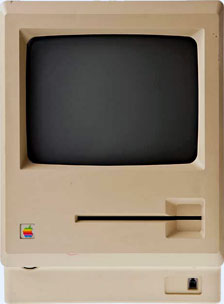 But the main reason Apple was able to more than double floppy capacity was by using constant linear data density – as with the later Macintosh, the floppy varied its speed to put more data on the outer tracks. Apple also used a redundant data structure to assure reliability, resulting in an error rate so low that Apple was unable to quantify it. (Apple built some Macintosh prototypes using the Twiggy drive, such as the unit in this photo, before deciding to adopt the 3.5″ floppy for the Mac.)
And if two 860 KB floppies weren’t enough, Lisa also came with Apple’s 5 MB parallel-port ProFile hard drive.
One really nice Lisa feature – you never turned it off. When you shut down Lisa, it continued to draw enough current to power the clock/calendar and CMOS memory – an internal battery would otherwise save those settings for up to 20 hours so you could move the computer.
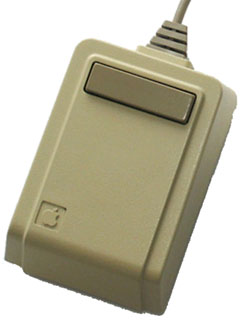 The Lisa keyboard had a numeric keypad and arrow keys, unlike the original Mac keyboard which lacked both arrow keys and a numeric keypad. The cursor was controlled by a one-button mouse (right), which Apple believed made arrow keys redundant and unnecessary. (Apple’s studies showed that multi-button mice confused new users, so using a single-button mouse would make Lisa easier to learn.)
The Impact
Lisa was perhaps the most innovative computer put on the consumer market prior to the Macintosh, and the Macintosh would not have existed if Lisa hadn’t paved the way.
Today, the entire computing world has followed Lisa’s lead of a graphical interface, a pointing device, lots of memory, and allowing the use of several programs at once.
Unfortunately, all this technology came at a price that kept Lisa from being the computer for the rest of us – $9,995. As a proof-of-concept computer, the Lisa was an incredible success, but the price kept it from ever catching on. Legend has it there’s a desert landfill near Logan, Utah, where Sun Remarketing buried the last 2,000 Lisas….
Still, it was an impressive piece of engineering that paved the way for Apple to release the vastly more affordable Macintosh one year later.
- Want to learn more or have Lisa expertise to share with others? Join LisaList, our email list for Lisa users.
Keywords: #applelisa
Short link: http://goo.gl/NGtw3P
searchword: innovativelisa
