
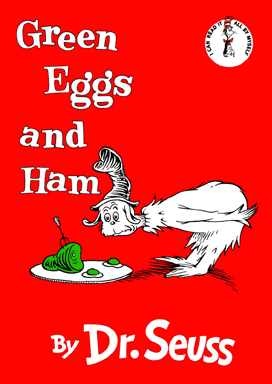
 2000 – “I am Sam.” If our sources are to be believed, Apple computer has licensed this phrase and the likeness of Sam from the Dr. Seuss classic, Green Eggs and Ham, for the forthcoming Sixteenth Anniversary Macintosh (SAM).
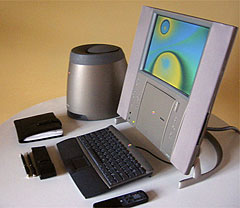 If you remember the Twentieth Anniversary Macintosh (TAM) of 1997 – a model celebrating 20 years of Apple, not 20 years of the Mac – you may be wondering what kind of innovations SAM will sport. After all, TAM was a desktop computer with an LCD screen, a vertical CD-ROM drive, and a powerful subwoofer.
 SAM won’t be anything like the pre-Jobsian TAM, which was a limited edition overpriced way cool toy.
 No, SAM (expected to be announced during Super Bowl half-time, just as the original Macintosh was sixteen years ago with the 1984 ad) will be a curious hybrid of new and old – less like TAM and more like the Mac Classic and Color Classic.
Forward Into the Past
For those who don’t recall it, Apple developed a reputation for great ideas inadequately executed. For instance, the original Mac had only 128 KB of memory and a single internal floppy drive. Between the OS and 21 KB set aside for video (it used system memory, just as many cheap Wintel boxes do today), you pretty much had to get used to swapping 400K floppies or buy an external floppy drive to get anything done. And even then, the burden of video, drive management, and CPU took its toll on the 8 MHz 68000 at the heart of the Macintosh.
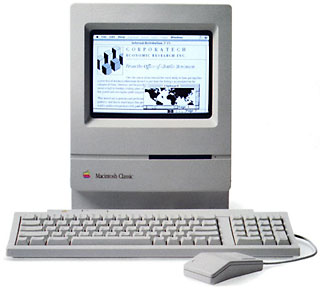 That was 1984. Almost seven years after that Super Bowl ad, in October 1990, Apple released the Mac Classic, which remained in the product line until September 1992. It has the same 8 MHz 68000 as the original Macintosh – and it was equally burdened by the OS, video, and floppy drive control. (For perspective, 1990 was the year that Apple introduced the “wicked fast” Macintosh IIfx with a blazing 40 MHz 68030 processor.)
The Classic had a few improvement over the first Macintosh. It was available at US$999 (just like the 350 MHz iMac) with a 1.4 MB floppy drive and a whopping 1 MB of memory. It also had a SCSI port for attaching a hard drive. And, for those with an extra $500, it could be purchased with 2 MB of memory and a 40 MB internal hard drive.
Think about it: six-and-a-half years after the first Macintosh, Apple introduced a new model with exactly the same processor and speed. The only real improvements were that memory could be expanded to 4 MB (as with the 1986 Mac Plus), a high density floppy drive, and the ability to use a SCSI hard drive, either internal or external (as with the 1987 Mac SE).
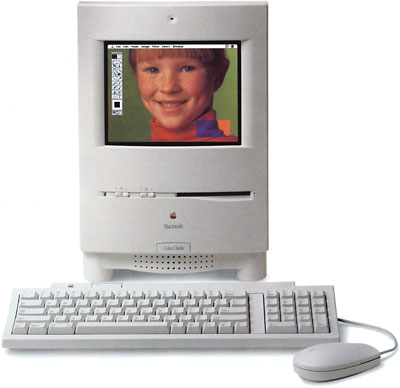 Let’s jump forward to February 1993, nine years after the Super Bowl introduction of the Macintosh and a month shy of the sixth anniversary of the 16 MHz Mac II. Apple introduced the powerful Quadra 800 (33 MHz 68040), the affordable Centris 610 (20 MHz 68LC040) and Centris 650 (25 MHz 68040), the consumer oriented LC III (25 MHz 68030), the first color PowerBook (165c with a 33 MHz 68030), and the underpowered Color Classic.
With a 16 MHz 68030 further crippled by a 16-bit data bus (see our Road Apples report), the Color Classic looked cool but was a performance dog. At least it shipped with 4 MB of memory, enough for System 7 and a program or two, and a just adequate 80 MB hard drive.
Is it any surprise Apple developed a reputation for shipping woefully deficient configurations? Look at it: Apple kept the 8 MHz 68000 processor in the line from 1984 until the Classic was discontinued in 1992. Likewise, the first 16 MHz Mac came out in 1987; the last was phased out in 1994.
If you’re familiar with Moore’s Law, you know processing power doubles every 18 months or so, yet Apple persisted in introducing five- and six-year-old technology in new packages while at the same time taking on the reigning Wintel speed champs with the IIfx and Quadras.
History Is About to Repeat Itself
I’m not sure Apple ever stopped selling barely adequate computers (in some respects – in other respects they’re wonderful). Remember how Steve Jobs wanted to sell the iMac with a 33.6 modem? Or how about the iBook’s miserly 32 MB of memory?
Well, SAM, the Sixteenth Anniversary Macintosh, is going to continue that tradition in spades.
In honor of the first Macintosh, SAM will be a compact unit a bit more akin to the Color Classic. It will have a 10″ color screen supporting both the CC’s 512 x 384 resolution and the more common 640 x 480 setting. And, just like the first Macintosh, it will have DRAM-based video – but this time it will reserve 1 MB of memory so it can support 24-bit video at 640 x 480.
Instead of a 400K floppy drive, SAM will use the same slot-loading CD-ROM drive found in the iMac. It will ship with OS 9 installed on a 4 GB hard drive that Apple acquired at fire sale prices from an overstocked drive manufacturer.
Just like the earliest Macs, the keyboard will connect to the front of the 19 pound machine – and it will also have a second USB port on the back for other peripherals.
This fascinating amalgam of new technology and old design ideas draws the line at the processor. Unwilling to design a computer with no potential for OS X, SAM will ship with 32 MB of memory and a 300 MHz G3 processor – exactly the minimum requirements for Mac OS 9 and OS X.
FireWire? Expansion slots? Video out? Nope.
TAM will be a closed box, just like early Macs and early iMacs. The only exception is a small door on the bottom that allows users to upgrade the memory should they find 32 MB inadequate.
 And that’s another brilliant move by Apple. They managed to find a memory vendor with lots of 16 MB DIMMs they couldn’t sell, so they got them at fire sale prices (just like the hard drives). One DIMM is inaccessible, so the computer will have 16 MB of memory in addition to whatever the user installs after removing the accessible 16 MB module. (And you wondered why it’s been hard to find 16 MB DIMMs lately!)
The great unknown is exactly what SAM will look like. It probably won’t look like the “Bondi and ice” image reproduced here. (This is reduced from an original by Jeff Foster, Digital Imagician & Pixel Painter. The image is copyrighted by Jeff Foster and used with his kind permission.)
Knowing Apple, we expect the unexpected. SAM may come in green and white in honor of the green eggs in Dr. Seuss’ classic. Or Apple could go for the hip blue and tangerine options of the iBook. Or maybe Jobs will vote for graphite, just because it looks so cool.
I’m holding out for a totally retro non-translucent beige case – just like the old Macs had.
– Anne Onymus
Short link: http://goo.gl/aszaDW
