
Low End MacRound Table
Intel Macs: The First 6 Years
Low End Mac Staff - 2012.01.10
Apple shocked a lot of Mac users in June 2005. After years ofextolling the virtues of PowerPC processor architecture over Intel'sx86 architecture, Steve Jobs dropped a bombshell at the WorldwideDeveloper Conference: Apple would make a transition from PowerPCarchitecture to Intel x86 within a year. Apple had been making x86versions of Mac OS X all along, and the company would makePentium-based development systems available so developers could compiletheir existing software for the new Mac hardware platform - and beginto write new code to take advantage of the new architecture.
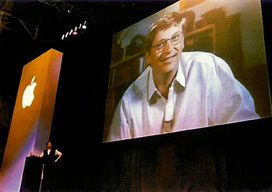
Bill Gates addresses Jan. 1997 Macworld Expo.
Needless to say, we were stunned by the announcement. Steve Jobs hadalready shown how the thought different by having Bill Gates address the January 1997 Macworld Expo via video.Wasn't Microsoft the mortal enemy? No, said Jobs, Microsoft is acompetitor but also a partner, and Microsoft was going to invest inApple and promised to continue development of Office and InternetExplorer for years to come. Still, having Bill Gates address Mac usersduring a Stevenote was a shock.
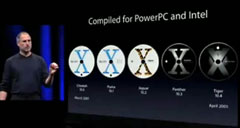
Apple had been compiling OS X for Intel all along.
Going Intel was at least as shocking. Just as Apple and Microsoftwere enemies in the world of operating systems, Intel and Apple were inopposing processor camps. Apple was going to abandon longtime partnersIBM and Freescale to embrace Intel, which had always been viewed as theenemy. Steve Jobs certainly did think outside the box on this one, andwhile we worried that Macs would become nothing more than PCs and thatour existing software would be left behind, he had it all figured out.Macs would still be unique hardware, and Intel Macs would includeRosetta, aprogram that let them run PowerPC software while the Mac world moved toIntel.
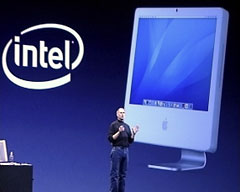
Jobs unveils the Intel iMac in Jan. 2006
We thought we had a year to get used to the whole idea, but at theJanuary 2006 Macworld Expo, Jobs unveiled the first two Intel-basedMacs - five months ahead of what we expected. That's the historicaldevelopment we're looking at today, Apple's hardware transition fromPowerPC to Intel - and how it has changed the platform.
Alan Zisman (Zis Mac): Justa year previously (more or less), Steve Jobs had provided a longexplanation at a keynote on why PPCs were more efficient - why acomputer built with a seemingly-slower PPC CPU could, in fact, get morecomputing done than another with an Intel-style CPU running at a fasterclock speed - something about the number of pipelines.
The Mac-faithful (myself included) nodded our heads - "Of course.""Makes sense."
In a way, it reminded me of the flip-flops of Communist parties inthe 1930s and 40s - first, the big enemy was Socialist parties. Thenthe Socialists were potential allies in a united front to fightfascism. Then Nazi Germany was an ally of the Soviet Union, and the USand UK were the enemy. Then Germany was the enemy and the US and UKwere allies. And then....
Ironically, when Intel introduced the Pentium 4 series, the samediscussion happened among PC-users: the Pentium III (P3) series CPUswere more efficient, but the Pentium 4 could be produced at higherclock speeds. Even more ironically, more recent Intel CPUs are moreclosely descended from that more-efficient P3 than the faster P4; hencethe relative lack of dramatic increases in clock speeds over the pastfew years.
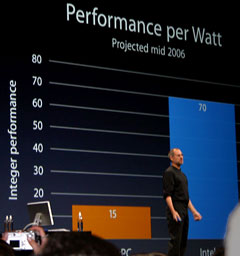
The new metric was performance per Watt.
Dan Knight (Mac Musings):It's interesting how Jobs positioned things in terms of performance perWatt, not traditional measurements of computing performance. I know theG5s were a bear to keep cool, especially the faster Power Mac G5s, andApple was never able to produce a G5 PowerBook it was willing toship.
Brian Gray (FruitfulEditing): My first Intel Mac was the first Intel MacBookPro. I bought it used from a friend in 2009, three years after itsintroduction. Even though it was "old tech" at that point, the powerful2.16 GHz Core Duo ran circles around my iMac G5. The machine was maxed out withthe original purchase, so my only upgrade option was a bigger harddrive and OS X 10.6 SnowLeopard.
I loved that MacBook Pro, except for the outer skin. The braininside was new, but the styling was so 2003. Heck, even the consumerMacBooks had magnetic latches!
My biggest regret in 2005 was purchasing that refurbed G5 iMacinstead of waiting a little longer for the Intel Macs. I don't mean tospeak ill of the dead here; I do love my iMac. It's still running greatand has given me many years of faithful service. But there will alwaysbe that part of me that wished I had just been able to hold out for afew more months.
Allison Payne (The BudgetMac): The smartest decision Apple made in the 90s was bringingSteve Jobs back into the fold, and the smartest decision they made inthe first decade of the 21st century was the transitioning to Intel.PPC technology wasn't progressing fast enough, and third-partychipmakers were either non-existent or still very new and smallcompared to Intel.
Apple needed a breath of fresh air in its hardware, and it was astroke of genius to use a chip that would allow any Mac to run Windowsnatively. They didn't have to change much in the way of chassis design,but by adding Windows capability, it felt like a radicallydifferent fleet of products.
With Intel, the company would have a chance at getting a better holdin the enterprise arena, and by focusing advertising on potentialswitchers, they hooked a lot of people (particularly college students)away from cheaper Windows laptops.
I'm not sure if Apple knew at the time how successful the strategywould be, but it has certainly paid off handsomely.
Charles Moore (several columns): When Steve Jobsannounced at WWDC 2005 that Apple would be switching to Intelprocessors from the PowerPC chips they'd been using for a decade, I wasnaturally curious how that would play out at the practical user level.The transition from 68k to PPC in the mid-90s had gone surprisinglysmoothly, but could history repeat itself?
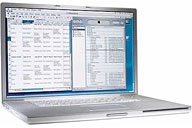
I decided to hedge my bets by purchasing what I anticipated would bemy last PPC Mac, an Apple Certified Refurbished 1.33 GHz 17" PowerBook G4.The big laptop proved to be a good computer, and I used it for threeyears as my main digital hub system before handing it off to my wife,who is still using it, running OS X10.5 Leopard. Actually, the 17-incher didn't turn out to be my lastPPC Mac purchase. I subsequently bought two Pismo PowerBooks, but that'sanother movie.
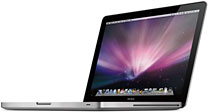
My first, and thus far only, Intel Mac is a Late 2008 Aluminum UnibodyMacBook that I bought - another Certified Refurbished unit - inMarch 2009, and it's been a better machine than I'd dared hope: fast(at least compared to what I'd been used to) and completely reliable.No problems or issues at all in just short of three years' intensiveuse. The original battery still has some life left in it, and the onlytime I've worked on this computer was to install a RAM upgrade to 4GB.
The only sign of the gazillion hours I've logged on this Mac is thatthe hard drive, which was almost inaudibly silent when I got theMacBook, has become a bit more noticeable to the ear, but only enoughthat I can now hear it running.
I love my old Pismos, but if this MacBook keeps on the way it has, Imay have to revise my pick for best Mac laptop ever.
Sebastian Patting (Edelweiss): When Apple buried OS 9, Ididn't laugh. When Apple buried PowerPC, I didn't laugh (again). Thoughless picturesque, it was the same kind of absurdity. What had just beenthe lastest and greatest was suddenly too dated, too cumbersome, tooinflexible to deserve further attention. As mentioned by my Low End Maccolleagues, just one year before the Intel switch Apple was stillpraising the PowerPC architecture as the future. In fact, as long-timeMac fans, part of our gospel was "we have modern RISC architecture,therefore we rule, and you CISC people suck". Well, kinda likethat.
The sudden move to the allegedly inferior x86 architecture provedthat Apple would betray its own principles as soon as it would promisean advantage. We would not have been surprised if Dell had done it. ButApple? Cupertino took pride in being not like the others. "Thinkdifferent", remember?
Apart from the ability of running Windows software natively (whichhas hurt loyal Mac software companies - especially gaming companies,thank you!) I don't see much of a gain in the Intel switch from a usersperspective. *silence* "Did he just say what he did?"*embarrased* Yes, call me whatever you want, a PowerPCFanboy™ or an embittered Luddite. But really, my 6-year-old Power Mac G5 is my main computer and fast enough foreverything I do. And that includes movie editing as well.
"Yes, but the latest Mac Pro is faster!"
Sure, but how fast is fast?
Much of the blame for switching to Intel was the inability of IBM toget out faster PowerPC CPUs, especially for PowerBooks. But if Applewould have really been the company that "thinks different", why didn'tit instead tried to optimize Mac OS X performance and the userexperience, thus increasing actual work speed? When you look in themirror and see some grey hair, chances are you worked with the classicMac OS during your younger years. And you remember, just like me, howeffectively we were working on our early Macs. If Apple would havefocused on its product instead of maximizing profits, it would havesaid, "Let's optimize PowerPC to the max!" However, Apple opted formore greenbacks. Too bad.
Simon Royal (TechSpectrum): Sebastian, the move to Intel may have come as a shock,especially as Apple were touting PowerPC as better and superior, butthere were internal builds of every version of OS X built for Intel,for x86. Apple had been planning this move for a long time, so itwasn't a sudden move.
IBM struggled to get faster, smaller, cooler chips, and Apple werebeing held back. No portables for a few years and the G5 struggling tobe updated. Its okay to say Apple should have tweaked OS X, but thatwould have only been short term fix. They would have needed fastermachines at some point.
The Wintel world would be steaming ahead with super fast 3, 4, and 5GHz machines, and the Mac world would be playing with a tweakedquad-core 2.5 GHz machine. However you play it, that won't hold up.
Running on Intel architecture is a good idea. Since moving to Intel,the amount of software available - especially shareware/freeware andspecialist tools - has grown massively. No more of the "you can't dothat on a Mac" from grinning Windows users.
Charles Moore: Sebastian, excellent points,philosophically.
I do like the speed with the Intel chips. I think a central issuewas that IBM had basically lost interest in the PC market, Motorola hadspun of its microchip operations as Freescale, which appeared to bemore interested in markets like automobile microprocessors, and soforth.
I also can't imagine Apple having the market share it's gained since2006 without the native Windows capability.
Dan Knight: I don't think we can underestimate theimportance of being able to run Windows natively on Mac hardware sincethe 2006 transition. Macs have had PC cards and emulators since thelate 1980s, but they were all poor solutions for those who neededaccess to PC software on their Macs. Thanks to Intel x86 processors,Mac owners can now boot and run Windows on Macs - and often better thanon name brand PC hardware. Add to that virtualization, which allowsrunning Windows alongside Mac OS X, and Windows users risk almostnothing by giving Macs a try. At worst, they have an expensive WindowsPC. At best, they slowly discover the power, flexibility, ease of use,and still virus-free world of Macintosh computing - perhaps even givingup on Windows over time.
For all the theoretical and even real world advantages Motorola680x0 chips had over Intel CPUs of their era and PowerPC had over x86in their era, the practical advantage of having Intel inside Macscatapulted them from a minority platform ignored by PC power users tobecome one of the leading PC brands across the board. Thank goodnessSteve Jobs anticipated that PowerPC might one day run out of steam andmade the bold decision to switch Mac processor architecure for a secondtime.
About LEM Support Usage Privacy Contact
Follow Low End Mac on Twitter
Join Low End Mac on Facebook
Favorite Sites
MacSurfer
Cult of Mac
Shrine of Apple
MacInTouch
MyAppleMenu
InfoMac
The Mac Observer
Accelerate Your Mac
RetroMacCast
The Vintage Mac Museum
Deal Brothers
DealMac
Mac2Sell
Mac Driver Museum
JAG's House
System 6 Heaven
System 7 Today
the pickle's Low-End Mac FAQ
Affiliates
Amazon.com
The iTunes Store
PC Connection Express
Macgo Blu-ray Player
Parallels Desktop for Mac
eBay