
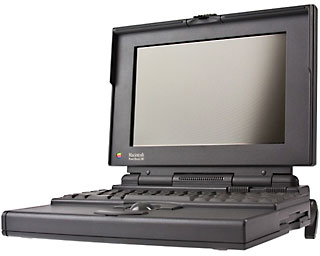
For the most part, the PowerBook 150 was a very nice computer. It was the fourth and final model in Apple’s economy series that started with the PowerBook 140 in October 1991. The 140 ran a then-decent 16 MHz 68030, shipped with 2 MB of memory (expandable to 8), and had a 20 or 40 MB hard drive.
The second generation was the PowerBook 145, introduced in August 1992. It replaced the pedestrian 16 MHz CPU with a 25 MHz 68030. Apple also included SCSI Disk Mode (which lets the PowerBook act as an external hard drive for another Mac), dropped the 20 MB hard drive, and added an 80 MB hard drive option.
About a year later, in June 1993, Apple quietly replaced the 145 with the 145B, which was almost the same computer with a few cost-cutting internal changes.
The PowerBook 150 came out in July 1994 with several advantages over the earlier models – and one seemingly insignificant drawback.
The 150 runs at 33 MHz, twice the speed of the 140 and one-third faster than the 145 and 145b, has a 4-bit grayscale display (the earlier models were strictly 1-bit b&w), and shipped with a just reasonable 4 MB of memory -which could be expanded to a whopping 40 MB. Hard drive options were 80, 120, and 250 MB. The screen was 640 x 480, not 640 x 400 as in earlier PowerBooks, and it was one pound lighter than the models the preceded it.
The one little drawback, and the primary reason the 150 merits the Road Apple label: Apple eliminated the ADB port.
Big deal, you may think, so you can’t attach a mouse or external keyboard. If that was all the ADB port was good for, the 150 wouldn’t be a Road Apple.
The problem is, that ADB port is sometimes used to power peripherals, such as the PowerPrint cable that let’s a PowerBook in the field work with almost any parallel port printer in existence. The impressive Farallon EtherMac and EtherWave adapters that managed to triple bandwidth on the printer port and let older PowerBooks work easily on ethernet networks also used the ADB port for power.
This in no way impairs the core functioning of the PowerBook 150, which is an excellent computer in almost every respect. We considered ourselves fortunate to have purchased a brand new PB 150 in late 1995 for under US$950, a record low price for a PowerBook at that time or any other.
Of course, a lot of us didn’t discover the missing ADB port until we tried to use PowerPrint or EtherWave. By then, it was a bit late to discover this was Apple’s only PowerBook (before 1999) without ADB.
The 150 did have a second drawback: That 4-bit grayscale display that sounds so good on the spec sheet isn’t so good in real life with anemic contrast.
Second Class Macs are Apple’s somewhat compromised hardware designs. For the most part, they’re not really bad – simply designs that didn’t meet their full potential. (On our rating scale, the more brown apples, the worse the hardware.)
Details
- introduced July 1994 at $1,300; discontinued October 1995
- requires System 7.0.1 to 7.6.1
- CPU: 33 MHz 68030
- FPU: none
- ROM: 1 MB
- RAM: 4 MB, expandable to 40 MB using a single Duo RAM card
- display: 9.5″ 4-bit 640 x 400 passive matrix
- 80 MB, 120 MB, or 250 MB IDE hard drive standard
- ADB port: none
- serial: 1 DIN-8 RS-422 port on back of computer
- SCSI: HDI30 connector on back of computer
- proprietary modem slot
- Size (HxWxD): 2.25″ x 11.25″ x 9.3″
- weight: 5.8 pounds
Other Resources
- The 10 Worst Macs Ever Built, Remy Davison, Insanely Great Mac, 2001.08.06
Keywords: #powerbook150 #secondclassmacs
Short link: http://goo.gl/Cq66xg
searchword: pb150roadapple
