
Apple has done some remarkable things with its third generation Power Mac, the Beige G3s. (The first generation Power Macs used NuBus, and the second switched to PCI.) The motherboard is smaller than in earlier Power Macs, leaving room for one more drive in the same type of desktop case used for the 7200-7600.
Apple realized that the second generation Power Mac motherboard had reached its limit: with a 50 MHz system bus, the fastest CPU it could support was a 350 MHz 604e (when this was originally published) or 400 MHz.* By designing a more compact motherboard with a 66 MHz bus, the Beige G3’s motherboard can support a 533 MHz CPU.
* 250-350 MHz pre-G3 CPUs required extra power. The 604e only supports multipliers to 7x bus speed. The Beige G3 supports multipliers to 8x, while the G3 CPU itself supports multipliers up to 10x (originally 8x), so running a 500 MHz is possible on the older 50 MHz-bus Macs. (Update: Some later high-speed G3s support a 16x multiplier!)
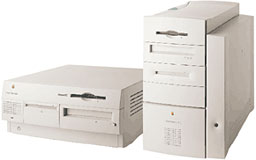 Unlike second-generation Power Macs with replaceable processor cards, where the CPU daughter card controlled processor and bus speed, the Beige G3 moved the bus and multiplier controls to the motherboard (note that some third-party upgrades override the motherboard setting). At the same time, Apple switched from a daughter card design to a ZIF socket, making upgrades completely incompatible between the older Power Mac line and the G3 models – and also less expensive for the newer models.
Some people just need to experiment, although doing so entails some risk. But they discover interesting things that Apple hasn’t publicized, like potential bus speeds faster than 66 MHz.
To access the bus speed and multiplier controls on the Beige G3 motherboard (nicely illustrated on Mac Gurus), you must remove a label that clearly states Warranty Void If Removed. Beneath the sticker is the J16 jumper bank, which controls motherboard bus speed (66, 75, or 83 MHz) and the CPU multiplier (CPU running from 3x to 8x motherboard speed). Using these options, it is theoretically possible for the G3 motherboard to support a 667 MHz G3 processor!
The default on the Beige G3 is a 66 MHz bus with a 3.5x multiplier on the 233 MHz model and a 4x multiplier on the 266 MHz one. Later models of the Beige G3 pushed this as high as 5.5x for 366 MHz.
The J16 jumper bank has nine sets of jumpers numbered P1 through P9 (see diagram on Power Macintosh G3 Clock Up and photo on Willy’s Wierd G3 Desktop). P1-P4 set the CPU multiplier, which ranges from 3x to 8x in 0.5x increments. P5-P9 control bus speed, ranging from 60 MHz to 83.33 MHz, and PCI bus speed, which can vary from 30 MHz to 35 MHz. These are the possible configurations. (For more details on the PCI bus multiplier, see Apple Beige G3 MB Jumper Settings at Accelerate Your Mac!)
The numbers in bold are based on the 66 MHz bus, which seems to give the most reliable operation. CPU speeds are based on bus speed and multiplier.
| Bus Speed | Jumpers On | Multiplier | Jumpers On | CPU speeds | |
| 60 MHz | P6 P7 P8 | 3x | P2 P3 P4 | 180/200/210/225/236/250 | |
| 66.67 MHz | P5 P6 P7 | 3.5x | P4 | 210/233/245/263/276/292 | |
| 70 MHz | P5 P6 P8 P9 | 4x | P2 P4 | 240/ 266/280/300/315/333 | |
| 75 MHz | P6 P7 P8 | 4.5x | P1 | 270/ 300/315/337/354/375 | |
| 78.75 MHz | P6 P7 P9 | 5x | P2 | 300/ 333/350/375/394/416 | |
| 83.33 MHz | P6 | 5.5x | P2 P3 | 330/ 366/385/413/433/458 | |
| 6x | P3 | 360/ 400/420/450/472/500 | |||
| 6.5x | P1 P3 | 390/ 433/455/487/512/541 | |||
| 7x | P1 P2 P4 | 420/ 466/490/525/551/583 | |||
| 7.5x | P1 P2 P3 | 450/ 500/525/562/591/625 | |||
| 8x | P3 P4 | 480/ 533/560/600/630/666 |
This design shows great foresight on Apple’s part. Assuming the Beige G3 motherboard actually supports the 83 MHz system bus (update: use of the different bus speeds varies from computer to computer and is generally more trouble than it’s worth), they won’t have to worry about designing a new motherboard until the PPC 750 reaches 666 MHz and it makes sense to move to a 100 MHz or faster system bus. And even if all the components on the current G3 motherboard aren’t certified for 83 MHz, Apple can worry about that when it moves the higher bus speeds. (Apple did move to a 100 MHz system bus on a new motherboard with the Blue and White G3 in January 1999.)
Two more factors affecting performance are the speed and size of the backside cache. The size of the cache on the Beige G3s is 512 KB; this can only be changed by replacing the CPU module (see our guides to G3 and G4 ZIF upgrades). By default, Apple runs the backside cache at half the speed of the CPU – 116 MHz on the G3/233 and 133 MHz on the G3/266. Changing the J16 jumpers will also change the speed of the backside cache, which becomes as crucial a factor as the CPU’s ability to run reliably at faster speeds. The backside cache will remain at half the speed of the CPU.
It is possible to change the multiplier on the backside cache from 2:1 to 3:2 or even 1:1 via software, as reported on the Mac Resource Page. However, the SRAM Apple uses may not support these settings.
One MacInTouch reader has reported successfully bumping his Power Mac G3/266 to 300 MHz on a 66 MHz bus. This brave soul was unsuccessful running the CPU at 300 MHz with either a 75 MHz or 83 MHz bus and didn’t try these bus speeds with lower multipliers. However, running the CPU at 300 MHz on a 66 MHz bus did generate a MacBench 4.0 processor score of 1002, an 11% improvement over 266 MHz.
Remember that Apple does not promote the Power Mac G3 as upgradeable and warns that such experimentation will void your warranty. Experiment at your own risk.
Still, you can confidently buy a Power Mac G3 knowing you need not be stranded at the current CPU speed. Even if components limit bus speed on current motherboards to 66 MHz, that will support a 533 MHz CPU. With the 233 MHz Power Mac G3 at just under $2,000 (11/97), Apple provides a good reason to consider a whole new computer instead of a CPU upgrade for those with processor-upgradeable second-generation Power Macs.




Keywords: #overclocking
Short link:
searchword: overclockbeigeg3
