
Adobe Photoshop™ was, for a time, the killer app for the Macintosh. During the mid-90s, publishing and graphic design had supplanted consumers as the most important market to target, at least in the eyes of former Apple CEOs Gil Amelio and Michael Spindler.
Consumer Macs languished as Apple poured resources into multi-processor Macs and ill-conceived operating system replacements for the Mac OS.
 Even after Apple emerged from its crisis of the mid 90s, Photoshop remained immensely popular and has even been adopted as a verb for retouching or modifying images (much to the consternation of Adobe).
The Knolls
Photoshop was not the result of an elaborate skunk works in the depths of Adobe. Rather, it was developed by Thomas Knoll and his brother, John. The boys’ father, Glenn Knoll (a University of Michigan Ann Arbor College of Engineering’s Nuclear Engineering and Radiological Sciences professor), had been an amateur photographer and an early adopter of micro-computers, passions that his boys eagerly embraced.
John took an interest in photography, developing his film in his father’s darkroom. He took more than just a passing interest in the hobby, since he began developing color prints – a very elaborate process compared to black and white film development. Learning to manipulate the color and exposure of the photographs he developed, John developed the skills that would later be applied in Photoshop.
John was passionate about programming. His father had brought home an Apple II+ and made his living programming a mainframe. John immediately felt at home with the computer. In an interview with Apple, he said his father “was using it for research, but he mostly did that work in the evenings, so when I got home from school that Apple II was calling out to me.”1
Glenn replaced the aging Apple II+ with a Macintosh in 1984, much to John’s delight. From that moment, he “became an instant convert” to the Macintosh.2 John was able to apply his hobby to his career as he joined Industrial Light and Magic, a leader in computer graphics research and the corporate sibling to Pixar.
Display
Thomas went to college, earned a BS from the University of Michigan, and started working towards his PhD at the school in computer vision, or, as the University of Michigan’s alumni magazine puts it, “the processing of digital images.”3 Thomas bought a Mac Plus to work on his thesis. Unfortunately, unlike some of the much less expensive home computers of the time (like the Amiga, Commodore 64, or Archimedes), the Mac Plus was not capable of displaying images in color – or even grayscale.
So he could do his research on his Mac, Thomas wrote a program called Display that allowed him to display grayscale images through dithering on the 1-bit black and white display. Display did not have a GUI, though. It used a C Shell-esque command line interface. The program did nothing but display color images and grayscale images on the Mac Plus through dithering. Thomas’ brother was very enthusiastic about the application, and Thomas was soon distracted from his thesis.
At Industrial Light and Magic, John tried out his brother’s program and was impressed. Industrial Light and Magic was one of the first companies to receive Pixar Image Computers (which had been developed by the Pixar employees at LucasFilm), essentially huge frame-buffers, before their commercial release in 1985. In an interview for a book on Industrial Light and Magic, John said “As Tom showed me his work, it struck me how similar it was to the image processing tools on the Pixar.”4 The biggest difference was that Display ran on a $2,599 Mac Plus and the Pixar computer cost $135,000.
John encouraged Thomas to turn the program into a true image editor that would allow people to manipulate digital images just like they would in the darkroom (dodge and burn, contrast and hue, etc.). The two began collaborating on Display’s successor.
Photoshop
In 1988, Display was tentatively renamed ImagePro, and Thomas began adding editing features to the program. John’s first suggestion was gamma correction so he could make images appear less dim on the screen, but Thomas soon added many of the darkroom techniques that he used as a boy in his father’s darkroom.
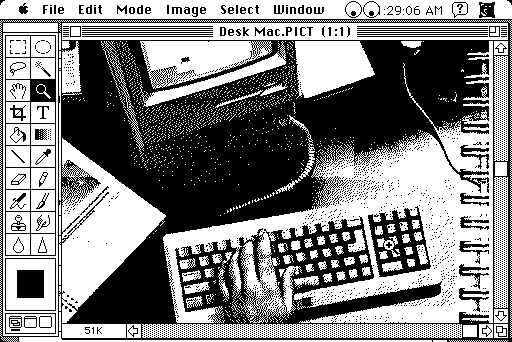
Photoshop 1.0 on a Mac Plus. (Screenshot courtesy of the Vintage Mac Museum.)
It was John who first suggested making ImagePro a commercial application instead of just freely distributed shareware, though neither brother knew how difficult it would be to find a distributor and get the program to a level appropriate for customers. Thomas decided to put his PhD work aside for six months and try to turn ImagePro into a commercial application.
 Image editing was not new to the Macintosh – or personal computers in general. Indeed, the Amiga had been widely adopted by professional photographers for its editing prowess and graphics abilities. Unfortunately, few commercial software companies saw the point in Photoshop. According to Story Photography, Thomas took the app to SuperMac, a company later known for its line of Mac clones and video cards, but the company already had a much less capable program called PixelPaint, which was more appropriate for MacPaint users than serious photographers.
Ultimately, it was a scanner company, BarneyScan, that released the software, though probably not the way that Thomas wanted. ImagePro (rename Photoshop because of a trademark conflict) was only distributed with scanners from BarneyScan, and only around 200 copies of the program were sold.
Luckily, Thomas did not sell Photoshop to BarneyScan, he only licensed it. The commercial distribution of the program gave him more credibility, which apparently paid off when he went to Adobe in September of 1988. Adobe’s creative department, headed by Russell Brown, fell in love with the program, and they were not alone. The program was released in 1990, and by 2000 it had sold over 3,000,000 copies (and presumably is used on millions more desktops through widespread software piracy).
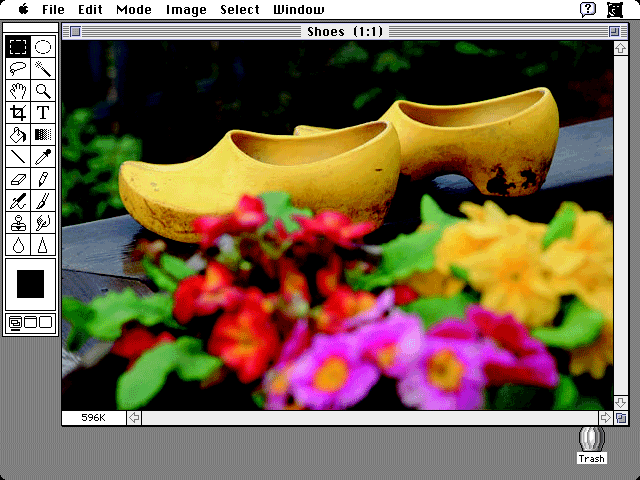
Working on a color image in Photoshop. (Screenshot adapted from guidebookgallery.org.)
The impact of the program’s versatility and popularity have perhaps been strongest on Apple’s own business. Even after Adobe ported Photoshop to Windows and Unix systems, the Macintosh remained the platform of choice. Professional Photoshop users flocked to Power Macs that cost just shy of $10,000, earning Apple a pretty profit. Eventually, as Apple struggled to retain footholds in enterprise and in homes, the graphics (and publishing in general) market became very important. Lamar Potts, the VP of clone operating systems at Apple, explicitly told the press that his top priority was to focus on “specific market segments, such as high-end graphics.”5
Eventually, a resurgent Apple would once again compete in the consumer and enterprise markets, but never neglected its power users. Even today, its high end workstations are promoted heavily for their graphics performance.
Footnotes
- John Knoll Interview, Apple, 2000.
- John Knoll Interview
- Family Ties Inspire Alumnus to Develop the World’s Most Popular Photo Software, University of Michigan.
- Story, Derrick. From Darkroom to Desktop – How Photoshop Came to Light, Story Photography, 2000.
- Jacqueline Henry, Heather Clancy, and Daniel Lyons. Apple cultivates its core, Computer Reseller News, 1996.
Keywords: #photoshop
Short link: http://goo.gl/DOIZ7D
searchword: photoshoporigin
