
Apple Corps was founded as a tax haven for the Beatles’ considerable cash reserves in January 1968. Apple Corps would finance a record label and other pet projects of the band members while also providing a “front” for their financial activities to reduce personal liability and taxes.
 Ultimately, Apple Records was the only successful and long lived division of Apple Corps. The label released all Beatles records after 1968 and was also home to other artists including Ravi Shankar.
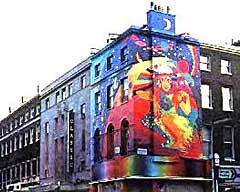 Less successful divisions included Apple Electronics, Apple Movies, and the Apple Boutique, the most ostentatious of Apple Corps’ businesses. Paul McCartney described the Apple Boutique as a “beautiful place where you can buy beautiful things – a controlled weirdness – a kind of Western communism.” (Uncontrolled Weirdness)
 Apple Computer’s name was a major departure from its microcomputer compatriots of the mid-70s. Companies like MITS, Kaypro, and Digital Research were the dominant companies in the industry. Apple’s name didn’t seem to belong in a science fiction movie (Digital Research’s original name was actually Intergalactic Digital Research) – and no doubt was a factor in its meteoric rise in the late 1970s.
 It’s likely that Steve Jobs was aware of the Beatles’ holding company because of his affinity for the group, though choosing Apple as the company name could have been a result from Jobs’ stint at the All-One Farm. Wozniak (in his interview with Owen Linzmayer) speculated: “Maybe he worked in apple trees” (pg. 207).
Whatever the inspiration for the Apple Computer, Inc. name (officially founded in 1976), it would cause trademark problems.
Apple vs. Apple, Round 1
It didn’t take long for Apple Computer to attract the attention of Apple Corps. In 1978, Apple Corps sued Apple Computer for trademark violation. The case went to court (Apple Computer probably looked like a pushover), and the two parties settled in November 1981 with the understanding that Apple would never enter the music industry. This clause was already a little shaky, since the Apple II supported sound and music and had even been used in several albums of the time.
The other stipulation was a flat sum for the rights to the Apple name. The amount was rumored to be in the tens of millions, but released court documents reveal that it was only $80,000.
To many industry observers, the conflict between Apple Computer and Apple Corps appeared to be over, but it wasn’t. As Apple’s products became more capable, they began to encroach on the music industry.
Apple vs. Apple, Round 2
Eight years after the first settlement, Apple Corps filed suit against Apple Computer again, this time for violating the original agreement not to enter the music industry.
The suit cited the Mac Plus, Mac SE, Mac II, Apple IIgs, Apple CD-SC CD-ROM drive, and Apple’s MIDI interface for the IIgs and the Mac. All were capable of music playback and creation (except for the Apple CD-SC) and seemed to infract on the original contract. The suit again went to court, and the two parties reached a settlement on October 9, 1991.
Apple Computer would be allowed use its name to market “computers, microprocessors and microprocessor controlled devices, telecommunications equipment, data processing equipment, ancillary and peripheral equipment, and computer software of any kind on any medium” and produce marketing materials and networks to support those products. Apple Corps reserved the right to sue Apple Computer if the company ever used its name to sell “creative works whose principal content is music.”
The agreement cost Apple Computer $26.5 million in addition to its legal costs. The suit caused much tumult throughout the company, since if Apple Computer lost, it might have been barred from producing computers or peripherals under the Apple brand capable of playing or producing music, eliminating it from the PC market.
System 7 development began in 1987 and was finishing just as Apple Corps and Apple Computer reached their settlement. As one of the sounds that might have been banned, the developers included Sosumi (pronounced “so sue me) as a jab at Apple Corps.
Apple Computer and Apple Corps went their different ways after 1991. Apple Computer’s products became more capable and less popular while Apple Corps began to rerelease its catalog to LaserDisc and CD.
In 2000, Apple hired Tony Fadell to market an MP3 player and the music store concept he had created after leaving Phillips. The iPod and iTunes Music Store were released in 2001 and 2002 respectively (see A Brief History of the iPod).
Apple vs. Apple, Round 3
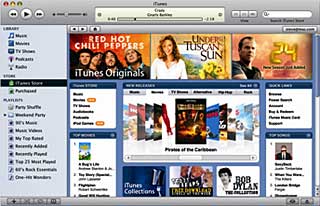 In the eyes of Apple Corps, the iTunes Music Store was a clear violation of the 1991 settlement. In September 2003 (25 years after Apple Corps’ first suit) Apple Corps sued Apple Computer for breach of contract simultaneously in the US and the UK. Settlement talks fell through after Apple Computer offered Apple Corps $1 million for the right to use the Apple name in the music industry.
The case went to court on March 29, 2006 (three days before Apple’s 30th anniversary) in the UK after the suits in the US and the UK were consolidated on September 21, 2004.
The judge found in Apple Computer’s favor, since the company was not marketing music, merely delivering it to customers through its network. Apple Corps was required to pay Apple Computer for its legal fees (estimated at £2m) – and Apple Corps promised to appeal the decision.
Apple Computer ultimately paid Apple Corps $26.8 million for the right to use the Apple name in computers and music distribution.
On January 9, 2007, the computer company renamed itself Apple Inc. to reflect its role in the consumer electronics and music industry.
The two Apple’s have reached a settlement. See Apple Inc. and The Beatles’ Apple Corps Ltd. Enter into New Agreement for more information.
Apple Corps and Apple Computer logos are from Wikipedia. The photograph of the Apple Boutique is from Strawberry Walrus. iTunes screen shot from Apple’s Press Relations page.
Keywords: #applecorps #applecomputer
Short link: http://goo.gl/FGblxZ
searchword: applecorps
