
Apple had transformed from a small three man venture in the late 1970s into a huge, multinational corporation in the late 1980s. With these changes came troubles.
Steve Jobs and Steve Wozniak had both left the company in 1985 – and so had its entrepreneurial spirit. The Macintosh had saved the company in the mid-80s, but Apple had become totally reliant on it and was unwilling to pursue any projects that might compete with it.
Engineers all over the company had become frustrated with the lack of creativity and innovation in the products they were working on. Apple was struggling.
The division that worked on revisions to the Mac OS (then known as the Macintosh System Software) was no different. Led by Gifford Calenda and Sheila Brady, only minor changes were being made to the operating systems, like the ability to work with hard drives larger than 32 MB in size.
The Gang of Five
Five of the most experienced engineers in the division were frustrated by the lack of progress on new features in Mac OS and threatened to leave the company. Dubbed the Gang of Five, the engineers either wanted to be reassigned to a more exciting project or make one themselves. Calenda and Brady were both hesitant to give up such skilled engineers and agreed to their requests.
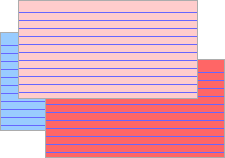 A division-wide staff meeting was held to determine the scope of the newly organized divisions. The developers were all given stacks of red, pink, and blue index cards and were asked to write their proposals for new operating systems on them. On the red cards, they wrote down features that could only be implemented in the far future, the pink cards were for a major revision of Mac OS not so far in the future, and the blue cards held proposals for System 4.
Features like an object oriented programming environment, better international support, preemptive multitasking, and improved graphics were written on the pink cards, while speech and character recognition were proposed on the red cards. The blue cards included suggestions for virtual memory, multi-user support, and cooperative multitasking.
The most senior engineer in the Gang of Five, Erich Ringewald, was given control over the Pink operating system (named for the cards from the meeting) and set up a research project to determine the feasibility of the proposed features. His task was to bring Pink to market in two years (1989).
Ringewald quickly came to the conclusion that Pink would have to be moved off campus to avoid being micromanaged by Apple’s senior executives (until then, it had been housed in the main building on the Apple campus). Gassée agreed and allowed the engineers to move to a warehouse on Bubb Road that was also being used by the Newton project.
By the end of 1987, Pink had a little over 20 engineers (there were hundreds working on Blue) and was making slow progress on bringing many of the new features to the Mac OS. Ringewald was insistent that Pink would still be a version of the Mac OS, albeit a heavily modified version. This approach meant that it would take much longer to implement some of the features – especially preemptive multitasking – and that ruffled some of the engineers’ feathers.
David Goldsmith issued an ultimatum to Ringewald: Either Pink would become its own operating system or he would resign. Erich did not budge, and Goldsmith resigned, making him the first casualty of Pink.
Only months later, a major change occurred at Pink. A senior Apple executive overrode Ringewald’s decision to keep Pink as a Mac OS after several engineers complained to his superiors. Three engineers were recruited from Apple’s research division to create a microkernel for Pink.
Slow Progress
Development of the new operating system was still much slower than Ringewald had anticipated. As Pink’s 1989 deadline approached, all the team had was a quasi-functional beta version of the operating system with a few new features implemented. Besides that, it was too unstable for anyone to use it as a production system.
Three more engineers of the original Gang of Five resigned from Apple as they saw the slow progress being made on Pink. Despite the internal problems, Pink was an attractive project at Apple, and engineers fought for the chance to be on the project (which many saw as the savior of the Macintosh).
In December 1989, Pink had well over a hundred engineers working on the software and was moved back to the Apple campus. Ringewald left the project in disgust, and it was turned over to an Apple VP, Ed Birss, and renamed the Object Oriented Systems Group. Despite the size of the project, the going was still slow. The new engineers would not become productive for months, because they had to learn how the software worked, so they relied on the more experienced engineers to answer their questions.
Paranoia & Secrecy
Now that Pink was back on Apple’s campus, it became a target for other divisions. Birss became very defensive of the software, hesitant to let anybody outside the group see the software running, much less the source code, out of fear that another project might cannibalize Pink.
 The Jaguar project, a project to produce a RISC workstation, wanted to use Pink, but the team was not allowed to even look at it until its head, Hugh Martin, got John Sculley to order Pink to open up. Because of the secretive policies at Pink, it ended up duplicating efforts made elsewhere at Apple, such as QuickDraw GX, PowerTalk, and the Newton OS (which was also object oriented).
Senior Apple executives were now aware of conditions at Pink. Upon the resignation of Apple’s COO, Jean Louis Gassée told John Sculley to cancel Pink and blame its failure on him. Sculley refused, and Pink eventually became the savior of Apple’s independence.
Apple & IBM: Pink Becomes Taligent
 The Star Trek project at Apple had contacted Phil Hester, the head of RISC at IBM, about licensing an Intel-compatible version of the Mac OS. Hester was uninterested (such a project would have competed with OS/2), but he remembered the call. Several months later, IBM had completed the POWER processor (based on earlier designs made in the late seventies) and was looking for customers.
The major workstation producers – HP, Sun and SGI – were all ruled out because they all had their own RISC designs, so Phil Hester suggested Apple at a meeting with senior IBM vice presidents. Jack Keuler, a senior vice president of IBM who was leading the meeting, was intrigued by the idea and contacted Apple about collaborating on hardware. He arranged a high level meeting in Dallas (halfway between IBM in Armonk and Apple in Cupertino).
John Sculley (now the chairman of Apple), Michael Spindler (the new CEO at Apple), and Hugh Martin (who had tried to convince Apple to acquire Sun for use of its SPARC processor) represented Apple. Jack Keuler and Phil Hester represented IBM. The five hammered out an agreement that would allow Apple to use modified POWER chips in its personal computers while IBM would sell workstations that ran Pink.
 Apple did not want to become totally reliant on a competitor for its processor supply and insisted that Motorola be allowed to produce processors. Several changes were made to the POWER to make it more similar to Motorola’s 88100, and it was renamed the PowerPC.
 Pink was spun out as Taligent, which was led by an IBM employee. The kernel was jettisoned. Taligent would run on top of an operating system and act as an object oriented system (like OpenStep). It was released in 1995, but it sold poorly. It was canceled altogether in 1998.
- 1990-92: The Windows Threat, the Next Generation Mac OS, and ‘Wicked Fast’ Macs (includes Jaguar project)
- How Jean Louis Gassée Changed the Mac’s Direction
- Star Trek: Apple’s First Mac OS on Intel project
- IBM, Apple, RISC, and the roots of the Power Mac
Bibliography
Some of the sources used in writing this article:
- Apple: The Inside Story of Intrigue, Egomania, and Business Blunders, Jim Carlton
- Infinite Loop, Michael Malone
- The Second Coming of Steve Jobs, Alan Deutschman
- Apple Confidential 2.0, Owen Linzmayer
- Odyssey: Pepsi to Apple . . . a Journey of Adventure, Ideas & the Future, John Sculley
- Wikipedia
Keywords: #pinkos #taligent
Short link: http://goo.gl/EpKDo0
searchword: pinkos
