
Even with the fabulous press reception given to the Macintosh upon its release (see my previous article), it did not sell well. There were a number of reasons for that.
- Macintosh Limitations
- Apple II Forever
- Changes at Apple
- Macintosh 512K: Filling the Mac’s Gaps
- Apple Developments
- Macintosh Plus
- Macintosh 512Ke and the Return of Wozniak
- Apple’s First Supercomputer
- Other Developments
Macintosh Limitations
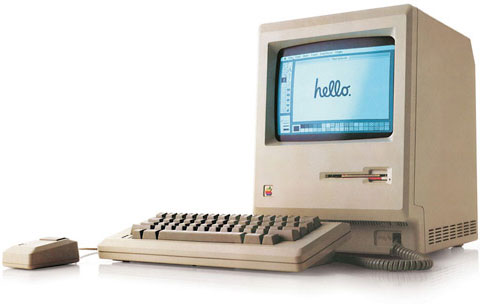
Macintosh 128K
The US$2,495 Macintosh seemed more expensive than comparable computers (the IBM PC AT was more powerful and cost more, but PC clones always cost less) and had very little software.
Those who bought the computer soon realized that a single 400 KB floppy drive and 128 KB of RAM were not really enough to run the GUI-driven software. Prior to the Mac’s release, Apple sensed that many users would run out of RAM and designed the operating system to load only portions of the applications and documents into memory. This conserved RAM but made the machine very slow.
Hard drives were still relatively rare, and those who had one for their Macintosh came up against the limitations of MFS (Macintosh File System, the predecessor to HFS), which was designed for floppy disks and did not allow for nested folders or more than 128 files on a single disk. A common workaround was to partition the hard drive into several partitions, each holding less than 128 files.
These hardware and software problems handicapped the Macintosh in the business world. IBM had the most popular software titles: Lotus 1-2-3, WordPerfect, and dBase II. At the time of its release, the Macintosh came with just two programs: MacWrite and MacPaint.
Businesses could not rationalize paying $2,495 for what they saw as a minimally useful computer, even if it was easier to use.
Microsoft was the first software developer to release a program for the Macintosh, MultiPlan, a graphical version of their DOS spreadsheet. At the time of its release, Bill Gates declared the Macintosh to be the best computer in the world, garnering him much goodwill, if only short-lived.
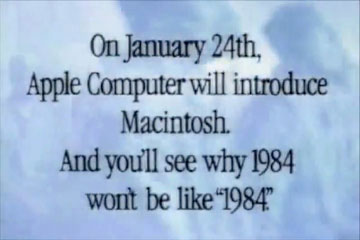 Apple launched a large, mainly consumer-oriented, publicity campaign for the Macintosh. Along with the 1984 spot, Apple bought spreads in major newspapers and magazines, including a 20-page advertising supplement in Newsweek. Potential customers were encouraged to come and try the product on one of the thousands of demo machines Apple distributed to retailers.
Apple also distributed Macs to major celebrities – including Michael Jackson, Andy Warhol, and Mick Jagger – and convinced Rolling Stone to write a seven-page article on the creators of the Macintosh.
Apple II Forever
While Apple struggled to sell the Macintosh, the Apple II sold in record quantities. On April 24, 1984, Apple announced the Apple IIc at a meeting titled “Apple II Forever”. Apple hoped to avoid the appearance of abandoning the Apple II in favor of the Mac.
The Apple IIc was the first computer Apple released to be designed around the “Snow White Language”, a set of design principles Apple would use until they discontinued the Beige Power Mac G3 in 1999. The “language” was characterized by the case color (a shade of gray dubbed platinum) and strong straight lines in enclosures, which was a major shift from the beige color of the Apple II.
Only a fraction of the size of the Apple IIe, the Apple IIc included no expansion bays, but it did include several built-in ports not present on the IIe motherboard: printer, modem, sound, disk drive. Another major feature of the IIc was the inclusion of the same mouse interface used on the Macintosh and Lisa, a feature previously only available via an add-on card.
The IIc was also the first Apple II that did not include a cassette player interface.
Changes at Apple
All was not well in the Apple boardroom. Steve Wozniak left the company in 1985, declaring “Apple has gone crazy”, and he founded a video company.
John Sculley created a Draconian plan for Apple that would return it to the levels of growth seen before the release of the Macintosh. In the plan, 1,200 people would be dismissed (20% of Apple’s workforce), and Steve Jobs would be stripped of his power in the company, relegated to the ceremonial position of President. In June of 1985, the plan was approved by the board, and Jobs left the company four months later.
 Jobs created his own computer company, NeXT, taking five Apple employees with him. He funded NeXT by selling all of his Apple shares. Apple sued NeXT shortly after that for stealing trade secrets, but the companies settled out of court with NeXT agreeing not to compete with Apple.
During the trial, Jobs hired Paul Rand, the man who had designed IBM’s logo, to design NeXT’s logo.
Macintosh 512K: Filling the Mac’s Gaps
There was just one major improvement in the Mac 512K (a.k.a. “Fat Mac”), which was released in September 1984. It was the inclusion of 512 KB of RAM, allowing entire programs to be loaded into memory, making the 512K dramatically faster than the Mac 128K and eliminating much of the disk swapping required with the first Macintosh.
The system software did not receive any updates, but many new titles were released to take advantage of the RAM boost.
The most hyped program was Lotus Jazz, an integrated suite with a Lotus 1-2-3-like spreadsheet. The program was completely compliant with Apple’s interface standards and was very easy to use. Unfortunately, the 512K did not offer enough horsepower to run the program well, and sales never took off.
Microsoft released Excel, a replacement for MultiPlan, and Andy Hertzfeld, one of the original Macintosh designers, released Switcher, which allowed users to switch between programs without having to quit them.
Apple Developments
In November 1985, Nancy Reagan presented an Apple IIe to a school in Switzerland while her husband had talks with Gorbachev.
In order to improve morale at Apple after the massive layoffs, Sculley gave all employees additional holidays and Christmas presents. In December, Apple bought 14 pages in USA Today to promote the Apple IIe and IIc.
Macintosh Plus
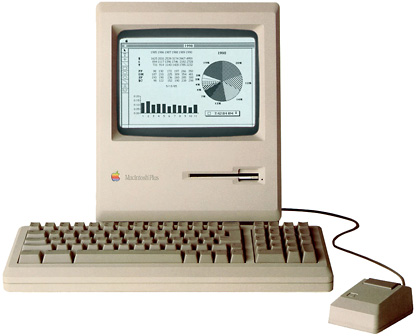 Two years after the original Macintosh, Apple released the Macintosh Plus, which had specs closer to a workstation than a PC. It came with 1 MB of RAM (expandable to 4 MB) and a standard SCSI interface.
The ROM swelled in size from 64 KB (on the original Mac and 512K) to 128 KB. This enabled it to use the new HFS (Hierarchical Filing System), which allowed for nested folders and many more files on a disk, which was very important with hard drives. The Plus also included a double-sided floppy drive capable of reading and writing 800 KB disks.
Apple allowed 128K and 512K users to upgrade their machine with a new logic board and floppy drive.
By this time, there were many software titles available for the Mac, including the hugely popular Microsoft Word and Excel.
Macintosh 512Ke and the Return of Woz
The Mac 512Ke, known to many as the “Mac More”, was a transitional model. It was a stepping stone between the Mac 512K (basically the Mac 128K, as the original Mac was known, with more memory) and the Mac Plus.
As with the Plus, Apple allowed 128K and 512K users to upgrade their machine with a new logic board for a few hundred dollars. Upgrading to the double-sided floppy was also an option, but it wasn’t necessary.
Apple’s First Supercomputer
In February 1986, Apple bought a Cray X-MP/48 supercomputer to test case materials and software. The machine was worth millions of dollars and had a dedicated four-person security team. A special room was built at Apple headquarters in Cupertino to house the computer; it was outfitted with two 20 ton air conditioners.
When a journalist asked Seymour Cray about Apple using one of his supercomputers, he retorted, “This is very interesting, because I am using an Apple Macintosh to design the Cray-2 supercomputer.”
Other Developments
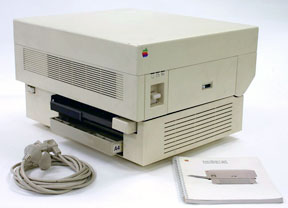
Apple LaserWriter
Two products vital to the survival and success of the Macintosh for decades to come were released during 1986. First was the Apple LaserWriter, a laser printer that used the Adobe PostScript page description language. Earlier printers relied on bitmaps, but Postscript was a programming language that scaled graphics and created high-resolution printouts. PostScript allowed developers to create very accurate printouts very easily.
The second product was Aldus PageMaker, which served as a graphical front-end to Postscript. PageMaker was the first true desktop publishing software for the Mac and allowed users to make documents that had required a $20,000 Xerox workstation months before.
In May 1986, Apple ended its relationship with Chiat/Day (which had produced the 1984 ad) and published a one-page ad in the Wall Street Journal thanking the company for its services. Apple then moved to BBDO, which handled its advertisements abroad, including the wildly popular “It’s time a capitalist start a revolution” series in France (French consumers were not familiar with the novel 1984).
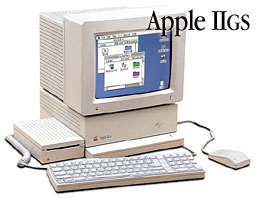
Apple IIGS
In September, Apple released the IIGS, its answer to the Atari ST and Amiga. The Apple IIGS was compatible with the Apple II, but it included many new features. It had integrated MIDI, high-resolution color, and ADB (Apple Desktop Bus) ports.
Apple even created IIGS/OS, a Mac-like operating system shell for the computer. Very few developers took advantage of the new features, and Apple did little to promote it (publishing only a few print ads), hoping that developers would move from the Apple II to the Macintosh.
This article was originally published in 2005 and has been updated with additional links and images.
Software
- Lotus 1-2-3, Wikipedia
- WordPerfect, Wikipedia
- dBase II, Wikipedia
- MultiPlan, Wikipedia
- Lotus Jazz, Wikipedia
- Microsoft Excel, Wikipedia
- Switcher software
Computers
Personalities
- Steve Wozniak, Wikipedia
- John Sculley, Wikipedia
- Steve Jobs, Wikipedia
- Andy Hertzfeld, Wikipedia
- Andy Hertzfeld: Mac Truly a Better Way
Other
Bibliography
Some of the sources used in writing this article:
- Apple: The Inside Story of Intrigue, Egomania, and Business Blunders, Jim Carlton
- Infinite Loop, Michael Malone
- The Second Coming of Steve Jobs, Alan Deutschman
- Apple Confidential 2.0, Owen Linzmayer
- Odyssey: Pepsi to Apple . . . a Journey of Adventure, Ideas & the Future, John Sculley
- Wikipedia
keywords: #macintosh128k #mac128k #mac512k #macplus #mac521ke #laserwriter #postscript #pagemaker
Short link: https://goo.gl/gnffZL
