
2000 – In one of my Mac Lab Report columns, I discussed the usual arguments that fly between passionate users regarding the superiority of the Mac vs. the PC platform. However, a dispassionate outside observer might listen to such an argument and rightfully ask, “What difference does it make? Just get on with your work,” and expect that to settle the matter.
Of course, it never does. The reason that people remain entrenched in the platform wars is not because one side is right or wrong. Clearly, the Mac side is correct in noting that the better integration of software and hardware from one vendor has its advantages. Yet there is just as surely a case for the economies of scale seen in the Wintel camp.
The reason the fight continues is very simple and explains not only our passion for our favorite computing platform, but also our stubbornness to acquiesce in the face of ambiguous election results.
The reason the fight continues, and why you still find advocates stubbornly using older technology including Amigas and Atari STs, is that we want to reassure ourselves we made a wise investment.
This is the same motivation that makes people stubbornly hang on to stocks when others sell them, keep repairing and bragging about a particular brand of vehicle past all point of reason, and certainly what motivates the lackeys of Mr. Gore and Mr. Bush to accuse each other of unfairness and even unpatriotic behavior. It is what motivates Evangelists to argue that Wintels are a hopelessly inelegant technology that no one really likes but everyone uses because they have no choice, and what motivates IT departments of large corporations to insist that they be Apple-free, because it would difficult (for them) to maintain a cross-platform network.
In the case of Apple (the side I personally support, obviously), I find the arguments regarding the cost/benefit ratio, the integration of hardware and operating system (for true plug and play), and the implementation of the desktop metaphor more convincing than for the Wintel side. Even though my motivation is to demonstrate, to myself and others, that I did not spend my hard-earned money foolishly, I find there are enough compelling reasons to have made the choices I made that I can sleep well at night.
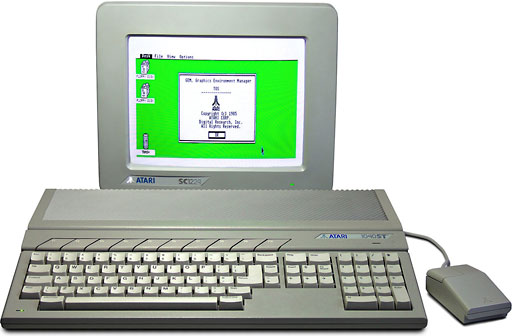 One thing keeps nagging me, however. I used many of the same arguments to justify my purchase and support of the Atari ST computing platform. At the time it was new (ca. 1987), in my view, it held many of the advantages of the Mac OS did regarding the implementation of the GUI, yet it was much cheaper and used a DOS-like file structure on disks. Opening a window on an Atari ST revealed a list or icon view as in a Mac. Opening a subfolder replaced the contents of the original window with the subfolder’s contents, reducing the clutter of windows common for new users of the Mac OS. This is what I understand happens with Mac OS X windows as well, although I haven’t tried the beta myself.
Eventually I found myself the proud owner of a desktop computer that had no software available in any local store, no magazine support (because the publishers couldn’t pull a profit), and a dwindling market share. What killed Atari’s desktop computer (except for those “obsessive diehards” you can still find on the Net) besides terrible marketing was that the OS was on a chip, not on the hard drive or a floppy, so the thing would boot even without a drive attached. This made upgrading the OS while being backward compatible problematic, and developers found it irritating, to say the least. I owned three different Atari STs – some would run this piece of software, and some wouldn’t, and so on. When the little irritations with the product become larger than its usefulness, people will switch, like I eventually did.
Now go back and read that paragraph again, and substitute Mac for Atari.
I hope I haven’t made the same mistake twice. I don’t think I have. Time, Steve Jobs, and OS X will tell.
Short link: http://goo.gl/cB2XJ7
