

Low End Mac Workhorses
Carl Blake - June 23, 2000
My Turn is Low End Mac's column for reader-submitted articles. It's your turn to share your thoughts on all things Mac (or iPhone, iPod, etc.) and write for the Mac web. Email your submission to Dan Knight .
I have always been involved with the Mac, starting with my first 128K unit that wowed me with MacDraw and MacPaint and the 400k floppy disks.
I started my first ISP based around the Macintosh in 1993. There was only one internet mail server for the Mac, Apple Internet Mail Server written by Glenn Anderson. I had to use Unix for everything else. I even used a Quadra 950 with the special board in it so I could run A/UX, Apple's version of Unix. It ran great.
But I used Sun equipment for DNS and other vital services. All management machines were Macs, including billing and customer information. I wrote a HyperCard stack that allowed us to create users and passwords, then set them up into a Livingston Portmaster with a special modem rack system I developed because at that time there were no racked modems that were cost effective.
Over time, since we were one of the first ISPs around, we had a large number of customers and were getting more and more every single day. It was crazy. We were adding sometimes 30 or 40 people a day to the system. Everyone, of course, thought we ran everything with Windows machines, but even then there was nothing really of use on the PC side of things for doing ISP work.
Clients were led to believe that their email was running on a very large Sun server. The reality was that over 2500 mail users were being served from an SE/30 with 32 MB of memory, a large (for an SE/30) 2 GB hard drive, and a Dayna internal ethernet interface.
I made nightly backups of the data files. It crashed really hard once in the beginning, and I could not resurrect the data files and user files, so I sat through an entire night recreating all the email logins. What a nightmare. But I learned my lesson. I started doing backups nightly without fail. I never had a problem after that.
Understand, that over the years I started getting larger and larger clients, from Huffy Sports to Allen Bradley and many other large corporate clients. From time to time some of the IS folks from these companies would come by and want to see my set up or see the server clusters, etc. They all thought that since I was so into computers, I would have to have some kind of big powerful machine.
It was obvious I couldn't use something less than a mainframe with all the clients we had and networks we managed. After all, I liked toys, and many of them knew that. I would get asked the question all the time, "What machine serves your personal email?" I would then point over to this giant refrigerator looking thing. In fact, it was bigger than a refrigerator. It was a Sun MP690 solid steel housing complete with blinking lights and whirring fans running (really loud fans sounding like two F16s taking off). My clients would just oooohhh and ahhhh over this thing and think it must be doing some enormous calculation or some task beyond the comprehension of mere mortals. Of course, I did not make them think anything different, after all, thinking different was not the fad back then.
The reality was that the Sun MP690 was an authentic Multi Processor
Sun box that at one time had housed a very large Sun computer. It
weighed some 400 to 500 pounds. However, I had since removed the
computer and all its components 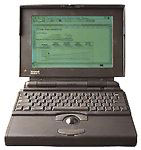 except
for the blinky lights and whirring fans. I left the fans in to cool it
down. I left a shelf in it and put my giant enormous computer in there
- a PowerBook 170.
except
for the blinky lights and whirring fans. I left the fans in to cool it
down. I left a shelf in it and put my giant enormous computer in there
- a PowerBook 170.
This was not just any PowerBook 170. This poor little computer had been through hell. The trackball no longer worked, the screen only came up half way, you could not even move the curson to get to any controls, and the modem port had been taken out by lightning. If you put a battery in it, the thing would spark and shut down immediately. I put an APC battery back up on the poor thing, turned it on, and away it went! Then installed Timbuktu. That is how I got around the mouse and screen problem.
Your probably wondering how I connected it to the network. I then used a Farallon SCSI ethernet adapter. Keep in mind that Farallon never made them compatible with Open Transport, so I had to install a special version of the OS and AppleTalk Networking - and then use MacTCP to set it up.
Timbuktu worked like a champ. If the 170 crashed, it was a simple matter of unplugging it from the APC unit and hitting the power button. It was back on in a minute. It had 8 MB of memory (the maximum it could take) and a 500 MB hard drive.
I never once was questioned on what I was using. I had many many clients actually using that machine that were personal friends and not one knew that it was a PowerBook on its last leg. That machine actually kept running night and day for over 4 years. It finally gave up the ghost one day when a technician touched the ethernet adapter and nailed it with a static charge. It popped the mother board. That was it.
To this day I am still using that same copy of Apple Internet Mail Server that was written so long ago. What is it running on today? I'd like to say a G4 fully loaded, but that would be a lie, and it would certainly not be using the Low End Mac to its fullest. I am using a Quadra 700 and running over 30 domains from it with over 140 email accounts.
I also have a large AS/400 steel cabinet, and that only has a fan in it as well, but the cabinet is full of SE/30s. People think it's an AS/400. I don't tell them otherwise. Why ruin the illusion?
How is that for touting the Low End Mac? Show me any Windows box made the same year as the SE/30 (1989-90) or the Quadra 700 (1991-93) running Internet apps for so long and so reliably.
In fact, I am guessing that you can't even find a Windows box that could come close to the PowerBook 170, which is the newest of the three machines.
Share your perspective on the Mac by emailing with "My Turn" as your subject.
Join us on Facebook, follow us on Twitter or Google+, or subscribe to our RSS news feed
Today's Links
- Mac of the Day: PowerBook 500 Series, introduced 1994.05.16. 'Blackbird' includes a 25 to 33 MHz 68040 along with smart batteries and grayscale or color displays.
- Support Low End Mac
Recent Content
About LEM Support Usage Privacy Contact
Follow Low End Mac on Twitter
Join Low End Mac on Facebook
Favorite Sites
MacSurfer
Cult of Mac
Shrine of Apple
MacInTouch
MyAppleMenu
InfoMac
The Mac Observer
Accelerate Your Mac
RetroMacCast
The Vintage Mac Museum
Deal Brothers
DealMac
Mac2Sell
Mac Driver Museum
JAG's House
System 6 Heaven
System 7 Today
the pickle's Low-End Mac FAQ
Affiliates
Amazon.com
The iTunes Store
PC Connection Express
Macgo Blu-ray Player
Parallels Desktop for Mac
eBay