

Not Another Ten Best List
Mike Sherman - 2002.01.23
My Turn is Low End Mac's column for reader-submitted articles. It's your turn to share your thoughts on all things Mac (or iPhone, iPod, etc.) and write for the Mac web. Email your submission to Dan Knight .
Over the past few weeks, I have read several articles on the all-time best and worst Macs ever built. I figured it was time to put in my two cents.
My qualifications? I have been an avid Mac fan and evangelist since 1989 and own 28 Macs (including nine mentioned in this article) ranging from a 128K in the original box to my current G4/500 Dualie.
So what constitutes a great Mac?
There were several criteria that I considered. Outstanding design, either from a physical or technological standpoint, on-target fulfillment of a market demand, or simply a machine without which the world of Macintosh computing might not have been the same.
That said, here are my Top Ten Macs of all time listed in chronological order.
1. Mac Plus (1986-90)
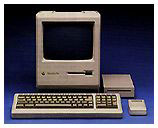 While it spent most of
its long life as the budget Mac, when it was introduced the Plus was a
true "Wunderbox." A full megabyte of RAM (expandable to 4 MB!),
SCSI (external 20 MB hard drive), an 800K floppy drive, and a beefed up
ROM containing the HFS (Hierarchical File Structure) made the Plus the
first Mac ready to do real work. Despite being overshadowed by the Mac
II and SE a little over a year into its run, the venerable Plus
remained on the price list nearly five years! How many computer models
today could survive a run of half that duration? Truly the Model T of
Macintosh.
While it spent most of
its long life as the budget Mac, when it was introduced the Plus was a
true "Wunderbox." A full megabyte of RAM (expandable to 4 MB!),
SCSI (external 20 MB hard drive), an 800K floppy drive, and a beefed up
ROM containing the HFS (Hierarchical File Structure) made the Plus the
first Mac ready to do real work. Despite being overshadowed by the Mac
II and SE a little over a year into its run, the venerable Plus
remained on the price list nearly five years! How many computer models
today could survive a run of half that duration? Truly the Model T of
Macintosh.
2. Mac II (1987-90)
I can hear the howls now - the Mac II? What is it doing on a "ten
best" list? It's a fact that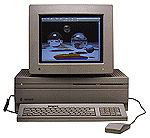 the Mac II did not age well. Bulky and equipped with the
short-lived 68020 processor, it was a dinosaur by the end of the
decade. But to appreciate the Mac II, one must return to the beginning
of 1987 when Apple offered the Plus and the 512Ke. Both were 8 MHz 68000
machines with 9" black and white monitors. No slots, no color (or
gray!), and no speed - just a great graphical interface and the promise
of better things to come. The II opened the door to the future of
Macintosh computing. It did not reign long as the speed champ, nor was
it a particularly endearing design. But its importance for what it
brought to the platform cannot be overstated. Merci, Monsieur
Gassé.
the Mac II did not age well. Bulky and equipped with the
short-lived 68020 processor, it was a dinosaur by the end of the
decade. But to appreciate the Mac II, one must return to the beginning
of 1987 when Apple offered the Plus and the 512Ke. Both were 8 MHz 68000
machines with 9" black and white monitors. No slots, no color (or
gray!), and no speed - just a great graphical interface and the promise
of better things to come. The II opened the door to the future of
Macintosh computing. It did not reign long as the speed champ, nor was
it a particularly endearing design. But its importance for what it
brought to the platform cannot be overstated. Merci, Monsieur
Gassé.
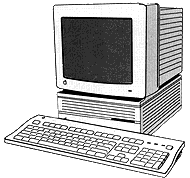 3. Mac IIcx (1989-91)
While the Macintosh world welcomed the enhanced performance and expandability of the Mac II in the spring of 1987, the huge PC-style case was most "un-Mac-like." Seen as a necessary evil, it was everything Mac's weren't supposed to be. So whack it in half and place a perfectly matched 13" monitor on top and voilà - a Mac that is again easy on the eyes and desktop. The two slots that remained after the video card was installed proved adequate for most users, and the 16 MHz 68030 processor was plenty sprightly running System 6. The IIcx proved immensely popular, and its replacement with the IIsi in the fall of 1990 was viewed as a premature passing.
4. Mac SE/30 (1989-90)
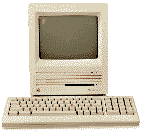 The closing year of the 1980s
was unarguably one of the Mac's finest. A compact, all-in-one design,
the SE/30 was the perfect number crunching box for busy executives with
crowded desks. A built-in hard drive, RAM expandability to 128 MB (if
you could afford it), a 1.4 MB floppy SuperDrive that could read PC
disks, and a speedy '030 processor freed of most of its video duties
made for a machine that begged to run Excel and FileMaker. For nearly a
decade, the Mac SE/30 remained a useful tool for basic financial
analysis, and their price on the used market reflected this.
The closing year of the 1980s
was unarguably one of the Mac's finest. A compact, all-in-one design,
the SE/30 was the perfect number crunching box for busy executives with
crowded desks. A built-in hard drive, RAM expandability to 128 MB (if
you could afford it), a 1.4 MB floppy SuperDrive that could read PC
disks, and a speedy '030 processor freed of most of its video duties
made for a machine that begged to run Excel and FileMaker. For nearly a
decade, the Mac SE/30 remained a useful tool for basic financial
analysis, and their price on the used market reflected this.
5. Mac IIfx (1990-92)
I know, you've all read a thousand times how "wicked fast" the fx was, but it really was. Motorola cranked the aging 68030 up to 40 MHz, and Apple added a slew of "helper" chips onto the motherboard to keep the CPU doing what it did best. The fx really shone on complex mathematical and graphics calculations, turning in results more that twice as fast as the IIci, the previous speed champ. Even by today's demanding standards, loaded with System 6.0.5 and "period" software, the fx flies. All this performance came at a healthy price, however, and the fx shares the dubious distinction with the 20th Anniversary Mac of having broken into five figures. But today, who really cares? For around fifty bucks, you can acquire this object of extreme envy from only a decade ago.
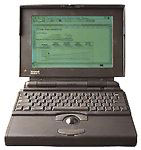 6. PowerBook 170 (1991-92)
Okay, so the original Mac Portable wasn't very portable, but when Apple finally "got it," they did it right. Of the three original P-books, this one was the prize. While the lower-end Books featured a marginal supertwist LCD screen and ho-hum performance, the 170 sported an active matrix screen, a "IIci-class" processor with a math coprocessor (remember those?), and a built-in modem. Ready to roll - again though, at a healthy price.
7. Quadra 840av (1993-94)
The Quadra 840av sent the old CISC 680x0 architecture out with a bang. Equipped with an AT&T digital signal processor (DSP) chip, the 40 MHz Quad 840 was able to pull off some amazing video and audio tricks that many of its successors remained unable to accomplish even years later. (See Adam Guha's excellent series on this computer elsewhere on this site.) Fact was, until your software was "PowerPC native," the Quad 840av blew the doors off the first generation PowerMacs.
- Treasure your Quadra 840av, Adam Robert Guha, Apple Archive, 2001.08.17. Amazing video effects, stunning sound input, amazing SCSI throughput, and other outstanding features of the Quadra 840av.
- Quadra AVs and some cool things you can do with them, Adam Robert Guha, Apple Archive, 2001.08.10. Thanks to digital signal processors, the Quadra AVs remain useful video machines.
8. Power Macintosh 8600/9600 (1997-98)
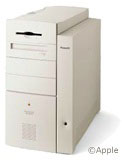 After years of scraped
knuckles and little piles of Phillips-head screws, Apple finally took
the hassle out of upgrades with an ergonomically designed case that
almost begged the owner to "pop the hood." With tons of expansion room
(5 bays and 12 DIMM slots in the 9600!), complete legacy I/O support
(ADB, SCSI, serial port and a floppy drive), quick processors
(especially the last 604ev "Kansas" line at up to 350 MHz), a
conservative beige case, and tons of upgrade options, these models
remained the choice of many graphics professionals for several years
after their discontinuance. Demand has only recently been dampened by
their inability to run OS X.
After years of scraped
knuckles and little piles of Phillips-head screws, Apple finally took
the hassle out of upgrades with an ergonomically designed case that
almost begged the owner to "pop the hood." With tons of expansion room
(5 bays and 12 DIMM slots in the 9600!), complete legacy I/O support
(ADB, SCSI, serial port and a floppy drive), quick processors
(especially the last 604ev "Kansas" line at up to 350 MHz), a
conservative beige case, and tons of upgrade options, these models
remained the choice of many graphics professionals for several years
after their discontinuance. Demand has only recently been dampened by
their inability to run OS X.
9. The Original iMac (1998)
Any color you want, as long as it's Bondi Blue. A funky color and an undersized mouse and keyboard couldn't keep the masses away. They came in droves and returned Apple to financial health - for a couple of years anyway. The iMac was Steve's first big success after returning from his long sabbatical, introducing millions to the joys of the Mac OS. (Apple sold 6 million iMacs before rolling out the new LCD model.) The iMac proved to be a true Internet "appliance" without the severe limitations of the Wintel efforts. While getting long in tooth today, the CRT-based Mac has enjoyed numerous upgrades and minor revisions throughout its nearly four-year life. And remember, without the iMac, Apple might never have made it to OS X.
10. Titanium PowerBook G4 (2001)
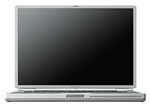 Abandoning the gently curved "gothic" look of the PowerBook
G3, Apple dazzled the world in January 2001 with the brushed titanium,
sharply angular look of the PowerBook G4. Only an inch thick and
weighing in at a svelte 5.3 pounds, the TiBook was thinner, lighter,
faster, cheaper, and had a wider screen than its predecessor. DVDs
never looked so good. Progress like that is tough not to like.
Abandoning the gently curved "gothic" look of the PowerBook
G3, Apple dazzled the world in January 2001 with the brushed titanium,
sharply angular look of the PowerBook G4. Only an inch thick and
weighing in at a svelte 5.3 pounds, the TiBook was thinner, lighter,
faster, cheaper, and had a wider screen than its predecessor. DVDs
never looked so good. Progress like that is tough not to like.
And lest anyone think Apple can do no wrong, the following five machines are proof that even the world's greatest computer company ain't perfect. The criteria for the worst machines, like those for the best machines, are varied. But in this brief list, I will attempt to focus on designs that were out-of-step with the market, exceptionally poor values, or miserably engineered.
The Worst Macs
Models such as the recent Cube, though overpriced and commercially unsuccessful, certainly don't merit inclusion with this sorry bunch. Again, in chronological order:
1. Mac Portable (1989-91)
 This
one was a tough call. While the Portable was not a bad computer, it was
a bad portable computer, and therein lay the rub. A
sixteen-pound, lead acid battery powered, briefcase-sized machine was
not what busy execs on the go wanted to be hauling up and down the
terminal concourse. Once set up and in place, the Portable was a
respectable 16 MHz computer with a decent screen and keyboard. But if
that was what you were after, the IIcx would have filled the bill
nicely, for less money, and included an '030 to boot. As an attempt to
fill the mobile niche, the Portable just didn't cut it. Early Mac-heads
on the go could always turn to Outbound.
This
one was a tough call. While the Portable was not a bad computer, it was
a bad portable computer, and therein lay the rub. A
sixteen-pound, lead acid battery powered, briefcase-sized machine was
not what busy execs on the go wanted to be hauling up and down the
terminal concourse. Once set up and in place, the Portable was a
respectable 16 MHz computer with a decent screen and keyboard. But if
that was what you were after, the IIcx would have filled the bill
nicely, for less money, and included an '030 to boot. As an attempt to
fill the mobile niche, the Portable just didn't cut it. Early Mac-heads
on the go could always turn to Outbound.
2. Mac Classic (1990-92)
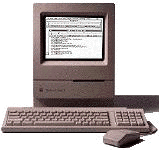 Just as the
IIfx looked three years ahead in performance, the poor Classic looked
three years (or more) in the opposite direction. After all, Apple
wasn't going to let you leave the computer store too happy for less
than a grand. So what did you get for your hard-earned $999? Not much.
One megabyte of RAM (with extremely limited, proprietary expansion), no
hard drive, and a nearly eight-year old processor running at a six-year
old clock speed. (For $500 more, you could get a Classic with 2 MB
RAM and a 40 MB hard drive.) A year later, Apple finally got around to
introducing the machine they should have originally - the 16 MHz
'030-based Classic II.
In fairness to Apple, $999 was not much for a computer in 1990. In
fairness to us, the Classic was not much of a computer. An antique at
birth.
Just as the
IIfx looked three years ahead in performance, the poor Classic looked
three years (or more) in the opposite direction. After all, Apple
wasn't going to let you leave the computer store too happy for less
than a grand. So what did you get for your hard-earned $999? Not much.
One megabyte of RAM (with extremely limited, proprietary expansion), no
hard drive, and a nearly eight-year old processor running at a six-year
old clock speed. (For $500 more, you could get a Classic with 2 MB
RAM and a 40 MB hard drive.) A year later, Apple finally got around to
introducing the machine they should have originally - the 16 MHz
'030-based Classic II.
In fairness to Apple, $999 was not much for a computer in 1990. In
fairness to us, the Classic was not much of a computer. An antique at
birth.
3. Mac IIvx (1992-93)
Talk about a disappointment. Take an aging four-year old processor with a 32-bit bus, hobble it with a 16-bit bus, overprice the computer, and replace it four months later with the much faster and cheaper Centris 650, and you have one of Apple's sorriest efforts ever. The ill-conceived IIvx offered 3-4 year old performance upon its introduction - inexcusable in the fast-changing computer industry - and clearly reflected the hubris of John Sculley in his waning days at the helm. The only bright spot - a built-in CD ROM drive.
4. PowerBook 5300 (1995)
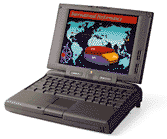 Incendiary batteries, a self-destructing
case, and quality control from hell almost ruined what until that point
had been one of the bright spots in Apple's mid-90s lineup, the
PowerBooks. In an attempt to update the line with the PowerPC
processor, Apple engineering simply dropped the ball and rushed a
thoroughly under-tested product to the market. Given proper testing,
problems with Sony's lithium ion batteries might have surfaced, and the
high mortality rate of minor accessories like the logic board might
have as well. Coming at the nadir of Apple's rocky journey through the
mid-90s and prior to the return of St. Steven the Wise, I guess it
could have been worse. Apple at least offered a modicum of relief to
beleaguered owners.
Incendiary batteries, a self-destructing
case, and quality control from hell almost ruined what until that point
had been one of the bright spots in Apple's mid-90s lineup, the
PowerBooks. In an attempt to update the line with the PowerPC
processor, Apple engineering simply dropped the ball and rushed a
thoroughly under-tested product to the market. Given proper testing,
problems with Sony's lithium ion batteries might have surfaced, and the
high mortality rate of minor accessories like the logic board might
have as well. Coming at the nadir of Apple's rocky journey through the
mid-90s and prior to the return of St. Steven the Wise, I guess it
could have been worse. Apple at least offered a modicum of relief to
beleaguered owners.
5. Power Mac 5200/5300/6200/6300 (1995-96)
What worst Mac list would be complete without these relics of the dark Spindler/Amelio era. A confused product in a confused product line, this "wicked bad" series suffered from about every ill a Mac could - poor engineering, mediocre speed, reliability problems, and some unique architectural issues that crippled Internet performance. As a general rule, anytime Apple built a computer "down" to a price, they came up with some extremely creative and cruel ways to handicap the machine and make the buyer regret not spending more. On this series, they pulled out all the stops.
- Performa and Power Mac 5200, 5300, 6200, 6300 Issues, Scott L. Barber, Online Tech Journal, 1997.12.30.
- Power Mac and Performa 5200-53xx & 6200-6320, Dan Knight, Road Apples, 1998.01.10.
- PDS Power Macs: Road Apples?, Adam Robert Guha, Apple Archive, 2000.09.29.
And there you have it - one Mac collector's biased look at the last 17 years. There are those who will question my sanity putting the clunky Mac II in the ten best, and rabid fans of the Portable who will do worse, but I have a thick skin and would love to hear from you regardless. After all, it's just an opinion, and, moreover, just a hobby.
Share your perspective on the Mac by emailing with "My Turn" as your subject.
Join us on Facebook, follow us on Twitter or Google+, or subscribe to our RSS news feed
Today's Links
- Mac of the Day: PowerBook 500 Series, introduced 1994.05.16. 'Blackbird' includes a 25 to 33 MHz 68040 along with smart batteries and grayscale or color displays.
- Support Low End Mac
Recent Content
About LEM Support Usage Privacy Contact
Follow Low End Mac on Twitter
Join Low End Mac on Facebook
Favorite Sites
MacSurfer
Cult of Mac
Shrine of Apple
MacInTouch
MyAppleMenu
InfoMac
The Mac Observer
Accelerate Your Mac
RetroMacCast
The Vintage Mac Museum
Deal Brothers
DealMac
Mac2Sell
Mac Driver Museum
JAG's House
System 6 Heaven
System 7 Today
the pickle's Low-End Mac FAQ
Affiliates
Amazon.com
The iTunes Store
PC Connection Express
Macgo Blu-ray Player
Parallels Desktop for Mac
eBay