
1998: Did you ever buy a computer, only to have them introduce a faster, more powerful model within months – sometimes at an even lower price?
Better yet, did you ever have it not happen?
It’s Always Been That Way
No, it’s not a conspiracy. It’s the nature of the industry.
Moore’s Law states that the capacity of integrated circuits (computer chips) will double every two years. It’s not a precise predictor of change – sometimes things move a bit faster than that.
What it means is that the space occupied by 256 KB of memory today will be able to hold 512 KB in two years, and 1 MB two years after that.
It means that CPUs can get smaller, allowing them to consume less electricity and generate less heat, and most of the time that also means a higher clock speed. It also means designers can add more features, such as larger on-chip caches, to make the processors even more efficient.
Smaller chips can run faster than larger ones since the electrons don’t have to move as far. (Yes, computers are so fast that the speed of electrons is a factor.)
In short, technology marches forward so quickly that you can expect computers will be twice as powerful and have twice as much memory at about the same price in two years.
Testing the Theory
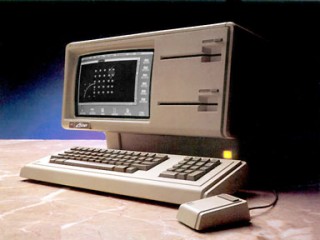 The year was 1983. Apple introduced the $10,000 Lisa with a 5 MHz 68000 CPU. One year later, Apple introduced the Macintosh at $2,500 (it had a smaller monitor and less RAM than the Lisa). Moore’s Law predicts a 7 MHz CPU (5 MHz times the square root of two); the original Macintosh runs at 8 MHz.
I can’t fathom why or how Apple stayed with the 8 MHz 68000 for so long.* It wasn’t until April 1987 that you could buy a faster Mac, the 16 MHz 68020-based Mac II. Coming three years after the first Macintosh, it should be about 2.8 times as fast. Benchmarks showed it to be about three as fast.
Apple’s next $10,000 computer was the “wicked fast” Macintosh IIfx. Sporting a 40 MHz 68030 CPU and some innovative RAM and I/O design, it was every power user’s dream. Since this was March 1990, it should have been 2.8 times as fast as the Mac II – and it was.
About eighteen months later (10/91) came the Quadra 700 with a 25 MHz 68040. Based on Moore’s Law, it should have been about 70% faster than the IIfx, but performance was closer to double. Very impressive.
The fastest Quadra ever was the 840av, running a 40 MHz 68040 and some special digital signal processors. This being July 1993, it should have been a bit less than twice as fast as the 700. And it was.
More Power
March 1994, ten years after the first Mac came out, Apple moved the Mac to RISC technology using the PowerPC chip. The top model at that times was the Power Mac 8100 with an 80 MHz 601 CPU. Only eight months after producing the Quadra 840av, Apple had introduced a model roughly 80% more powerful.
By June 1995, the Power Mac 9500 was running a 120 MHz 604, providing almost twice the performance of the 8100/80 – far more than Moore’s Law predicted.
There were other incremental improvements. The 604 was replaced by a faster 604e with a larger on-chip cache. It eventually reached speeds of 350 MHz, nearly three times what the 9500 first offered. But in 1997 development of the 604 came to an end.
 Last November, Apple introduced the Power Macintosh G3. Using the new PowerPC 750 processor with a fast backside cache, it cooked. The G3 was optimized for real-world Macintosh applications, not some theory of how a processor should work. That plus the cache plus other design changes made what was intended to be an entry-level CPU faster than the powerful 604e.
Not only was the G3 significantly more powerful than earlier PowerPC designs, but Byte magazine’s benchmark demonstrated that it offered up to twice the performance of a Pentium II running at the same clock rate. (Byte was one of the last magazines to cover multiple platforms. Shortly after these benchmarks, it was purchased by a pro-Windows publisher and put on hiatus.)
The first G3s ran at 233 MHz; Motorola has already announced 366 MHz, with 400 MHz just around the corner. (IBM even demonstrated a 1,100 MHz PowerPC prototype, but Moore’s Law anticipates that it will probably be 2000 before we can buy CPUs that fast.)
I can hardly wait to see benchmarks on these faster-than-ever Power Macs.
The Big Picture
Just how do today’s Macs compare with the original Macintosh? One way to find out is to run the same benchmark on both machines. The earliest Macs, from the 128K to the Plus, score 0.8 on Speedometer. A Mac SE or Classic scores 1.0.
A stock iMac at my local computer score pegs 109.5 on Speedometer 3.06 – roughly 135 times as fast as the original Mac. Fourteen years of Moore’s Law projects a computer with roughly 128 times as much power, so that’s very close to prediction.
However, the iMac is today’s entry-level computer. Running Speedometer on a Power Mac G3/233 at work showed a processor score of 175 – over 200 times as fast as the first Macintosh. This was undoubtedly helped by Speed Doubler’s better 680×0 emulator for running older Mac software (if you use a Power Mac, you owe it to yourself to buy Speed Doubler).
But that’s last year’s model. I don’t have a G3/300 to run Speedometer on, let alone the just announced 333 MHz model. I’d guess the G3/333 with Speed Doubler would score about 250, nearly twice what a strict interpretation of Moore’s Law would have predicted for 14 years of Macintosh evolution.
Conclusion
And that’s why you can expect your computer to be “one-upped” regularly. The industry works on marketing perceived advantages. If you can deliver 300 MHz instead of 266 MHz, that 12% sounds like a lot, so you’ll release it – even though 12% is about the smallest performance boost we can notice.
Don’t just expect your computer to feel a bit more outdated every few months. Expect that you’ll be able to buy twice the speed, twice the memory, twice the hard drive capacity (which has nothing to do with Moore’s Law, but it follows a similar pattern), and an even faster CD-ROM or DVD drive just two years after your last purchase.
(Another incredible thing is how long supposedly outdated Macs are useful. Through my Low End Mac site and several email lists I moderate, I’ve found a large community of people productively using even the oldest Macs.)
* The Mac Classic, the last model to use an 8 MHz 68000, was discontinued in September 1992, over eight years after the first 8 MHz Mac was introduced.
Further Reading
- Feeling Left Behind?, Mac Musings, 1999.06.02
keywords: #plannedobsolescence #unplannedobsolescense #mooreslaw
short link: https://goo.gl/tgMvwq
