
The first rule of computing: You can never have too much computer.
The first corollary: Your computer is never quite enough computer.
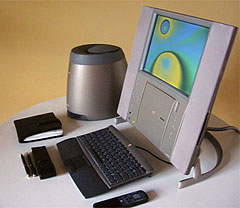 1998: On this rule and corollary rest the entire marketing strategy of the computer industry – with one exception: The iMac, Twentieth Anniversary Mac, and PowerBook G3 Series may be the only computers sold on the basis that no other computers are cool enough.
There has always been a strong upgrade market, starting with memory upgrades for early 4 KB and 16 KB computers, and that market is still growing today. The biggest differences are that we now work with megabytes of memory, gigabytes of hard drive space, and triple-digit megahertz ratings. (Most early computers ran at 1 MHz. One!)
In the old days, a faster computer usually meant much faster – probably a doubling in performance. CP/M boxes went from 1 MHz to 2 MHz to 4 MHz, then were displaced by the IBM PC with a 4.77 MHz 8088 processor. Soon clone makers started shipping “turbo” PCs with 8 MHz CPUs, two-thirds faster – and a very noticeable difference.
Two significant things happened in 1984. First, the Macintosh was introduced with a powerful 8 MHz 68000 CPU, and then IBM introduced the AT with a 6 MHz 80286 CPU. These computers were at least a generation more powerful than the Apple II and IBM PC lines.
The PC market was strongly shaped by marketing concerns. If IBM was selling a 6 MHz computer, someone would one-up it with an 8 MHz machine – and one-third more horsepower is noticeable.
Then came 10 MHz boxes, an addition 25% boost in performance. Of course, they were followed by 12 MHz computers offering 20% more speed. And the faster computers always had a premium price tag.
Back in Apple Land
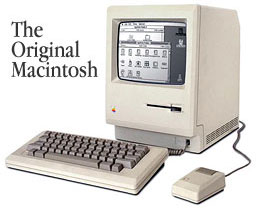
Apple didn’t stop. The original Mac was soon replaced by an almost identical model with four times the memory, the Macintosh 512K. Then came the Mac Plus, the first Mac with 1 MB of memory (take that, IBM clones with 640 KB maximum!), and the first Mac expandable to 4 MB (take that again, PC world!). And the new SCSI bus meant that users could link up to 7 drives to the Plus.
In 1987, Apple introduced the next generation Macintosh, the Mac II. Not only did the 16 MHz 68020 run at twice the clock speed of the 8 MHz 68000 in earlier Macs, it was also a far more efficient design. Overall performance was about three times that of the Mac Plus.
After a series of 16 MHz designs, Apple introduced the 25 MHz Mac IIci in 1989. The first Mac with built-in color video support, it was over 50% more powerful than the Mac II; with an optional cache card, it nearly doubled Mac II performance.
Then in 1990, when the DOS world was going gaga over 33 MHz 80386 machines, Apple introduced the best Mac II ever, the “wicked fast” Mac IIfx. Running a 40 MHz 68030 with a built-in cache and special high-speed memory, it doubled performance of the stock IIci.
Each time, upgrading to the top of the line meant at least 50% more speed than your previous Mac. This was in stark contrast to the PC world, where 16 MHz models gave way to 20 MHz ones, then to 25 MHz, 33 MHz, and 40 MHz. Each step offered only about 25% more horsepower than the previous model.
Fast Forward
Apple learned that buyers were willing to settle for a bit less speed if it made the computer more affordable, so it usually had several less costly models to supplement its performance leader, such as the Mac LC, IIsi, Centris line, and Performas.
The Quadra line was the first one where Apple adopted the 25% rule. The Quadra 700 and 900 ran at 25 MHz. These were followed by 33 MHz models, and the line topped out with the 40 MHz Quadra 840av.
Apple did the same thing with Power Macs. The first powerhouse was the 8100/80 with an 80 MHz PowerPC 601. This was topped by a 110 MHz version, providing over 30% more speed. In the next generation, the top of the line used a 120 MHz PowerPC 604, giving it roughly 50% more power than the 110 MHz 601.
But that was the end of the line for the 25% rule. Apple started copying the Wintel world, where manufacturers had learned to market even a 10% boost in performance.
From 120 MHz, Apple went to 132 MHz, then 150 MHz, each a tiny 10% speedup – but usually with more than a 10% difference in price.
Enter the G3
Then came the G3, starting at 233 MHz. This chip could almost hold its own against a 350 MHz 604e. The 266 MHz G3 was 14% faster, a small improvement over the 10% rule. But each additional 33 MHz provides a smaller gain than the previous one, until we reach today’s Power Mac G3/366 and 400 MHz G3 daughter cards.
For a slightly less than 10% difference in performance, buyers often pay a huge price premium. For instance, the Newer Technology MAXpower G3 at 366 MHz costs $1,600, but at 400 MHz, it’s $2,100. That’s 30% more money for an almost imperceptible (under 10%) difference in speed. (Studies have shown any performance difference under 15% on a computer system is generally imperceptible.)
XLR8 also offers cards in both speeds. The 366 MHz MACh Speed G3 is $1,500; the 400 MHz version, $1,900. That’s a bit over 25% more for almost 10% more speed.
PowerLogix offers less costly cards, asking $1,600 for 400 MHz and $1,400 for 366 MHz. That’s just under 15% more for just under 10% more speed, so it’s a much more reasonable price difference. (All prices from our Guide to G3 Daughter Cards.)
Sure, it’s nice to have the fastest CPU available, but that last 10% can add $20 to $600 to the price of a G3 card. Likewise, buying a Power Mac G3/366 holds a steep premium over the Power Mac G3/333.
Remember that a 10% boost in CPU performance may mean a 5% or lower boost in productivity, since it does nothing to make your hard drive, network, printer faster, let alone your typing.
All things considered, you’ll probably find the best computing value or upgrade value one or two steps below top of the line.
keywords: #computervalue #valueequation
