Mac Musings
Daniel Knight - Tip Jar
Personal Computing
Daniel Knight - 2001.04.11
At the tail end of every Apple press release is the image Apple wants to project:
- Apple ignited the personal computer revolution in the 1970s with the Apple II and reinvented the personal computer in the 1980s with the Macintosh. Apple is committed to bringing the best personal computing experience to students, educators, creative professionals and consumers around the world through its innovative hardware, software and Internet offerings.
Apple offered one of the last hobbyist kit computers, the Apple I, and the first consumer computer, the Apple II. With BASIC built into the ROMs, the Apple was a computer you could use right out of the box. This was in contrast to mainframes and minicomputers in "clean rooms" maintained by professionals and kit computers built by hobbyists.
Personal Computing
Unlike any computer that had gone before it, the Apple II was the personal computer for the non-geek. The Macintosh was all that - and even more so.
Where the Apple came with BASIC, the Mac included MacWrite and
MacPaint, an internal floppy drive and monitor, and 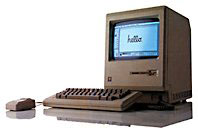 that
newfangled mouse. Where the Apple II had looked a lot like a
typewriter and the IBM PC like a terminal with 5.25" floppies, the
Mac even looked different. (At 9.6" wide and 10.6" deep, it didn't
take a lot more desk space than today's Cube.)
that
newfangled mouse. Where the Apple II had looked a lot like a
typewriter and the IBM PC like a terminal with 5.25" floppies, the
Mac even looked different. (At 9.6" wide and 10.6" deep, it didn't
take a lot more desk space than today's Cube.)
The contrast with the DOS boxes of the era was complete. They were business computers (that's what the B in IBM stands for); this was personal. They were hulkingly complex desktop monstrosities; this could be hauled around in a tote bag. They required you to learn DOS commands; this let you point and click to do your tasks.
Apple had invented personal computing in the mid-70s; they reinvented it in contrast to business computers in the mid-80s.
Business Computing
None of this is to imply that Macs can't be used in business; quite the opposite is true. Macs make wonderful business computers.
But Apple's model was different; they sought to empower individuals. IBM and Microsoft wanted to empower the corporation by creating "personal computers" that were less than personal. To this day Windows computers seem pretty much interchangeable faceless boxes, even if some have been jazzed up with colorful faceplates.
You see, right from the start, Apple was less concerned with creating the most powerful machine on the planet and more concerned with creating the best computing experience. The fact that Macs are powerful is no accident, but it's incidental to their being the best crafted tools for writing, editing, designing, manipulating images, accessing the Web, and handling email.
That's the image the 1984 ad brought home: Big Brother and his nameless drones cannot comprehend the power of the individual.
Be Different
Apple has always been different: unconventional, innovative, risk-taking, leading. The Mac is the computer for those willing to be different, too. Macs are built better, last longer, have a more stable OS, are easier to learn, and provide a more personalized computing experience.
That's Apple's strength. It's also Apple's downfall.
Mac owners are often fanatical about their computers. They cost us a bit more than Wintel drone machines, and they are worth it. We made a deliberate choice to buy different, to be nonconformists in a beige world. We are thrilled with the computing experience the Mac provides.
We also tend to hold onto our Macs far longer than Windows users keep their machines. Where some PC users have gone from XT to AT to 386 to 486 to several generations of Pentiums, Mac users may have skipped from a Mac Plus to a Quadra to a Power Mac. As long as they keep working and work comfortably, we see no reason to upgrade. (I used a Centris 610 for five years; few Windows users would dream of keeping a computer so long.)
This is part of the reason Apple isn't growing any faster and the core truth behind our April Fools Day High End Mac. We don't replace our computers nearly as often as Compaq and Gateway users do, so Apple has to constantly scramble for new users.
They do a good job of it. Apple sold 2.76 million Macs in fiscal 1998, 3.45 million in 1999, and 4.56 million in 2000. If they continue that trend, Apple may sell 5.5-6.0 million in fiscal 2001.
That's a lot of computers.
Sell Different
The problem is, Apple can't do it alone. Not only do they need us to stick with the Mac and be repeat customers (when we finally decide our old Macs are just a bit too slow to keep using), they need us to evangelize the platform. You and I, the Mac users, are Apple's most valuable resource.
We live in a world of interchangeable computers. PC Magazine and Consumer Reports rate brands side-by-side, because there is no essential difference on the PC side. They are all just slower/cheaper or faster/more costly versions of the same thing.
Fear
People are afraid to buck trends, afraid of getting stuck with Beta in a VHS world. We have to assure them that this is not the case. We have email. We have the Web. We have Microsoft Office, whether you're a fan of the program or not. Our Macs can comfortably coexist in a world dominated by Windows computers.
Fear is the first enemy. Fear that Apple will die. Fear that the Mac is incompatible. Apple is strong; the Mac is compatible. Being different doesn't mean being incompatible.
Cost
Cost is the second enemy. The 400 MHz "fast" iMac at $899 is a lot of computer for the money, but it's hard to convince friends and relatives to part with $899 when they see Wintel systems selling for less - printer and external speakers included. Even more than MHz, price is a huge stumbling block. So many times I've advised friends to buy Macs, then had to tell them I couldn't help with their new computer after they bought Windows because it was cheaper.
There are many ways to look at cost. The out-the-door price is our enemy; the annualized cost is our friend. If a Celeron system sells for $699 and is replaced in two years, the cost averages out to $350/year. If an iMac sells for $899 and is replaced in three years, it averages down to $300/year. And while the Wintel system might go three years tops, the iMac could have a useful life of 4-5 years.
Of course, a first-time buyer probably doesn't think that way, nor do a lot of repeat buyers. They become used to "buy new every two" (or maybe three). They think they're buying an information appliance that will last for years, not knowing it's built like a cheap VCR or phone that might give out inside of two years.
Macs are the better value, because they really do last longer - Apple's problem, but also our opportunity. A lot of us can demonstrate this by looking at how long we've used our Macs and how older Macs have been put into productive use long after equally old PCs have become doorstops. (A few years back, Apple claimed that 79% of all Macs ever built were still in use.)
Upgrades
Most of us eventually outgrow our computers. In the Mac world, it's very easy to clone everything from your old hard drive to the one in your new Mac - sometimes you can even transplant the hard drive itself.
In the Windows world, there's no easy way to do that. You can't simply copy all your files to CD or link to your computers via ethernet and transfer every single file to virtually recreate your old computing experience on your new computer. It's not impossible to get there, but it's nowhere near as easy as it is on the Mac side. (What about OS X? I don't know yet.)
Ease of Use
There are those who debate whether Macs really are easier to learn and use than PCs. The point is that Macs are easier to use in the long term. From System 0.97 through 9.1, the same skills have formed the foundation of the Mac user's experience. Apple has enhanced the OS and the interface over the years, but what you did under one version of the Mac OS would carry over to the next.
Windows hasn't really been like that. They keep trying to get things right, making an interface change here, a file change there, and ending up with a whole family of similar but different operating systems: Windows 3.1, 95, 98, Me, NT, 2000, CE, and the Pocket PC OS.
Until Mac OS X, Apple kept everything pretty much the same, almost always adding to the interface and OS without taking away any of the old features. It has made for a very happy user community - one which has vociferously questioned every change from the established conventions while Apple tried to finish OS X.
Once we reach OS X nirvana, I suspect we'll see the same kind of incremental growth we experienced with the old Mac OS. What worked before will continue to work. Better yet, people will keep finding better ways to do things without eliminating the old ways.
Community and Support
We're moving from the concrete to the ephemeral, but you and I know there's something very special about Mac users. For the most part, we see ourselves as a community and are generally quite willing to help each other. Unlike Windows users, we don't just say, "Wipe the hard drive and reinstall the operating system." For the Mac user, that's a rare last resort.
This brings us back to other aspects of cost: down time and technical support. Macs spend a lot less time down, rarely need their system reinstalled, and seldom go in for service. We lose less productive time than Windows users. We have less need of Mac gurus to keep our systems going - another part of the reason Wintellians dominate Information Technology.
Year after year, the total cost of owning a Mac is lower. (Tell your school board next time they want to go Windows!)
Personal Computers
"Think Different" isn't just a slogan - Apple Computer really is different. The Mac is different. Mac users are different.
The world marches to the beat of the Wintel drummer, and the masses follow.
A few will find the Macintosh way on their own, but unless we advocate for the Mac, the rest will think blue screens of death, 63,000 bugs, and system reinstalls are the way computing has to be.
We need to point them to a more excellent way and ignite their interest in personal computing, not business computers.
Join us on Facebook, follow us on Twitter or Google+, or subscribe to our RSS news feed
Dan Knight has been using Macs since 1986, sold Macs for several years, supported them for many more years, and has been publishing Low End Mac since April 1997. If you find Dan's articles helpful, please consider making a donation to his tip jar.
Links for the Day
- Mac of the Day: PowerBook 500 Series, introduced 1994.05.16. 'Blackbird' includes a 25 to 33 MHz 68040 along with smart batteries and grayscale or color displays.
- Support Low End Mac