Mac Musings
The New Apple
Daniel Knight - 6 January 2000 -
Just over a week ago, on one of those cold, wintry, black-ice
days, my wife lost her '95 Bonneville to the back end of a delivery
truck. The truck braked and slid; she braked and slid into the
truck. Thanks to a complete lack of standards regarding bumper
height, her bumper didn't receive a scratch.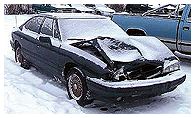 That
meant the air bag never deployed. Yet her car was totaled as the
truck's bumper shoved the hood and radiator into the engine,
shattering her battery and damaging the engine.
That
meant the air bag never deployed. Yet her car was totaled as the
truck's bumper shoved the hood and radiator into the engine,
shattering her battery and damaging the engine.
Linda was fine, if a bit shaken. Our insurance company came through with flying colors. The accident was on Tuesday. On Wednesday we knew how much the settlement would be. On Thursday we had a check.
We spent two evenings looking at replacement cars. Linda drives a lot; her adoption agency covers the entire state of Michigan. So a car that handles well, feels secure, and has cruise control was a must.
We looked at several and drove a few. It was a real learning experience. One car made a whistling noise. Others just felt cheaply built. Then we drove a '95 Grand Prix that had just come in. It felt as solid as the Bonneville and handled very nicely. Decision made.
Apple vs. the Microsoft PC
One of the best pieces I've ever read by John Dvorak is in the current issue of PC Magazine. In it, he looks at Microsoft and explains how it is not a conventional monopoly.
In Not a Monopoly, Marketing, Dvorak claims that Microsoft thinks it is a monopoly and acts accordingly. It, not Intel or IBM or Compaq, defines the hardware standard for the "Windows PC." MS doesn't make the hardware, but it lets everyone know what they have to do to make sure their PC is a Windows PC.
Having defined the specification, it must irritate Microsoft no end that Linux, BeOS, OS/2, and other operating systems run on Windows PCs, but the level of standardization Microsoft has forced on the PC industry probably makes it easier for other OSes to find a broad enough base to survive.
By analogy with cars, Microsoft with their Windows PC is a lot like GM. A lot of cars and even more parts are the same across the six product lines: Chevrolet, Pontiac, Buick, Oldsmobile, Cadillac, and GMC. They really don't care which brand you buy, as long as it's one of theirs.
Likewise, MS doesn't care if your computer is a laptop, cheap desktop, killer gaming machine, CAD workstation, or high end server. As long as you're buying Windows, they win. (Does this help explain why MS is working to marginalize Linux?)
Apple Is Different
Apple got its start in the days when computers were proprietary. You'd never dream of running a TRS-DOS program on a Commodore PET or an Apple II program on an Ohio Scientific computer. Until CP/M, each personal computer maker had their own OS. That's called vertical integration - the company makes the hardware and operating system.
That was the existing model. It had worked with IBM, Burroughs, DEC, and all the other mainframe and minicomputer companies. It worked for the first five or six years of the personal computer market.
Then IBM joined the game. Instead of creating a vertical solution, they wanted to invest as little as necessary into this curious new market, so they licensed an operating system from Microsoft, among others. This provided the fulcrum Microsoft needed to dominate the computer industry.
- Because IBM used off the shelf parts and didn't have an exclusive license with Microsoft, it was possible for Compaq, Columbia, and others to reverse engineer the PC and create the clone industry.
Apple didn't play the game. They stuck with the Apple II line as long as they could, eventually trying to hold their own against the DOS world with the Apple ///, the Lisa, and the Macintosh.
As Commodore, Atari, Amiga, and most of the CP/M companies fell by the wayside, Apple managed to eke out a coexistence with the Microsoft juggernaut by offering a powerful GUI and good desktop publishing programs in contrast to the DOS command line.
Windows changed all that, especially Windows 3.1 (1992), the first relatively powerful and stable version of Windows. Windows 95 brought parity with the Macintosh OS in the eyes of the average consumer and the businessman. And, from their perspective, Windows 98 vaulted Microsoft past Apple.
As Mac users, we know that perception isn't reality, but it's been an uphill battle. The world doesn't understand that it's more than a box of components and an operating system - it's a fully integrated power tool.
Steve Jobs understands that, and that is the key concept behind the new Apple. Apple doesn't sell hardware. It doesn't sell an operating system (which is why clones had to go). It sells the whole enchilada, computer and OS.
After all the others have failed or bowed before Microsoft, Apple remains the lone vertically integrated personal computer company. And that's the reason it can succeed with USB where the Wintel juggernaut failed, why it's able to push iMovie and FireWire when Intel and Microsoft are seething.
Macworld Expo 2000 in San Francisco
Because we still don't understand that, Steve Jobs hammered it home by not talking hardware, not using geek-speak, not putting the focus on the box.

It's taken considerable reflection to understand that Apple is selling power tools for the mind, not hot rods, SUVs, or cheap transportation. Each Mac is crafted for a certain group of users. Just as the Bonneville and Grand Prix feel right to my wife (and the Montana minivan to me), the iMac, iBook, Power Mac, or PowerBook will feel right to the user it's intended for.
This explains the friendliness of the Mac OS. It's meant to be picked up and experienced, not learned from a book or class. It's the opposite of the backyard mechanic tweaking his car for best performance. It's like buying the minivan that fits your family like a glove or the car that you just know is going to get you safely and comfortably from point A to point B.
Apple controls the user experience.
Microsoft can't. They control the operating system. They design the interface. But they have no idea if you'll be running a 366 MHz Celeron or a 750 MHz Athlon, whether your video is poky DRAM video or a highly charged video card, whether you'll use a modem or a LAN to connect to the internet.
The level of hardware and OS integration we are accustomed to is foreign to the Windows user. It all works together, but only because Microsoft keeps all the manufacturers in line with their annual hardware specifications.
To bring home the point that the Macintosh is a power tool, Steve Jobs kept the anticipated new PowerBook, multiprocessor Power Mac, and everything else out of his presentation.
Macintosh. It just works.
It's a brilliant, if dangerous, strategy. The very day Apple makes a decision to focus on solutions, Intel introduces a 533 MHz Celeron chip - that's the chip for low end PCs. And to the average consumer, that's going to seem faster than a 450 MHz G4 no matter how many times Apple runs the tank ad and says supercomputer.
The geeks will, for the most part, stick with Wintel hardware. The uber-geeks will buy or build the boxes, then run Linux. (Sorry, Bill, but geeks don't seem to be big Windows fans.)
These people are concerned with having the right hard drive, video card, modem, processor, and so forth. It's a never ending quest to have the most tweaked out computer.
Apple doesn't make computers for those people. It makes computers for people who need to get their work done, people who want a better tool than the beige boxes running Windows.
And it seems to be working. Two-thirds of iMac buyers never considered any other computer. They want the computer they know is easy to use, whether it's blueberry, graphite, or even (shudder) beige. The color was mostly to get their attention and scream out, We Are Different.
Sure, we'll see dual-processor G4 systems, better laptops, faster iMacs, and iBooks with more memory at some point. That's inevitable.
But those who stand on the shoulders of giants see further. They see the computer as a means to an end, not an end in itself.
- As a hardware geek, I need to keep reminding myself of this. Look at my site - the focus is mostly on hardware. I have hints on tweaking Macs. I run benchmarks. But in the end, I always remember that it's a means to an end. The faster hard drive lets me work faster. It's not about bragging rights.
That's the lesson Steve Jobs needs to drill home. I think he did a good job of it today. Apple is about solutions.
- Need a good internet computer? Over 90% of iBook and iMac users are on the internet. It's that easy.
- Need a portable for home? One in nine iBook buyers purchased it as a first computer. One in six switched from Windows. And for over half, it's the first portable computer in the home.
- Need an easy-to-use desktop? Three in ten iMac buyers are buying their first computer, and three in twenty are switching from Windows. Two of three iMac buyers never seriously considered any other computer.
- Need networking on the go? AirPort lets your roam 100' from your hub without wires, connecting to the LAN or internet at ethernet speed.
- Need to edit those home movies? The iMac DV makes it easy. Already one in ten iMac DV owners have made iMovies; a lot more plan to.
- Need to share those movies? QuickTime 4 lets you do that.
- Need to find a good website? iReview will help you.
- Need to send a cybercard but tired of the second-rate stuff? Pop on over to iCards. (The recipient won't even need web access to see it!)
- Need to protect your kids from the dark underside of the web? The KidSave iTool is for you. Apple even thinks different about filtering.
- Need an easy way to share your photos and movies? iDisk and HomePage let you do it in minutes.
- Need an internet service provider? Every new Mac will ship ready to link to Earthlink, Apple's ISP partner.
It goes on and on. Apple make solutions. The G4 is a killer Photoshop machine. The PowerBook G3/400 not only lets you work in the field, it also gives you a way to watch a movie. And on it goes.
The price of admission? You've probably already got the Macintosh. If you're happy, don't change a thing. But if you want access to the iTools and your Mac (or clone) has a PowerPC processor, you just need to invest in OS 9 for full access to KidSafe, Mac.com email, iDisk, HomePage, and iCards with your own photos.
It'll cost you under US$100 to add OS 9, unless you need a bit more memory. (OS 9 needs 40 MB, but I suggest you head toward the 96-128 MB mark if you want really good performance and room for OS X later this year.)
And OS 9 is about all Apple is trying to sell you today, unless you happen to need a new computer.
Apple could have turned the keynote address into a geekfest of specmanship, as they did with the 4 gigaflops G4/500 supercomputer last summer, but this company really does think different.
It's time to remind ourselves that there's a lot more to a car than horsepower, miles per gallon, and towing capacity.
Ditto for computers.
Further Reading
- Macworld 2000 Keynote Address Special Report, Mac News Today, 1/5. We couldn't be there, but caught it through the miracle of QuickTime 4.
Join us on Facebook, follow us on Twitter or Google+, or subscribe to our RSS news feed
Dan Knight has been using Macs since 1986, sold Macs for several years, supported them for many more years, and has been publishing Low End Mac since April 1997. If you find Dan's articles helpful, please consider making a donation to his tip jar.
Links for the Day
- Mac of the Day: PowerBook 500 Series, introduced 1994.05.16. 'Blackbird' includes a 25 to 33 MHz 68040 along with smart batteries and grayscale or color displays.
- Support Low End Mac