
We all get nostalgic about certain things. For some, it’s the first car. And sometimes, it’s the first Macintosh.
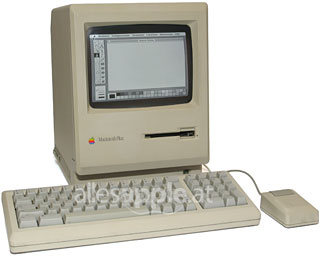 The first Mac I ever used was Mike Vander Wall’s Mac Plus, a beige machine recently upgraded from 512K “Fat Mac” status. We ran PageMaker 1.0 to design a booklet, then printed it on his amazing and huge LaserWriter printer.
It was late 1986. Mike pretty much walked me through the process step-by-step. In February of 1987, I got a sales job at the Heath/Zenith Computers and Electronics store in Virginia Beach, VA, where I abandoned my Commodore VIC-20 and 64 for a Zenith PC. The store carried Macs, but nobody really understood them, and the store manager wasn’t interested in getting us trained on them.
We moved back to Michigan over Thanksgiving weekend of 1988. I put in time at Radio Shack selling mostly 80286 machines, and then got my break. In July 1989, I started at ComputerLand of Grand Rapids. I was a DOS geek in a shop full of Mac lovers. I really didn’t understand them.
That holiday season Apple ran a sales promotion. Each Apple computer, printer, etc. was worth points. Earn enough oints, get Apple merchandise. I scraped together just enough for a Mac Plus and a black Apple carrying case.
I had no idea how much it would change my life.
My First Mac
A Plus all by itself can’t do much. One 800K floppy drive and 1 MB of memory didn’t go far. I could run Dark Castle. Or I could connect to the ComputerLand LocalTalk network and run files over the network, booting from a single 800K system floppy.
I borrowed a second floppy from a coworker, then scraped up enough money for two 1 MB SIMMs at $77 each. With 2.5 MB and that second floppy, I was going places! In fact, I spent $20 for a RAM Disk program from Dove (unlike System 7, System 6 does not have a RAM disk), although I don’t recall just what the purpose of that was from this distant point in history.
Over time I added another pair of 1 MB SIMMs, followed by a 40 MB Microtech hard drive. Even with my employee pricing, that was a $450 drive. The Quantum mechanism was one of the fastest available back then, and 40 MB seemed huge after my Zenith PC and its 20 MB drive. That Microtech lasted long past its five-year warranty, although it died sometime in intervening years.
 I ran a late beta of System 7.0 on that Plus, although I had to sign a nondisclosure agreement (NDA) for the privilege. That was also the machine where I learned to love ClarisWorks. (I still use AppleWorks 6 on my Macs running OS X 10.6.8 and earlier.)
Over Twice as Fast!
 It was also the first computer I accelerated. A company called Brainstorm had a clever hack that replaced the 8 MHz 68000 with a low power 16 MHz version. It did this right on the motherboard, which also required new ROMs to manage the timing differences. The Plus was actually a bit more than twice as fast with the upgrade.
Of course, I had to run Speedometer 3.0.2 to verify this. All systems listed below, except for the stock Mac Plus, were tested with System 7.5.5 and the disk cache set to 128 MB. The hard drives may well have been different, so don’t put much stock in disk scores. Except for slower hard drive scores, tests with System 6.0.4 showed almost identical performance on my Plus. The stock Mac Plus had only 1 MB of memory, so it was tested with System 6.0.4.
model       CPU graphics disk    math
Plus       0.88   0.94    n/a    1.00
Mac SE     0.98   0.98   1.13    0.99
Plus+BS1   2.03   1.95   1.28    2.18
Plus+BS2   1.90   1.84   1.21    2.05
Portable   2.15   1.82   1.24    1.95
Mac II     3.46   4.41   1.35    5.76
Mac IIcx   4.24   4.94   1.98    6.81
As you can see in the Plus+BS1 results, the Brainstorm upgrade more than doubles performance of my Plus, putting it right in the same ballpark as the 16 MHz Mac Portable. Way back in 1991, I thought the upgrade was an excellent value for $200. (The Brainstorm runs so fast it messes up sound. Installing their control panel and extension solves that, but it reduces overall performance by about 5%, as shown by the Plus+BS2 results.)
The only drawback of having Brainstorm upgrade my Mac Plus: It would no longer play Dark Castle. A small price to pay for doubling performance.
That Mac Plus was the beginning of my love for Macs. I used it until the summer of 1993, when I sold it to help finance a Centris 610 with 4 MB of memory, an 80 MB hard drive, and a 20 MHz 68LC040 processor. Compared to my Plus and the Mac IIci I used at work, it was an awesome piece of hardware – and it “only” cost about $1,340 plus monitor. (During 1990, we were able to “blow out” the Plus for $1,299 at ComputerLand.)
I sold my Plus to a coworker. When she upgraded, she sold it to her father. When he got an iMac, my coworker contacted me, I contacted her father, and I now own my first Mac again.
Some things are worth a bit of nostalgia. This computer is one of them.
Keywords: #myfirstmac #danknight #macplus
Short link: http://goo.gl/ZjZMUS
searchwords: macplus, brainstorm
