Mac Musings
Macintosh IIx: Apple's Flagship Gains a Better CPU, FPU, and Floppy Drive
Daniel Knight - 2007.09.19
Apple changed the face of the Macintosh when it introduced the modular 68020-based Mac II in March 1987. Not only was it more powerful than any previous Mac, but it blew the platform wide open by supporting color and expansion slots.
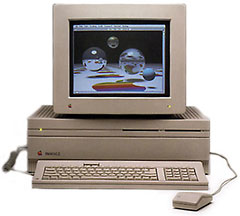
The Mac II, IIx, and IIfx
The 16 MHz Mac II could support up to six video cards, and the Macintosh operating system supported them easily. There was room for two 800K floppies and a 5.25" hard drive. The Mac II shipped with 2 MB of memory and could theoretically be expanded to 128 MB. (As such high density chips did not yet exist, Apple had no way of testing that.) For adding cards, there were six 32-bit 10 MHz NuBus slots, one of which had to have a video card.
Suddenly Macs weren't just "those little computers" with built-in 9" displays; they were business machines.
The Mac IIx
The Mac II was good, but Apple could do better - and did just 18 months later with the Mac IIx, which was unveiled on Sept. 19, 1988. Where the 68020 had been significantly more powerful than the 68000, the 68030 mostly added finesse and a built-in PMMU, which made virtual memory possible on the IIx. It also supported the improved 68882 math coprocessor, a step up from the Mac II's 68881.
Of course, being an Apple product, there was one more thing: The Mac IIx was the first Macintosh to support a high density floppy drive, known as FDHD (floppy drive, high density) or a SuperDrive (much later used to signify a DVD burner). With Apple's File Exchange software, it was now possible to read and write DOS floppies. (Windows scarcely existed in 1987.)
About the only drawbacks the Mac II and IIx share are that the PRAM battery is soldered in place and they weren't ready for the 32-bit memory model that would come with System 7 in 1991.
Shrinking the Mac IIx
The IIx formed the basis for Apple's next modular Macintosh, the compact Mac IIcx (March 1989), which trimmed the gargantuan 18.7" width of the Mac II series to a more reasonable 11.9" and dropping weight from 24 lb. to 13.6 lb.
Like the Mac II and IIx, the IIcx ran at 16 MHz and had no onboard video, depending on a NuBus video card. Unlike its bigger siblings, the IIcx had only three expansion slots, part of Apple's attempt to build a more affordable midrange desktop machine.
At $2,000 less than the $7,700 IIx, the IIcx was a runaway success, and it was succeeded by an even more powerful model, the Macintosh IIci, just six months later.
Faster Yet
The IIci was the first Mac to pass the 16 MHz mark - it ran at 25 MHz - and had onboard video, meaning users could have three available NuBus expansion slots.
On the plus side, it was fast video, handily outperforming video cards of the era. On the minus side, it was "vampire video", which meant that 64 KB to 320 KB of system memory was used for video (depending on resolution and bit-depth). Sharing system memory also slowed the rest of the system, as the CPU could not access RAM while the video chip was using it. A standard video card overcame that, but that meant slower video. The ultimate solution was an accelerated video card.
Perhaps the best feature of the IIci was a processor direct slot (PDS) that could be filled with a level 2 cache or, later on, a faster CPU. Apple eventually made a 32 KB cache card standard on the IIci, and several high speed 68030 and 68040 CPUs were made for the IIci PDS.
The "one more thing" introduced with the IIci was "32-bit clean ROMs", which paved the way for 32-bit memory addressing in System 7, letting the Mac move past the 8 MB barrier imposed by 24-bit addressing. That wouldn't matter for nearly two years; System 6 was strictly a 24-bit operating system.
The Mac IIci took the baton from the IIcx and ran with it for 3-1/2 years.
Wicked Fast
The culmination of the Mac II line was the Macintosh IIfx, a workhorse built for speed. In March 1990, the PC world was excited about 33 MHz computers, and Apple blew past them with the 40 MHz IIfx, a full-sized Mac II model with six expansion slots. The CPU and system bus ran at 40 MHz, and it used a pair of dedicated 6502 I/O processors to handle interfacing with the rest of the world and free the CPU for computing.
To top it all off, Apple introduced one more thing - its first accelerated video card, 8•24GC, which gave it a further edge over the competition. The computer itself cost US$10,000 and used expensive 64-pin memory for optimized performance, and every Mac power user lusted for one. Even today these ancient speed demons have a following.
While IBM compatible PCs were breaking the 640K barrier, tied to 16-bit 8 MHz expansion slots, and looking toward the day when Windows would become practical, Apple had created its own market (desktop publishing) and carved out a huge niche in the graphics industry. The Mac II family played a big part in building Apple's reputation as a powerful, friendly computer for creative types.
Join us on Facebook, follow us on Twitter or Google+, or subscribe to our RSS news feed
Dan Knight has been using Macs since 1986, sold Macs for several years, supported them for many more years, and has been publishing Low End Mac since April 1997. If you find Dan's articles helpful, please consider making a donation to his tip jar.
Links for the Day
- Mac of the Day: PowerBook 500 Series, introduced 1994.05.16. 'Blackbird' includes a 25 to 33 MHz 68040 along with smart batteries and grayscale or color displays.
- Support Low End Mac