
1998: Bill Gates plays for keeps. He always has. And, DOJ permitting, he always will.
I’m not a Microsoft basher. I’ve used their BASIC, DOS, Word, and Excel. My favorite web font is Verdana, a font Microsoft owns and makes freely available on its website.
That said, I don’t do Windows, use Office 98, or care for Internet Explorer. Those are personal opinions – I’ve found products I’d rather use.
That doesn’t make Bill Gates happy.
Microsoft 101
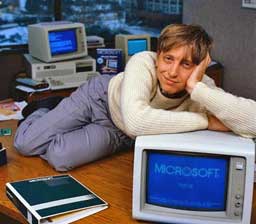 Bill Gates got his start in the software industry by creating a BASIC interpreter for the MITS Altair 8800, one of the earliest personal computers.
Starting with a strong programming background, a manual with the Intel 8080 instruction set, and the Altair spec sheet, Gates and Paul Allen first wrote a program to emulate the Altair on a “real” computer and then developed a BASIC interpreter for it. When they brought it to MITS, it ran on the first try.
MITS bought the interpreter, which they sold to Altair owners for $500. Gates and Allen founded Microsoft. And Altair BASIC quickly became the most highly pirated software in the country, as members of the Homebrew Computer Club copied the paper tape for each other.
Microsoft hadn’t sold their BASIC outright, but instead received a royalty on each copy that MITS sold. Gates and Allen were not happy to see their work freely distributed – and things haven’t changed much in the intervening years.
Microsoft 102
Microsoft ended up licensing its BASIC to Commodore, Apple, and other computer makers, most of who burned the language into ROM, where piracy wasn’t an issue. Even the IBM PC came with Microsoft BASIC in ROM.
BASIC, which had started out as a freely available learning tool, became the foundation of the Microsoft empire. Because of the sheer number of computers running Microsoft BASIC, any incompatible BASIC had no chance of entering the mainstream.
One solid attempt to change that, Turbo BASIC from Borland, resulted in Microsoft greatly improving its BASIC compiler, then reinventing it as QuickBASIC, lowering its price, and slowly driving Turbo BASIC from the picture. About the same time that Borland gave up on Turbo BASIC, Microsoft introduced Visual BASIC for Windows, which dominates the Windows world.
Microsoft 201
Before IBM introduced its personal computer in 1981, there were several different operating systems used by different families of personal computers: TRS-DOS for the Radio Shack TRS-80, Apple DOS 3.2.1 for the Apple II, Apple SOS for the Apple III, and CP/M for the Zilog Z-80 and Intel 8080, to name only a few of the more popular ones.
IBM’s goal was to take the personal computer and turn it into a business tool. Their new PC was designed around a 16-bit 8088 processor that could handle much more memory than any of the popular 8-bit computers. And they needed an operating system to go with it.
I don’t think IBM was convinced of the market since they designed their PC to use off-the-shelf components as much as possible. IBM has traditionally used as many custom parts as possible to keep others from copying their designs.
Likewise, they didn’t want to invest in an operating system for the PC. Better to let others develop the OS and then have IBM make some money selling it to PC owners. So the IBM PC shipped without a disk operating system (even without a disk drive in some configurations).
Buyers could choose the UCSD p-System, CP/M-86, or PC-DOS with their new IBM PC. CP/M-86 from Digital Research and PC-DOS from IBM (via Microsoft) had a natural advantage: Both were rooted in the CP/M operating system used in many Z-80, 8080, and 8085 computers.
PC-DOS had the additional advantage of a lower price, so it quickly came to market dominance.
The clever people at Microsoft made sure they didn’t grant IBM an exclusive license. When the PC took off as a real business computer, manufacturers soon realized that it could be cloned – and they could buy MS-DOS from Microsoft, so it could run the same operating system and programs as the IBM PC.
MS-DOS/Windows has been the dominant operating system ever since, although niche operating systems like the Mac OS and Linux do hold a small market share against the Microsoft behemoth.
Microsoft 202
Microsoft owned BASIC and dominated in operating systems. The next step was to compete in the world of applications. Microsoft Word was created to compete with the dominant WordPerfect. Microsoft Multiplan was designed to compete with Lotus 1-2-3. (Ever notice how Microsoft manages to put their company name in almost every software product’s title?)
Both were competent programs in a market with lots of options. Neither Word nor Multiplan dominated in the days of DOS, but they had a much more promising future.
Microsoft 301
The same year that Apple introduced the Macintosh, Microsoft announced Windows – a graphical shell for DOS that would make PCs run a lot like Macs. Windows 1.0 shipped in 1985. It went nowhere.
Of course, that was the era of the 4.77 to 8.0 MHz 8088 and the 6-12 MHz 80286, neither of which had the horsepower to run a graphical user environment (GUI) on top of DOS.
But 1986 saw the first 80386 computer, using a core architecture which has defined the Intel family right through the Pentium II. Starting at 16 MHz and with new memory models, the PC world finally had a chip that could run a GUI decently.
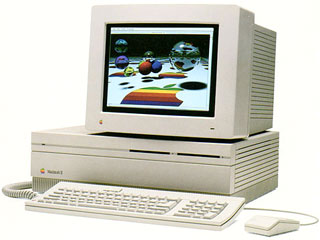 In April 1987, Apple rolled out the Mac II, a gorgeous color Macintosh with a 16 MHz 68020 processor and capable of handling megabytes of memory. In August, Microsoft released Windows 1.01. Ho hum.
January 1988 saw Windows 2, a significant improvement, but still not enough to go anywhere in the market. The Macintosh operating system was up to System 6.0.x by now.
PC users scoffed at the WIMP (windows, icons, mouse, pointer) interface of the Mac. I was one of them.
Microsoft 302
Apple gave every Mac a one year warranty in 1990 and rolled out the “wicked fast” 40 MHz Mac IIfx in March. Microsoft countered with the first serious version of Windows in May, Windows 3.0.
Buggy, but serious.
Mac owners got System 7 in 1991, perhaps the biggest evolutionary jump in the Mac OS since it had been created. With 32-bit memory addressing, multitasking, and virtual memory, the Macintosh was suddenly a very grown-up computer.
The following year Microsoft introduced the bug-patched version of Windows 3.0. Windows 3.1 remains in use to this day in many schools, homes, and offices that either don’t have the hardware, have the money, or see the need to upgrade to Windows 95 or 98.
Along the way, Microsoft had trounced a couple GUI wannabes, such as GEM from Digital Research, GEOS, and IBM OS/2 (which Microsoft had co-developed with Big Blue). Just as DOS had dominated before, now Windows became the dominant PC operating system.
Microsoft 303
But Microsoft wanted more than that. So they developed Microsoft Word as the premier Windows word processor. And they created Excel to be the dominant Windows spreadsheet.
By the time Lotus, WordPerfect, and other software companies finally realized that Windows had overshadowed DOS, it was almost too late to create Windows versions of their programs. A lot of software companies died during or shortly after making that transition.
Today Microsoft Windows is the most popular OS, Microsoft Word the dominant word processor, and Microsoft Excel the most used spreadsheet. The latter two even have dominance on the Macintosh.
Microsoft 401
Bill Gates had used his programming skills to create a BASIC dialect that came to dominate personal computers. He bought QDOS, a blatant adaptation of CP/M for the 8086 processor, and transformed it into MS-DOS, which quickly became the most popular computer operating system.
As GUIs began to enter the public consciousness, Microsoft always had a version of Windows to show, something that appeared Mac-like enough that users wouldn’t see any reason to leave their PCs behind. Built on DOS dominance, Windows slowly became the premier GUI for PCs. Word and Excel came along for the ride, only to be recognized as predominant after it was too late for the competition.
Over the past five years, the internet has come to dominate the computer world. We send email, ftp files, and surf the Web. There are dozens of email clients, probably as many ftp, chat, and news clients, and a handful of web browsers.
And Microsoft didn’t have a piece of any of it!
Microsoft Mail was completely proprietary, as were all the office email programs in the old days. Email between disparate computers was something for academics, computer science departments, government agencies, and the like. By the time Microsoft and other realized that TCP/IP, SMTP, and POP were essential for worldwide email connectivity, there were a host of freeware solutions.
Mosaic was the early leading web browser, later supplanted by Netscape Navigator, which completely dominated the field thanks to free licensing for academia and widespread availability on the internet. Some users actually paid their shareware fees.
Netscape came to define the World Wide Web. As quickly as Netscape added an enhancement to Navigator, websites started using it.
Microsoft saw a market that it didn’t have a presence in, let alone control. So they threw together Internet Explorer (IE) 1, their first browser, in 1995 and included it free as part of Microsoft Plus! for Windows 95. This was clever on Microsoft’s part because the lesson it learned from MITS BASIC was that there is no percentage of income to pay out when you have a free product. This time it worked to Microsoft’s advantage.
And to make it even tougher for Netscape to survive, Microsoft made IE free to all Windows users. Netscape managed to reach level 4 of its browser before it realized that it couldn’t compete with Microsoft’s freeware. Thus Netscape Navigator and Communicator also became freeware.
According to most surveys, that saved Netscape from oblivion. They seem to maintain a majority of the browser market, especially in the non-Windows world, but by a smaller margin every year. By now, I’m guessing IE has passed the 50% mark on Windows computers.
Having reached a stalemate, Microsoft decided to build Internet Explorer right into the Windows 98 operating system. That’ll teach Netscape to think they can survive against Microsoft!
Microsoft 402
But that isn’t the whole story. While both browsers handle basic HTML the same way, each one has extensions that don’t work on the other platform. And each one has some codes it interprets differently than the other one. Ask any webmaster – we’ll tell you that it’s almost impossible to use advanced HTML features such as Cascading Style Sheets and have your design work the same on Netscape Communicator and Internet Exploder.
It’s a nightmare.
But Microsoft will take any advantage it can to beat the competition, even if it has to create that advantage through proprietary HTML extensions, a variant version of Java that has Sun fuming, and the annoying habit of displaying certain commands differently than Netscape.
Webmasters are faced with a choice: code for Netscape and have it look bad on IE, code for IE and have it look bad on Netscape, or only use the safest HTML commands so the site isn’t outstanding – but at least it looks the same on both browsers. (I try to be platform agnostic and use the third option for Low End Mac.)
The same goes for Java. Programmers either go Sun, Microsoft, a subset that both can handle, or ignore Java completely.


This explains why you’ll visit websites that are “Best Viewed with Internet Explorer” or “Best Viewed with Netscape.”
By forcing Internet Explorer on Windows 98 owners, and by providing it free with Windows 95 and the Mac OS, Microsoft hopes to convince webmasters that if they have to code for a specific platform, it should be Microsoft’s.
And that’s how Microsoft turns market dominance into an unfair monopoly. By defining the standards, they control the market.
(And we haven’t even mentioned purported threats to pull Microsoft Office from the Mac OS, not support Intel’s MMX commands in Windows, or twist Compaq’s arm to keep them from licensing Apple’s QuickTime technology.)
keywords: #microsoft #monopoly #microsoftmonopoly
short link: https://goo.gl/4mt3Va
