
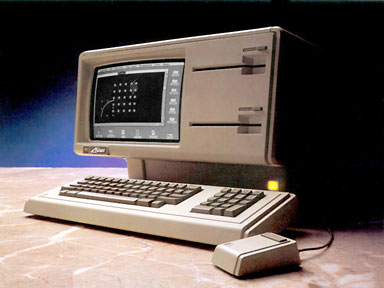
1999: Change is the very nature of the computer industry. From the first computer kits to the first personal computers. From the 8-bit Apples, Commodores, and TRS-80s to the pseudo-16-bit IBMs, and then to the graphical Lisa and Macintosh.
 The IBM and its clones moved from the 8088 to the 80286, 80386, 80486, and then the Pentium family. Macs progressed from the 68000 to the 68020, 68030, and 68040 – then jumped to an entirely new and different processor, the PowerPC.
Through it all, some computers have been left out in the cold, either deliberately or because of progress in chip and drive technology.
Phase 1
The first Mac had 128 KB of memory and a 400 KB floppy drive. Starting in 1986, it could be updated to a Mac Plus, capable of using 4 MB of memory, an 800 KB floppy drive, and up to seven SCSI devices.
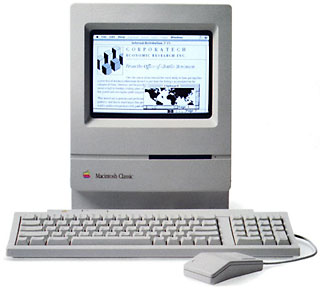 All the earliest Macs used an 8 MHz 68000 processor, from the original 128 through the Classic in October 1990. When it was finally discontinued in September 1992, Apple had been using the same CPU for over eight years, which has to be some kind of record in the personal computing industry.
More incredible yet, a Mac Plus, SE, or Classic with 2.5 MB of memory and a 40 MB hard drive could run System 7.5.5 with enough free memory to run one or two programs. (Of course, 4 MB is better.)
It wasn’t until January 1997 – thirteen years after the Macintosh was introduced – that the first Mac OS that couldn’t run on these models shipped. And since the first Mac could be upgraded to a Plus, it was possible that some twelve- and thirteen-year-old Macs were still in use then.
But the end was in site. On August 31, 1998, Apple discontinued all parts support for these and other ancient Macs.
Remarkably, there are still a good number of people using these and other vintage Macs, enough to keep two email lists, Classic Macs Digest and Vintage Macs, quite busy.
Although left behind with Mac OS 7.6, most of these users are content with the abilities of System 6, 7.1, or 7.5.5 on their older Macs.
Phase 2
Mac OS 7.6 and 7.6.1 ran on any Mac with 32-bit clean ROMs and a 68030, 68040, or PowerPC chip. Mac OS 7.6 came out in January 1997, was patched to 7.6.1 a few months later, and replaced by Mac OS 8.0 later in the year.
The earliest Mac with a 32-bit clean ROM was the Mac IIci, introduced in 1989. A stock IIci with 8 MB of memory and an 80 MB hard drive can run Mac OS 7.6.1 reasonably well.
There was some disappointment when Mac OS 8 shipped with no support for the 68030. A few companies found ways to run OS 8 with ‘040 accelerators, but for the most part, the ‘030 users were left behind with 7.6.1.
Frankly, a lot stopped upgrading at 7.1 or 7.5.5, so there wasn’t a huge uproar.
Phase 3
Mac OS 8.0 and 8.1 run on any 68040-based, as well as pre-G3 Power Macs. By removing support for the 68030, Apple could take advantage of some heretofore untapped 68040 features, making it a faster, more stable OS for the Quadra set.
I’m running 8.1 on all my Centris, Quadra, and SuperMac machines.
But once 8.5 shipped, the ‘040-based Macs were left behind. The first Quadras, the 700 and 900, had been introduced in 1991; OS 8.5 came out in 1998.
The first Macs had up to 13 years of OS support, the 32-bit clean models up to 8 years, and the Quadra only 7.
There was a bit of a stink on Quadlist, but most of us conceded that we’d gotten many years from our Macs and that OS 8.1 was a lot more than we’d bargained for when we bought them.
But it gets worse.
Phase 4a
In March 1994, Apple released the first Power Macs. The 6100, 7100, and 8100 all used the new PowerPC 601 processor, at speeds ranging from 60 MHz to 80 MHz. (Five years ago, those were considered blazingly fast. Really.)
Although still supported in Mac OS 8.6, these Macs will never run Mac OS X. They will run Sonata, expected for release later this year as OS 8.7. There may be another round or two beyond that, but once OS X Client ships (January 2000?), all 601-based Power Mac users will be left behind.
Phase 4b
On the outside, we’re looking at six years of OS support for the first generation of Power Macs.
The second generation, which used PCI slots, came out in August 1995. For these and almost all Mac compatibles, OS X Client will also be out of reach. Only the Power Mac G3 (November 1997) and more recent models will run OS 10 and beyond.
We, the owners of Power Macs and clones, were promised a lot of features, which Apple is slowly rolling into Mac OS 8.x, but a lot of people have been buying Power Macs since 1994 on the promise that they would run the next great Mac OS. We’re waiting to see how much of that promise Apple fulfills with Sonata.
And then OS X will ship, and we’ll be left behind.
The Big Picture
Change is the very nature of the computer industry. We’ve gone from 8 MHz chips to 450 MHz ones – processors which are also more powerful, not just faster. Where the 68000 could only see 16 MB of memory (limited to 4 MB on most early Macs), the entry-level iMac ships with 32 MB. From 400 KB floppies, we’ve gone to multi-gigabyte hard drives.
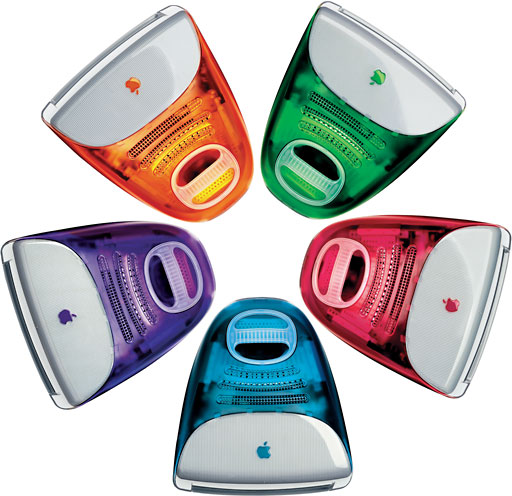 Like clockwork, processor speeds, memory chips, and hard drives seem to double every two years. (That’s why the iMac has had two speed bumps inside of a year.)
Along the way, the Mac OS has evolved. The first Macs only ran one program at a time. With System 6, MultiFinder let you run several applications and switch between them. With System 7, that became the Mac’s default.
But at heart, the Mac OS remains a one-application-at-a-time operating system.
Just as Apple moved from the potent 68040 to the promising PowerPC without abandoning old software, Apple is working to create a whole new OS rooted in multitasking and multithreading, and supporting multiple processors – while still offering backward compatibility with our old software.
Apple has a knack for making evolutionary changes look revolutionary (the iMac), and revolutionary changes look evolutionary (OS X).
Unfortunately, as the OS grows, it has to leave behind processors that don’t support enough memory or horsepower for the OS to run efficiently. We should be grateful that even today shareware programs are being released for pre-Power Macs.
We should be even more grateful that Apple is providing as much software compatibility as possible under OS X. Many users of OS X Server have noted that the OS 8.5 compatibility box works exactly like any Mac running OS 8.5 – except that you only have to relaunch the compatibility box when a program crashes, not restart the whole computer.
The future promises a more powerful operating system that will need a lot of memory and horsepower. Even if OS X could somehow run on a Quadra 650 or Power Mac 7200, we wouldn’t be happy with the performance.
As for the old Macs, they are still capable of doing everything they did when we bought them. Further, in most cases, there have been several OS updates that added capabilities we hadn’t imagined when we bought these Macs.
Even though Apple keeps moving ahead, we have to remember that the machines left behind remain very capable computers that can see us through Y2K and beyond.
Further Reading
- Unplanned Obsolescence, Mac Musings, 8/25/98
- Operating Systems Past, Present, and Future, Mac Musings, 8/5/98
- Unix to the Core, Mac Musings, 8/10/98
