
1998 – On the Mac side of the fence, we all know the processors found in the Power Mac G3, the PowerBook G3, and in G3 upgrades in a host of older Macs are up to twice as fast as Intel’s Pentium II processor. But did you also know that Intel has a long history of intentionally crippling chips?
Birth of the PC
16 Bits on an 8-bit Bus
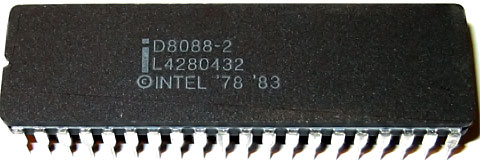 It all began with the 8088. Intel had leveraged it’s 8-bit 8080 and 8085 designs into a 16-bit CPU, the 8086. The new chip had a 16-bit data path, 16-bit registers, and could address 16 64 KB banks of memory, 1 MB in total. In all respects, the 8086 was a worthy successor to its 8-bit parents.
But the world was already full of 8-bit motherboards and peripherals, so Intel created a version of the 8086 that would work on an 8-bit data bus. It was the crippled 8088 CPU that IBM chose for its first Personal Computer (it had been working on an 8-bit 8085-based design, so choosing the 8088 let them use a lot of work they had already done on the project). Almost every clone maker chose, not the more efficient 8086 with its 16-bit data bus and larger prefetch queue that resulted in a 50% reduction in I/O performance.
32 Bits on a 16-bit Bus
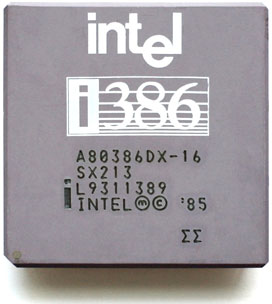 Jump ahead to the late 1980s. Intel introduced the 80386, a full-fledged 32-bit CPU with 32-bit registers and a 32-bit data bus. Then, because other companies were allowed to make the 80286, Intel decided to kill that market with the 80386SX, a 32-bit CPU on a 16-bit bus. Every benchmark showed it the equal of the less expensive 80286 – but it was the 80386SX name and the Intel brand sold it. Remarkably, because of other architectural improvements in its design, the 386SX was only about 10% slower than the 386DX (so called in contrast to the 386SX – because you cannot trademark a number, Intel added letters to its product names and later adopted names such as Pentium).
Crippling the Floating Point Unit
In the next generation, Intel built the floating point unit (FPU) into the CPU. For number crunching, the 80486 ran circles around the 80386. And, to reach a cheaper market and stave of CPU competitors, Intel created the 80486SX, essentially the same chip but with the FPU disabled. Of course, you could supplement this with the 80487SX, an 80486 with only the FPU enabled.
Somehow Intel pulled it off. In fact, I sometimes wonder if this wasn’t part of the reason for the Motorola 68LC040, essentially an FPU-free version of the 68040.
Fast Forward
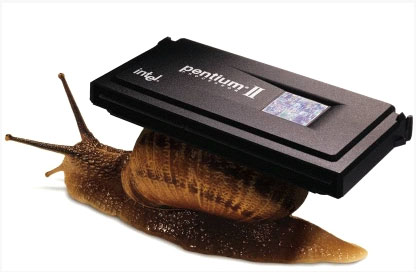
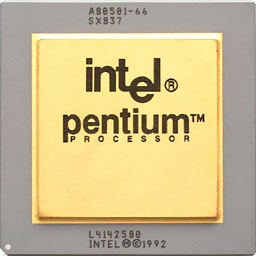 Why shouldn’t history repeat itself? This year [1998] Intel did it again, taking the mighty Pentium II and removing the cache (which is essential for top performance). The new chip is named Celeron, which brings to mind speed. It’s cheap, but it isn’t fast. (A common nickname is Deceleron.)
Intel designed the first generation 266-300 MHz Covington Celeron that way on purpose.
However, manufacturers balked, saying Intel had gone too far in crippling the Celeron. So the next generation Celeron, Mendocino [released in August 1998, two months after this article was first published], had a 128 KB Level 2 cache built into the CPU. (At the time, all other Intel x86 CPUs had separate L2 caches that were slower then the CPU.) The 300 MHz Mendocino was nearly twice as powerful as the 300 MHz Covington primarily due to that full speed Level 2 cache. In fact, the new Celeron was so good that it began to steal customers from Pentium II, and overclockers discovered they could push it as high as 450 MHz!
With Covington Intel has intentionally crippled another CPU.
Just to show it can move forward, Intel has announced the Pentium II Xeon (see Intel’s Xeon to Tip Price Scales). Where the Pentium II has a 512 KB 2:1 cache (that is, the cache runs at half of CPU speed), Xeon runs a 1:1 L2 cache (at full CPU speed) of 512 KB, 1 MB, or 2 MB. Intel is promoting Xeon for servers, where up to eight 400 MHz CPUs can share a 100 MHz data bus and run flat out.
It wasn’t until the second generation Pentium III, Coppermine, in 1999 that Intel used an onboard L2 cache on its flagship consumer CPU.
Thinking Different
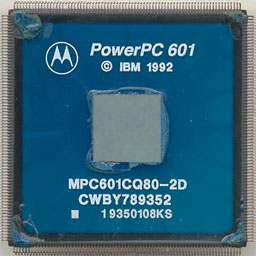 The same thing hasn’t happened in the PowerPC world. It simply didn’t occur to the PowerPC partners to intentional cripple a CPU. The 601 was followed by the equally powerful 603* and the more powerful 604. These became the 603e and 604e.
 The 603e has evolved into the 740 and 750, commonly called the G3 – the processor TV watchers know is twice as fast as the Pentium II.** And next year we’ll see the G4, which should be significantly more powerful than the 604e and the G3.
Apple, Motorola, and IBM haven’t resorted to making stripped down chips. It’s much easier to make one or two chips that aren’t intentionally crippled than a family including Celeron, Pentium, Pentium MMX, Pentium Pro, Pentium II, and Pentium II Xeon.
Further, it doesn’t confuse the consumer nearly as much to choose between three different G3 speeds than between several different CPU names, each available at multiple speeds.
The Final Outcome
What’s completely ludicrous is that Intel is willing to cut margins on its low-end CPUs just to gain market share – then inflate the price of its top-end Xeon to make up for it.
The Xeon is a 400 MHz CPU with a 400 MHz cache. Pricey. With a 512 KB cache, cost is estimated at $1,124 (quantity 1,000). Add $175 to that and you’ve got an iMac – the whole computer. And you don’t have to buy 1,000 iMacs to get the $1,299 price.
With 1 MB cache, Xeon is a $2,836 chip. That’s about $100 more than the 300 MHz Power Mac G3, but all you’re getting is a single Xeon CPU. Perhaps a more fair comparison to the Xeon is a 300 MHz G3 daughter card with 1 MB of 1:1 cache. But those start at about $1,700 – still $1,100 less than Xeon.
Top of the heap, the Xeon will be available with a 2 MB cache. Projected price, quantity 1,000, is $4,489. That’d buy three iMacs, a printer, and a scanner. Or nine of the least expensive G3 upgrade cards. Or a fully decked out 300 MHz Power Mac G3 system.
Intel wants that much money for a single CPU.
I guess they do know how to think different.
* Some may argue that the first generation 603-based Macs were less powerful than the 601-based Macs that preceded them. They’d be right. The system architecture of the Performa 6200 and 6300 was horrendous, but that was due to the 16-bit data path on the logic board. The 603 processor itself matches 601 performance.
** The key difference between the PPC 740 and 750 is that the 740 has no built-in cache support, while the 750 supports both inline and backside caches.
Keywords: #intelx86 #crippledcpu
Short link: http://goo.gl/YorHci
searchwords: crippledcpu
