
1999 – One little chip sure can set off a world of controversy. It started when Apple introduced the Power Mac G3 in November 1997.
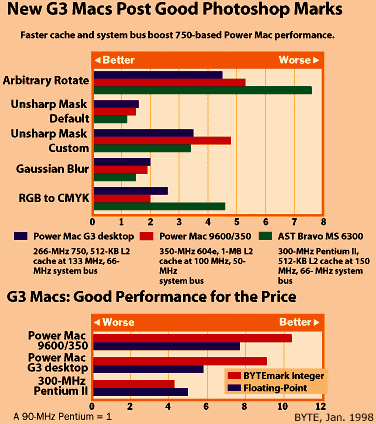 Based on benchmarks from Byte, a highly respected independent magazine that covered many types of computers, Apple claimed, “The processor in the Power Mac G3 is up to twice as fast” as the Pentium II at the same clock speed.
Wintel magazines kept asking, “Where’s the speed?” And Apple fans kept saying, “up to twice as fast doesn’t mean always twice as fast.”
For certain types of operations, as the BYTEmark results showed, the PowerPC G3 processor is twice as fast as a Pentium II at the same MHz rating. But only for certain operations.
Still, it made for great marketing.
Twice as Fast, Round 2
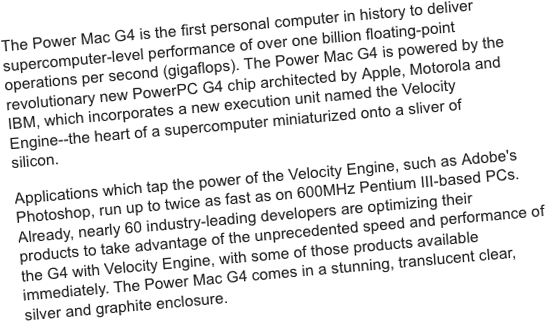
 Last week at Seybold 1999, Steve Jobs didn’t proclaim the G4 twice as fast at the Pentium III. He demonstrated it – using Intel’s own benchmarks (press release quoted above).
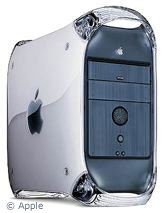 Then he spilled the beans: The 500 MHz G4 wasn’t twice as fast as a 500 MHz Pentium III. It was over twice as fast as a 600 MHz Pentium III. In fact, some benchmarks showed the 500 MHz G4 at 2.9 times the performance of the 600 MHz Pentium III.
Intel’s response: We’ll be making faster chips.
News flash: So will Motorola. When Intel hits 700 MHz, expect the G4 to be running at 550 MHz, maybe even faster.
On top of that, to match the capabilities of the Velocity Engine-equipped 500 MHz G4, Intel would have to make 1600 MHz Pentium III chips. And that isn’t likely until mid-2001.
Of course, by then the G4 will be running at speeds in excess of 1000 MHz, too.
Benchmarks aside, the 500 MHz Power Mac G4 system does things like Photoshop and 3D rendering about twice as fast as Compaq’s top of the line 600 MHz PIII system.
Foul?
Expect the Wintel world to cry, Foul!” over this. After all, nobody likes being in second place.
Here’s one example (from CNBC):
- “It was good showmanship,” says Martin Reynolds, vice president of Dataquest, based in San Jose, Calif. “But it was not good benchmarking.” The Intel PC used during the demo, for example, didn’t have the same software plug-in used by the G4.
The plug-in in question is one specifically designed so Photoshop can use the Velocity Engine in the G4 processor. Of course the Pentium system doesn’t have the same plug-in. On the other hand, neither does the Mac version of Photoshop use the MMX support built into the Windows version.
- Apple still lags far behind Intel in the desktop PC market. The company controlled just 4.8 percent of the dollar market share during the second quarter, according to Dataquest. Intel-powered PC’s, by comparison, held more than a 90 percent market share during the same period.
If you can’t question the facts, confuse the issue with other facts. Does G4 performance depend on how many units Apple sells or their dollar percentage of the US retail personal computer market? Does the overwhelming number of Celeron systems sold somehow undermine the power of the G4?
Market share is a straw man argument, not one that holds any weight here.
- Several other factors, including the availability of compatible software, are at least as important as raw microprocessor speed when it comes to assessing the competitiveness of a desktop computer, analysts say.
Straw Man #2. Does it matter if the Mac has only thousands of programs available instead of tens of thousands? The simple fact is that the Mac can do anything PCs can do, either with genuine Mac software or by running an emulator and using Windows applications.
What do you want to do today? Can the Mac do it? If not, then you’ve got a reason to look at Wintel – but that reason has nothing to do with G4 performance.
- “The really important comparison is the price-performance comparison,” says Charles Smulders, principal analyst at Dataquest. “In real terms, the industry is not as focused on performance right now. It’s more focused on sub-$1,000 PCs and smaller appliances.”
Straw Man #3. If we can’t confuse performance with market share and how many software titles are available, let’s look at value.
Although this again has nothing to do with the performance of the G4, price-performance is a good issue to raise. But you have to be willing to look at the whole picture.
First, sub-$1K systems are not being sold to the same market as G4 systems, so you don’t want to compare the Power Mac with a Compaq Presario or any other low-end Wintel box. You want to compare it, as Apple did, with the 600 MHz PIII powerhouses.
For argument’s sake, let’s assume the 500 MHz G4 offers twice the performance of a 600 MHz PIII across the board. It doesn’t – it’s faster at some tasks and slower at others – but we have to make some assumptions in this comparison.
The 500 MHz G4 is a $3,500 computer. That includes a 27 GB hard drive, 256 MB of memory, a DVD-RAM drive, a Zip drive, FireWire, 10/100 ethernet, and accelerated 2x AGP video.
I can’t find any information on the Compaq 600 MHz PIII system on Compaq’s site, so let’s go to the Gateway site and build a system. If anything, this should offer the same performance for less money than a comparable Compaq system.
The Gateway Performance 600 with 600 MHz Pentium III, 256 MB RAM, 27 GB hard drive, a 10/100 ethernet card, a Zip drive, and a CD-RW (no DVD-RAM option) comes to $2,324.
The Gateway includes a floppy drive, so we’ll add $100 to the G4 system for that. We’ll estimate a DVD-RAM drive can be added to the Gateway for $500 (Outpost.com currently has prices from $530-610).
Total price of the Gateway computer: $2,800. At a performance of 10, we’ll give this a value rating of 0.35 (rating/price). It would rate 0.43 without DVD-RAM.)
Total price of the Power Mac G4: $3,600. On the assumption of twice the overall performance of the Gateway, that’s a performance score of 20. This gives the 500 MHz Power Mac G4 a value rating of 0.56, or almost 60% higher than the Gateway.
Now assume we’ve been too generous in rating the G4 at twice the performance of the 600 MHz PIII. Reduce that to 50% and the value rating drops to 0.42 – equal to the Gateway computer without DVD-RAM.
The Bigger Picture
But that only looks at purchase price. Let’s assume the user is a graphics professional who spends 10 hours a week using Photoshop – which is twice as fast on the G4. The G4 user could either reduce that to 5 hours, freeing 5 hours for other projects, or get twice as much done in the same amount of time.
Further, let’s assume this graphics professional earns $20 per hour. By putting a 500 MHz G4 system on his desk instead of a 600 MHz PIII system, the business saves $100 per week based on load of 10 Photoshop hours with the Gateway. That’s $5,000 per year, allowing two weeks for vacation.
A more likely scenario is that the worker will be twice as productive, increasing billables per hour to twice that of the PIII user. Taking an arbitrarily low rate of $40 billable per hour on the PIII, the same user could do $80 worth of billable work on a G4. Instead of billing $400 per week for 10 hours of Photoshop work, twice to productivity means $800 of billings.
Whether the company saves $800 or $1,200 by going Pentium instead of G4, even a low Photoshop workload obviates that price advantage within two to three months. From the perspective of billable services, the Pentium system loses any price advantage within the first month of use.
A Still Bigger Picture
There are other factors. Wintel machines have more down time. Assume 1% down time for Windows and hardware issues, which is probably low. That’s $400 per year spent paying the employee to tinker or wait for a tech to fix things. That’s also $800 less billable time over the course of a year.
We’ll assume the Mac is twice as reliable, although it’s probably more than twice as reliable.
Now stretch all this over two years, about the maximum time before a high-end production computer will be replaced by an even more powerful one.
| System | Gateway PIII | Power Mac G4 |
| Purchase price | $2,800 | $3,600 |
| Billable services | -$4,000 | -$8,000 |
| Down time | $800 | $400 |
| Lost billables from down time | $1,600 | $800 |
| Net cost | $1,200 | -$3,200 |
Plug in your own numbers: hours, wages, billables, down time, years of use. The more hours the system is used, the greater the Mac advantage. The higher the wages, the greater the Mac advantage. The longer until the computer is replaced, the greater the Mac advantage.
Unless you’re simply going to buy the computer and your time has no value, the Power Mac G4 is the best computing value on the market. Even if you don’t bill your time, it leaves more of your time for billable work or for yourself.
Conclusion
Because the Velocity Engine makes the Power Mac G4 the first personal computer with GFLOPS (gigaflops) performance, it is the best computer available for graphics and video production.
The Wintel camp can try to confuse the issue by looking at market share, titles available, or initial purchase price, but from the perspective of the professional user, the Power Mac G4 provides more value than any Wintel computer available.
Even if it isn’t always twice as fast.
Keywords: #ppcg4 #powerpcg4 #macvalue #pentiumiii #twiceasfast
Short link: http://goo.gl/FGKjFG
searchwords: g4vspiii, twiceasfast
