
2000: Sean Terrill says that the G4 debacle is all Apple’s fault. He makes some interesting arguments in his article on Mac Junkie, The Great G4 Debacle: Why It Is Apple’s Fault (no longer online).
I disagree with him on several points, but I fully agree that Apple plays a large role in the G4 debacle. However, it is joined in its guilt by Motorola and, to a lesser extent, IBM.
The G4 Debacle, Round 1a
 It was completely Apple’s problem when it announced the 500 MHz G4 on August 31, 1999. Apple already knew that Motorola could not supply the required 500 MHz processor in quantity. Apple never should have announced a product based on it.
Yes, there were a handful of 500 MHz G4 processors in existence. Yes, Apple did give itself a margin of about four weeks to have product ready for shipment. But it shouldn’t have bet its reputation on a CPU it couldn’t deliver immediately.
The G4 Debacle, Round 1b
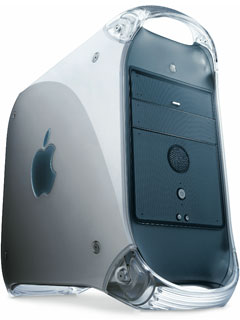 For reasons known only to Steve Jobs and those at Apple who were close to him, the Power Macintosh G4 came in two versions from August 31, 1999 until December 1, 1999. The slowest model used the Yikes! motherboard, a variation of the Yosemite design used in the Blue & White Power Mac G3. The faster models used a new Sawtooth motherboard with improved memory bandwidth.
It really confused not only the market but Apple itself. It had to come up with a way of distinguishing two models that had the same name, looked nearly identical, yet had very different system boards. Worse, the consumer had to deal with the first 400 MHz G4 being Yikes!, followed by a Sawtooth version – and the same thing happening later with the 350 MHz Power Mac G4.
The G4 Debacle, Round 1c
Finally, Apple made the hugely stupid mistake of putting all its eggs in one basket. When the Power Mac G4 was announced in August, the Power Mac G3 was completely retired. After all, the G4 ran faster (400-500 MHz vs. 350-450 MHz) and had the Velocity Engine. Why not retire the Blue & White G3?
For one, because the G3 is a less expensive processor. Apple could have offered G3 machines at speeds from 350 to 500 MHz while G4 systems were back ordered. It could have offered a Power Mac for several hundred dollars less than the G4 computers.
But Apple didn’t do that. Despite that fact that the G4 is insignificantly superior to the G3 except in two specific areas (multiprocessor support and the Velocity Engine), Apple relegated the G3 to the consumer and portable markets.
Different sources report different numbers, but it is widely known that IBM has developed the G3 well beyond the 500 MHz mark. Instead of just putting that power in the Pismo PowerBook, Apple could be offering a 500 MHz Power Mac G3 today. And, if sources are to be believed, even models in the 600, 700, and maybe even 800 MHz range.
[Update: IBM’s version of the G3 eventually reached 1.1 GHz!]
But Apple chose to base its entire Power Mac line on the G4, which remains stuck at 500 MHz – the same speed Apple announced last August.
The G4 Debacle, Round 0
But there’s a story that goes back well before Apple announced the Power Mac G4, a story that involves Apple’s partners in the AIM consortium, Motorola and IBM.
While the companies had worked well together through the G3 design, IBM and Motorola had a serious difference of opinion about the next generation. Motorola wanted to create an enhanced G3 with better multiprocessing support and a high powered graphics engine. IBM wanted to go beyond the G3 by improving overall horsepower and adding strong multiprocessing support. Finally, IBM was not interested in licensing Motorola’s AltiVec design, nor did Motorola care to follow IBM’s lead on the MHz front.
Based on history, given the choice, I’d follow IBM’s lead over Motorola’s any day. Motorola has good ideas, but IBM has better ones.
Apple should have mediated, but instead, it let things get out of hand. Motorola did an incredible job with AltiVec, but its chips lag seriously on the MHz front. IBM ran with the G3, bringing it to 800 MHz according to one rumor site.
Now Apple has appealed to IBM, which is producing the AltiVec G4 under license from Motorola. In fact, several sites report that the 500 MHz Power Mac G4 comes exclusively with IBM processors since Motorola is still having problems at that speed.
Worse, the above-mentioned rumor site notes that IBM has the G4 (a.k.a. PowerPC 7400) running at 650 MHz in some of its prototype computers, but Motorola won’t let IBM sell anything faster than Motorola can produce (no matter how limited the quantity).
Before round one of the Great G4 Debacle, which was pretty much exclusively Apple’s fault, we have to place the blame in round zero on all three consortium partners. Motorola and IBM should have worked together; Apple should have forced them to.
The G4 Debacle, Round 2
I’ll skip over last October’s speed downgrade and price fiasco, which was completely Apple’s doing. I’ll applaud Apple for moving the 350 MHz G4 to Sawtooth in December and finally making the 500 MHz G4 available at Macworld Tokyo in February. That was mostly cleanup from rounds zero and one.
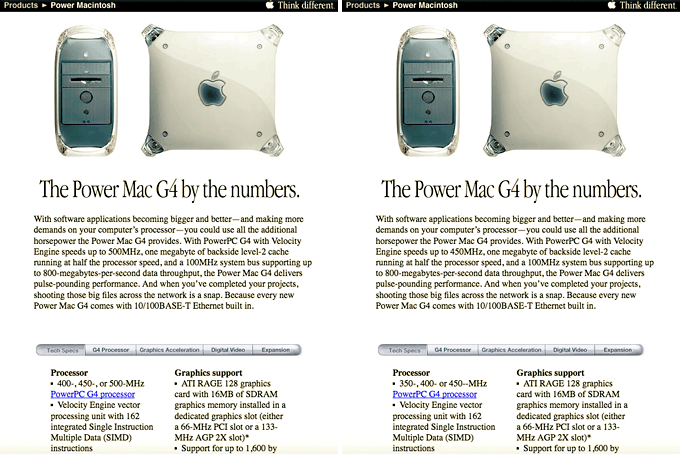
Round two is where we stand today. IBM can make wicked fast G3s, but Apple has no interest in using them in the Power Mac line despite the fact that for most users most of the time, a 600 MHz G3 would outperform a 500 MHz G4.
[Update: Apple eventually used IBM G3s to get the iMac to 700 MHz and the iBook to 900 MHz.]
Apple has IBM and Motorola working together on the AltiVec version of the G4. They have an improved design that should be available in May or so, which will allow IBM and Motorola to reach 700 MHz.
[Update: The Mystic Power Mac G4 came out in July 2000 with dual 450 MHz or 500 MHz CPUs. It wasn’t until the Digital Audio Power Mac G4 arrived in January 2001 that Apple would finally have a Power Mac faster than 500 MHz. That model went as high as 733 MHz.]
AMD and Intel are expected to announce 1 GHz processors this month, while Apple languishes at 500 MHz. When you double the speed of a CPU that’s half as efficient, you match performance. The Pentium III and Athlon at 1 GHz will hold their own against the G4 except in certain classes of AltiVec operations. No longer will we be able to brag that our “up to twice as fast at the same clock speed” processor really is more powerful.
If various sites are to be believed, and I do take my rumors with a lot of salt, IBM can produce wicked fast G3 and G4 processors today. Apple’s refusal to adopt the faster G3 is the primary reason Apple users won’t be able to brag about more power than Wintel users – a 700 MHz G3 would outperform the 1 GHz Pentium or Athlon, but unless one of the upgrade companies makes it available, we’re unlikely to ever see it in a Macintosh.
 If Motorola is preventing IBM from selling faster G4s, and if IBM can actually produce 550 to 650 MHz G4s in quantity, Apple needs to put a lot of pressure on its partners. Believe me, a 650 MHz G4 would smoke any Pentium or Athlon we’re likely to see by summer.
Apple needs to keep the pressure on IBM and Motorola because Apple’s livelihood is completely dependent on the ability of these two companies to make the G3 and G4 processors used in every Apple computer. Apple has to stress the importance of offering performance that blows away Intel and Athlon regardless of price. Apple has to convince both companies that it is in the interest of all three partners to offer faster, better processors – even if one of the companies is having manufacturing problems.
IBM had an enviable reputation in the industry for making incredible components, whether hard drives or processors. Research is a way of life at IBM, which is why it has so many cutting-edge technologies. Apple must unleash IBM to do what it does best, even if that means pressuring Motorola or offering some form of incentive for Motorola to allow IBM to retake leadership on the PowerPC family of processors.
If that doesn’t happen, we’ll end up with the best computers on the market becoming the laughing stock of the performance-oriented crowd.
Apple, do whatever it takes to retake bragging rights from Intel and AMD. Whatever it takes.
[Update: Who would have imagined that this entire time Apple was porting Mac OS X to Intel just in case its partnership with Motorola and IBM didn’t keep Apple competitive. Less than six years after this was published, the first Intel-based Macs shipped.]
Keywords: #apple #ibm #motorola #powerpcg3 #powerpcg4 #aimconsortium
