
1997: The entire Mac world has been on a roller coaster ride for the last year. Good news: Power Computing, Motorola, Umax, Daystar, and others were making Mac OS computers. They were offering performance, features, and prices that made them a legitimate alternative to Apple’s own hardware. They seemed to be growing the Mac market and taking a small chunk out of the Wintel market in 1996.
Bad news: The press has been ganging up on Apple, making it appear to be a 98-pound weakling in comparison to star quarterback Wintel, famous son of Microsoft and Intel. “Apple is dead,” the pundits moaned, “they and their crazed supporters just don’t know it yet.” The prophets of doom helped convince people to buy the more popular platform, Windows 95. Apple’s market share dropped. The Mac OS market share dropped. The total number of Mac OS computers sold dropped.
Microsoft
Apple is hurting. Apple CEO Gil Amelio did what he could to stem the losses, but couldn’t fight the negative media spin. He’s out, and Apple co-founder Steve Jobs is at the helm. Jobs even had the guts to make nice with Microsoft, convincing them to ante up $150,000,000 to bolster Apple Computer.
Finally, something the media couldn’t figure out. Unfortunately, neither could a lot of Mac lovers. “Apple has sold out to the evil empire,” they intoned.
That’s not my take. Microsoft has invested $150 million in nonvoting stock that they agree not to sell for three years. Microsoft obviously believes Apple will be around in three years – and probably worth more than today.
Microsoft and Apple have agreed to stop quibbling in court, which should save a small fortune in legal fees. They also have the right to use each other’s technology, making it easier for Microsoft to design real Mac software again. (Not like the current Microsoft Office, which is just a bad port from Windows.)
Microsoft has agreed to write Mac applications that are consistent with Mac standards and take advantage of Mac features that might not exist on the Wintel platform.
Apple has agreed to put the world’s second most popular web browser, Internet Explorer, on its system disks. (FYI, this site is best viewed with Netscape Communicator. It looks fine in Navigator 2 and 3, but they were designed before cascading style sheets [CSS]. It also looks fine in Internet Explorer, but because IE doesn’t handle CSS the same way Communicator does, it looks best using Communicator. I find both products adequate, but I’m used to Netscape, and it still dominates the browser market.)
So, in addition to a little money, Apple and Microsoft have become amicable. Microsoft keeps a viable software market and avoids the antitrust problems of controlling 100% of the OS market.
Market Share
Microsoft got huge by selling software. One of its early licenses put AppleSoft BASIC on the Apple II+. A few years later, Microsoft licensed an OS to IBM. It quickly became the dominant OS for Intel-based computers, running over CP/M-86, the UCSD p-system, and DR-DOS. Then came Windows, which buried GEOS, Digital’s GEM environment, and other GUI shells for MS-DOS.
Microsoft grew huge selling mostly software, a lot of mice, and very little other hardware.
Apple got huge by selling hardware. First came the Apple II. Thanks to a push into the education market and VisiCalc, the first spreadsheet program, Apple pretty well defined the personal computer market before IBM entered the picture in 1981. And suddenly Apple became a second-string player. It fought back with Lisa, and then with Macintosh, and Apple has held second place ever since. From 1988 to 1995, Apple had over 10% of the US market. That dropped below 7% in 1996 and is now below 5%.
Part of the drop can be attributed to Mac clones. Since their debut in 1996, clones have accounted for 20-30% of the Mac OS market. Total Mac OS market share in 1996 was about 10%, the same level Apple had maintained for over a decade. But people didn’t understand the difference between Apple’s market share and Mac OS market share. One had declined while the other remained steady.
This is where the press came in. Apple had a bad quarter, several bad quarters, a very bad year. The public perceives that Apple is dying and assumes the Mac OS market is dying. Nothing could be further from the truth. Apple has billions in reserve. A lot of its losses were attributed to restructuring costs, not necessarily real dollars and cents.
But the damage was done. Guy Kawasaki and his evangelists do what they can, but perception is hard to fight.
Unit Sales
Rather than look at market share, we should look at how many computers Apple sells. A declining share of a growing market can still mean a growing business – as long as the decline isn’t drastic.
Alas, it is drastic. Writing in MacWeek, Henry Norr notes that Apple unit sales have declined. Norr reports that Apple sold 4.5 million computers in fiscal 1995, just under 4 million in 1996, and is projected to sell just 3 million in 1997.
Surely the clones are taking up the slack!
Alas, that is not the case. It seems only 275,000 Mac clones sold in 1996, for a total Mac OS drop of roughly 225,000 units. Roughly 200,000 were sold in the first half of 1997. If this pace continues, total Mac OS computer sales will be about 3.4 million this year. That’s a 25% drop in two years.
While the Mac clones have a place, they do not seem to be growing Mac OS market share. On the other hand, one shudders to think how much worse things would be without entry-level machines from Umax and Power Computing.
User Share
What none of this takes into account is how many Mac OS users there are. Recent figures from Apple put the number of users at about 60 million. Ironically, recent figures from Microsoft place the number of Windows 95 users at about 60 million. (See “Just the Numbers” by Eldee Stephens III [no longer online].)
Microsoft has several other versions of Windows on the market. Windows 3.1 was the standard for several years. Many sources report that half the users who could run Windows 95 choose not to do so. Perhaps 40-60 million users are still using Windows 3.1. (If you can substantiate or correct this guesstimate, please let me know.)
In very round numbers, the Windows market is 100-120 million users. The Mac OS market is 60 million users. The entire number of personal computer users worldwide is approximately 180,000,000 people.
Perhaps one-third of personal computer users use the Mac OS;
over 97% of Mac OS users use Apple hardware.
Growth Mode
Apple licensed the Mac OS in hopes of growing market share. The timing was bad, but the idea was good.
Now there are rumors that Apple wants to eliminate the clones. Rumors include:
- Apple is taking over Power Computing.
- Apple is forcing Power Computing from the Mac OS market.
- Apple will not license Mac OS 8 to any clone maker.
- Apple is dumping CHRP (clones using more non-Apple components).
If Apple discontinues clones, hundreds of thousands of Mac clone users will feel betrayed. “If this is how Apple treats its OS customers,” they may reason, “why should I stick around?”
- Update 8/30/97: Apple has dropped Mac OS-Up-To-Date support for any Mac OS computer not manufactured by Apple Computer. Apple seems to be doing this to force clone makers into new licensing terms. Unfortunately, those most hurt are the 500,000 Mac clone owners.
- Update 9/4/97: Apple has announced that it will purchase the Mac OS license and core assets of Power Computing. Apple maintains it has no intention of doing this to any other clone maker. In fact, it will honor all current OS license agreements until they expire. (What then? Time will tell.) A new rumor is that Apple will abandon the low-end market (4400, 6500) to Umax, which will either sell low-end computers under their own name or as Apple products.
- Update 9/10/97: Apple has reinstated Mac OS-Up-To-Date for Umax. PowerTools will ship new systems with Mac OS 8.
- Update 9/17/97: Apple has reinstated Mac OS-Up-To-Date for Power Computing.
Worse, millions of Mac users don’t own a computer. They use Mac OS at work or school and would love to buy one. But unless you’re willing to buy a refurbished or discontinued model, you can’t buy a Macintosh for $1,000. Shop around, though, and you may find a Umax, Power Computing, or Motorola machine in that price range. (On September 3, 1997, Power Computing dropped the price of the PowerBase 240 to $1,299!)
If nothing else, the Mac clones have created a low-end market that Apple has rarely addressed.
But there is more to it than that. Here are some clone innovations:
- Daystar introduced multiple processors and made them work with the Mac OS.
- Power Computing consistently introduced faster models than Apple.
- Apple and Motorola were the first to use IDE hard drives and ATAPI CD players with the Mac OS.
- Umax offered the first Mac clone with an inline cache.
- Power Computing showed the first Mac clone with a backside cache.
- Power Computing has the first motherboard to run at 60 MHz.
- Umax and Power Computing have upgradeable processors on entry-level computers.
- Several cloners have designed CHRP motherboards with a 66 MHz or faster bus.
- Competition has driven down the price of Apple’s hardware.
In the long run, everyone wins with a viable clone market. Niches are addressed that Apple is too big to notice. Users who might otherwise buy Wintel based on price may now buy an entry-level Mac clone. Shops that need something faster than Apple offers can buy it elsewhere. Custom built Mac clones are available. And even the most Apple-dedicated will still be able to buy something should Apple have production problems.
In fact, these are very good reasons for Apple to stop protecting the PowerBook line and let cloners at it.
Sure, some competitive models will eat into Apple’s hardware market. But to keep the Mac OS alive and provide a broader hardware base for launching Rhapsody, clones are essential.
Apple may continue to lose market share and unit sales. But if it can regrow the total Mac OS market past 10% of new CPU sales, it will make enough from licensing the OS and selling future OS upgrades to keep going.
Marketing
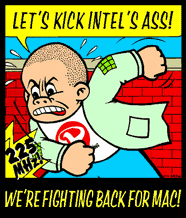 Everyone knows that Apple hasn’t been able to market its product successfully. The Mac is still insanely great. Rhapsody promises something even better. The PowerPC kicks Intel’s butt, especially the new 750.
But the world needs to know.
Until then, we’re those fanatics with the odd computers. You know, the ones who don’t do Windows.
I’m doing my little bit on my Mac Promo Page to provide some slogans and graphics that promote the platform. We’ve got to shout it loud!
Apple, if you’re listening, don’t kill the clones. Join together with your PowerPC partners (IBM and Motorola) and your Mac OS partners (Motorola, Umax, and others). Build a war chest. Finance a campaign that screams on TV, in People, on the radio, in the local newspaper, and on billboards: We’re the best!
Here are two samples I created. Do with them what you will.


