
Apple had done a marvelous job marketing OS X 10.8 Mountain Lion, resulting in over 3 million downloads over its first four days on the market. That’s an impressive number, but what does it mean?
Snow Leopard and Beyond
 To put things in perspective, Apple has sold over 22 million Macs since making the switch from PowerPC processors to Intel in 2006. Every single one of them can run OS X 10.6 Snow Leopard or newer, but not all can run OS X 10.7 Lion, let alone Mountain Lion.
There is almost no reason for users of early Intel-based Macs not to have switched from OS X 10.4 Tiger or 10.5 Leopard to Snow Leopard, especially with its US$29 price tag, a $100 reduction from the $129 retail price of OS X that had prevailed since its introduction in 2001. Granted, you need more than 1 GB of RAM to run Snow Leopard decently, but that’s an inexpensive upgrade.
Site logs show that at present, only 8% of those reading Low End Mac on Intel-based hardware are using something older than Snow Leopard. About 1.5% are still using Tiger, and another 6.5% Leopard. (Site logs also show that only 13.3% of Mac visitors are still using PowerPC hardware. I count myself among that minority.)
The Lion Cohort
 Except for the Mac mini (which remained Core Duo until August 2007), by the end of the third quarter of 2006, all Macs sold had Core 2 Duo CPUs, the minimum requirement for Lion. Let’s subtract 5 million for Core Duo and Core Solo Macs, which still gives us 17 million Macs that can run Lion or newer.
It took time for Lion to really get traction. For users new to Macs since the Intel transition, it was mostly the new, more iOS-like experience that put them off. For longtime Mac users with old (pre-2006) software, the loss of Rosetta kept us from making the transition.
Lion became dominant over time, reaching almost 50% share among all Mac users reading Low End Mac and 55-56% among Intel users in July 2012 – until Mountain Lion shipped.
Mountain Lion: Higher Hardware Requirements
 There’s not a clear-cut date you can use to tell if your Mac can run OS X 10.8 Mountain Lion. Some 2007 Macs can run it, and some 2008 models can’t. My best guess is that 10-14 million Macs can run it, about 2/3 of those able to run Lion.
And I’m sure the $20 price tag didn’t hurt adoption of Mountain Lion.
If we take 12 million as the number of Macs capable of upgrading to Mountain Lion, 3 million sales is a phenomenal figure. Fully 25% of machines capable of running OS X 10.8 are already doing so!
Who Is Adopting Mountain Lion?
The question is, where are those sales coming from – Lion users or Snow Leopard users? (You need at least OS X 10.6 to be able to access the Mac App Store and order Mountain Lion.)
As the following graph shows, Mountain Lion came out of almost nowhere (less than 3% of Mac-using visitors to Low End Mac prior to July 25) to become the second most popular version of OS X among our readers. It took just 4 days to pass Snow Leopard.
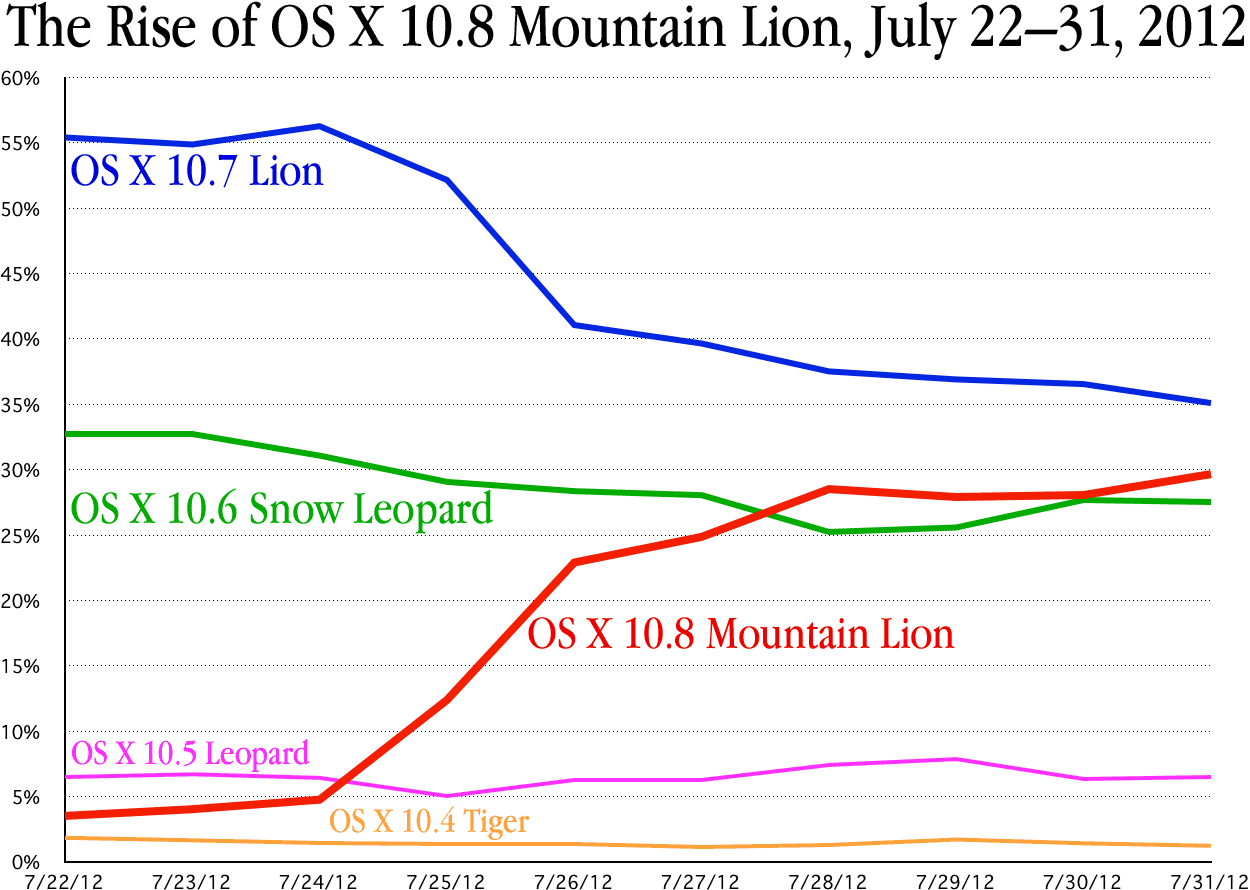
Mountain Lion has already taken a huge bite out of Lion.
What’s interesting is the difference in conversion rates between Lion and Snow Leopard. Where Lion really did have the lion’s share at 55%, it’s now down to 35%. Nearly 40% of Lion users have moved to Mountain Lion, which is already is up to 30%, and two-thirds of that can be directly attributed to users migrating from OS X 10.7 to 10.8.
Among Snow Leopard users, the change is less dramatic. Earlier in July, 33% were using it, and that’s settled down to 28%. (Interestingly, it was as low as 25% late last week, but some users have switched back to it after trying Mountain Lion for a bit.) Only about 15% of OS X 10.6 users have migrated to 10.8 and stuck with it.
Why would they do that? There could be several reasons. Lion and Mountain Lion are more demanding of hardware resources and want more system memory, so some Snow Leopard users may have found things getting sluggish and gone back to the less demanding Snow Leopard. Some of them may have been put off by Gatekeeper, which by default won’t le them run old software not signed with an Apple approved developer ID. And some may have just found it a bit alien after years using traditional (pre-Lion) versions of OS X.
My guess is that the bulk of Snow Leopard users who will stick with it are using older software, especially applications written for PowerPC Macs that require Rosetta to run on Intel-based Macs – and OS X lost Rosetta a year ago when Lion was introduced.
Looking Ahead
Mountain Lion had a huge growth spike upon its release and will now enter a period of slow, steady growth as people buy new Macs and those with older Macs move to it. I wouldn’t be at all surprised if our site logs show OS X 10.8 overtaking 10.7 within the next 7-10 days – perhaps by the weekend.
Lion is going to see a continual bleed as users who can make the move to Mountain Lion do so. That said, with about one-third of Macs unable to run Mountain Lion, Lion is going to stick around as long as those Macs remain in use.
Snow Leopard is destined to displace Lion as the #2 version of OS X because some Macs can’t run Lion and some users still have PowerPC apps that keep them using Snow Leopard. I don’t expect to see Snow Leopard’s share grow, but it will shrink much more slowly than Lion’s and remain a significant force among developers for at least a couple more years.
Leopard isn’t going to go away, but at just 6.5% of the Intel-based OS X base, it’s already becoming less significant to developers, and many apps already require OS X 10.6 (or even 10.7) or newer. The number of Leopard users will shrink slowly, but their percentage will decline as more users come to the platform and as Leopard users decide to make the leap to Snow Leopard.
Tiger on Intel Macs is an insignificant 1.5% of the user base, and as with Leopard, that number will slowly decline as Apple sells more Macs and as Tiger users decide to migrate to Leopard or Snow Leopard – although at this point, I doubt many will migrate until they move to a newer Mac.
In summary, Mountain Lion is destined to dominate the Intel-based OS X user base until it is replaced by a newer version, overtaking Lion by mid-August and undoubtedly breaking the 50% mark by the end of 2012. This will be due to both new Mac sales and by Lion users who can run it deciding it’s worth $20 for some of those new features.
Snow Leopard has a long, solid future ahead of it, and within a few months it will have more users than Lion. At this point, most Snow Leopard users have a reason for not abandoning it, whether due to hardware that doesn’t support 10.7 or 10.8 or to PowerPC software that won’t run under Lion-and-beyond or where the cost to move to a Lion-compatible version just doesn’t make sense.
By October or November, Mountain Lion and Snow Leopard are going to be the significant versions of OS X for developers, which bodes well for those of us who have chosen to stick with Snow Leopard. All the marketing in the world won’t get us to switch if our Macs or software collections prevent us from leaving Snow Leopard behind.
Keywords: #osxlion #osxmountainlion #osxsnowleopard
Short link: http://goo.gl/7Ajytu
searchword: riseofmountainlion
