
As a longtime Apple user – I cut my computing teeth on an Apple II+ circa 1979 – I get a kick out of reading articles about the 10 best or 10 worst Apple products of all time. The latest of these, Top 10 Worst Apple Products of All Time, appeared on the Australian PC Authority website last week. I have to say that, for a change, I wasn’t disappointed with the list of “worst” Apple computers and accessories.
Here’s the list compiled by Shaun Nichols and Iain Thomson:
- Mac Portable, honorable mention
- Mac Color Classic, honorable mention
- 10. Apple QuickTake digital cameras
- 9. Bandai Pippin/@mark
- 8. iPod Hi-Fi
- 7. PowerPC
- 6. Mac OS 9
- 5. eWorld online service
- 4. Performa line
- 3. “Hockey puck” mouse
- 2. 20th Anniversary Macintosh
- 1. Apple III
Let’s take a Low End Mac look at these choices.
Mac Portable: Widely Misunderstood
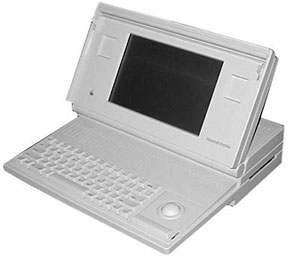
The Mac Portable (1989) was a lousy laptop. Then again, it was never intended to be a laptop. Old timers will remember the earliest successful portables: The 23.5 lb. Osborne 1 (1981) with its 5″ CRT display, the 26 lb. Kaypro II (1982) with its 9″ screen, and the 28 lb. Compaq Portable (1983), the first portable IBM compatible. These were large, heavy beasties, often compared in size to a portable sewing machine – and they were hugely popular.
The Macintosh was also designed to be portable and originally shipped with a carry case that had room for the computer, keyboard, mouse, power cable, and a bunch of floppy disks. The first Macintosh (1984) weighed just 16.5 lb., so even with a case and accessories, it was a relative lightweight. I remember toting my Mac Plus between home and work when I was at ComputerLand of Grand Rapids. It was kind of big, heavy, and awkward, but it was portable.
The Mac Portable was intended as a portable Macintosh, not a notebook computer. Compared to the suitcase-sized portables, the 16 lb. Mac Portable was a lightweight. Compared to the Mac Plus, it was a lot easier to tote – it even had a built-in handle. The Portable had twice the power of the Macintosh SE, supported over twice as much RAM, and had a larger display (640 x 400 pixels vs. 512 x 342 – 75% more pixels). It could run up to 10 hours from its battery, and its active matrix display was a treat in good light (but without backlighting, it was virtually unusable in low light).
The Portable had a great keyboard, and it could be used with a numeric keypad or a trackball. For lefties, the trackball could be mounted on the left side.
Mac users who wanted or needed a real laptop would have to go the DOS route – or wait two years for the first PowerBooks, which would forever change notebook design.
At $6,500, the Portable sold well, although it was never a runaway success. It was a very competent, well designed computer and does not deserve a dishonorable mention on any list of worst Apple products.
Further Reading
- The Misunderstood Macintosh Portable
- A Brief History of Portable Computing: From Dynabook to Netbooks
- Inside the Macintosh Portable, Technologizer
Macintosh Color Classic
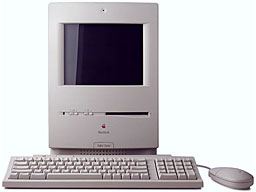 Although the Color Classic (Feb. 1993) has always had something of a cult following, it merits a place on any 10 Worst Macs list. There are several reasons for this:
- The nominal 10″ 512 x 384 pixel display allowed Apple to make the Color Classic just a bit larger than the Macintosh Classic, but the end was already in sight for such low resolution displays. Apps that supported color often assumed a 640 x 480 minimum display size, making them incompatible with the CC’s undersized screen. The only benefit of this resolution is that it allowed the Color Classic to use the Apple IIe Card, which only supports that resolution. This made it easier to sell the CC in the education market.
- The Color Classic was underpowered. Apple’s top-end Mac was the 33 MHz 68040-based Quadra 950. The Color Classic has a 16 MHz 68030. In fact, it was the last 16 MHz Macintosh.
- The logic board in the Color Classic was deliberately crippled. The design originated with the Macintosh LC in late 1990, one of three desktop Macs introduced at the same time. The top-end 25 MHz Mac IIci had three NuBus expansion slots, a Processor Direct Slot (PDS), and supported up to 128 MB of RAM. The 20 MHz Mac IIsi was limited to 65 MB of RAM and had one PDS slot, which supported a NuBus adapter. It was designed to grow the Mac market but not cannibalize IIci sales. The LC was designed with even more limitations: Its 16 MHz 68020 CPU was designed for a 32-bit data bus, but Apple only used a 16-bit data bus in the LC. Additionally, Apple hard wired the ROMs to support no more than 10 MB of RAM. That deliberately compromised design was at the heart of the Color Classic.
On the plus side, the Color Classic was the first Mac with a built-in microphone and the first with a slide-out logic board. This made upgrades easy for those willing to swap the board from a 25 MHz LC 520, 33 MHz LC 550, or 33 MHz 68LC040-based LC 575.
One popular modification involves some hardware hacking that converts the built-in display to 640 x 480 resolution. It’s a shame Apple didn’t design the CC with both 512 x 384 and 640 x 480 screen resolutions.
Further Reading
- A History of the Color Classic
- Second Class Macs: Macintosh Color Classic
- The Macintosh Colo(u)r Classic FAQ
10. Apple QuickTake
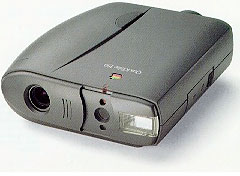 You’ll be forgiven if you’ve forgotten that Apple ever made a foray into the world of digital cameras, as the first one was introduced in February 1994, there were only four models, and the line was discontinued in 1997.
Apple’s goal was to help create a consumer digital camera market. By standards of the past decade, they were nothing to get excited about, but the QuickTake 100, built for Apple by Chinon, was the first color digital camera to retail below the $1,000 mark (at a breakthrough $749). Maximum resolution was 640 x 480, and there was room for storing just eight images at that resolution. No LCD for reviewing your images. No zoom lens and no focus. There was a built-in flash. And it was Mac only.
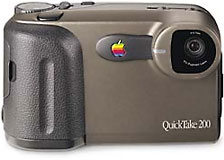
The QuickTake 100 Plus and 150 added some minor improvements, and the QuickTake 200 was a whole different machine – essentially a Fujifilm DS-7 with the same 640 x 480 maximum resolution, but now the lens could focus. The 200 used SmartMedia cards (also largely forgotten nowadays) and had a much wider range of shutter speeds.
Iain Thomson pans the QuickTake, saying, “Apple chose a stinker of a product to slap its logo on.”
The QuickTake cameras were not a commercial success, and they were discontinued in 1997 alongside the Newton and LaserWriter product lines as Apple streamlined for survival and put the focus fully on computers.
Further Reading
- Apple QuickTake Digicam Found, but How Can You Use It?
- Apple’s Largely Forgotten QuickTake 150 Digital Camera
- Apple QuickTake, Wikipedia
9. Apple Pippin/Bandai @mark/@world
 Another largely forgotten system was the Apple Pippin, which was launched by Bandai in 1995 in Japan (1996 in the US) and pitched as a gaming console. Unlike most gaming systems, it used CD-ROM discs, had a computer operating system (a stripped down version of the Mac OS), and had a very small selection of titles.
Apple developed the Pippin technology and hoped to license it to multiple vendors, but only Bandai took the bait. The Bandai @mark (pronounced at-mark), as it was known in Japan, only sold 42,000 units worldwide.
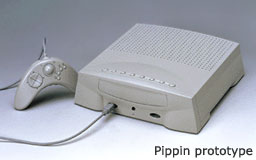 The technology was lackluster, and it faced competition from the Nintendo 64, Sony Playstation, and Sega Saturn. In 2007 GamePro rated it the worst gaming console of all time, and in 2006 PC World put it on a list of the 25 worst tech products of all time.
Further Reading
- Apple’s Pippin and Bandai’s @World: Missing the Mark(et)
- Apple Bandai Pippin, Wikipedia
- The 10 Worst-Selling Consoles of All Time, GamePro
- The 25 Worst Tech Products of All Time, PC World
8. iPod Hi-Fi
Apple stinkers weren’t limited to the 20th century. Although the iPod, introduced in October 2001, eventually became the dominant MP3 player (after it stopped being Mac only and added USB), little good can be said of iPod Hi-Fi, a dedicated speaker system/dock for the iPod introduced in early 2006.
First off, it was way overpriced. You could buy a Bose SoundDock, which was more versatile and sounded better, in the same price range. And then there was sound quality – definitely not high fidelity (a common complaint about Apple’s stock iPod earbuds as well). It was only compatible with iPods with a dock connector, so first- and second-generation iPod owners were left out, and the remote control had very limited options.
iPod Hi-Fi was big, ungainly, and didn’t provide the sound quality expected at the price. Apple finally killed it off in late 2007.
Further Reading
- iPod Hi-Fi, Wikipedia
7. PowerPC
I was shocked to see the entire PowerPC processor family on this list. Shaun Nichols says:
“The PowerPC project was a marvelous piece of engineering, but not a great business decision.
“The merits of the chip itself are readily apparent today, derivatives of the POWER line are widely used for high-performance systems, gaming consoles and embedded systems.
“But it wasn’t the right choice for personal computers.”

Co-author Iain Thomson was also surprised, noting that the decision to adopt RISC architecture made sense at the time. By the late 1980s, it was already apparent that Motorola’s 680×0 CPU family was running out of steam. Although architecturally superior to early Intel x86 designs, a new stream in CPU design had emerged promoting RISC (Reduced Instruction Set Computer) design. In brief, RISC design meant the CPU would process a reduced number of instructions but would execute them more efficiently than standard CPUs.
Apple’s original plan was to adopt the Motorola 88000 RISC CPU, but Motorola was unable to produce chips until 1990, by which time Apple was looking at other options.
IBM produced its first RISC CPU, the 801, in 1980. The 15 MHz CPU was powerful, but IBM used it primarily for channel controllers and networking devices. The lessons learned from the 801 formed the core of IBM’s POWER architecture, which was introduced in 1990 and remains with us to this day.
Apple teamed up with Motorola and IBM in 1991 to develop a new RISC architecture that used some of Motorola’s 88000 technology and a lot of IBM’s POWER technology. The first PowerPC CPU, the 601, was introduced in 1992 and made its way into Power Macintosh computers in March 1994. PowerPC chips remained at the heart of Macs through 2005, and in 2006 Apple moved its entire line of computers to Intel x86 chips.
The PowerPC architecture was superior to Intel’s, but two things happened. On the PowerPC side, after the G3 design, IBM and Motorola parted ways. Motorola added the AltiVec processor and introduced the G4, but was unable to achieve clock speeds that would keep it competitive. Apple eventually convinced IBM to add a velocity engine with the G5 design, but in a world of 3 GHz Pentium 4 CPUs, it also lagged in terms of clock speed.
Burned by Motorola’s inability to deliver a 500 MHz G4 when promised and IBM’s inability to deliver a 3 GHz G5 when promised, Apple went to its backup plan. The company had been secretly porting OS X to Intel x86 architecture during the entire development process, and it threw in the towel on PowerPC in 2005.
The second important development was the Intel kept moving forward. Today’s x86 CPUs are a far cry from the CPUs of the 1980s and 1990s. When Apple made the jump from PowerPC to Intel Core Duo in 2006, there was a big step forward in processing power.
Although PowerPC ran out of steam, I would never call it one of Apple’s worst products. There were several times during the PowerPC era when Apple could claim the fastest notebook and/or the fastest personal computer on the market.
Further Reading
- PowerPC Was Not a Failure
- IBM, Apple, RISC, and the Roots of the PowerPC
- Reduced instruction set computer, Wikipedia
- PowerPC, Wikipedia
6. Mac OS 9
Iain Thomson mercilessly calls Mac OS 9, “Apple’s last flogging of the dead horse that was System 7. It was a dog of an operating system in many ways….”
Ouch. Mac OS 9 was the culmination of many years spent improving System 7, which itself had been a big step forward from System 6. By version 9, the Mac OS had gained the ability to do things like format a floppy disk in the background, although it was still necessary to reboot the system when an application locked up. It was a dated operating system, but it remained eminently usable.
Shaun Nichols calls OS 9 a stopgap, which is closer to the truth. The Classic Mac OS was on its way out, but just as PowerPC Macs had been mostly backward compatible with 680×0 software and 32-bit mode in System 7 had been mostly backward compatible with 24-bit mode, Classic Mode in Mac OS X would be mostly backward compatible with Mac OS 9. Not System 7 or Mac OS 8.x; the line for Classic Mode was drawn at OS 9 – and later 9.1 and 9.2.2. And right up through Mac OS X 10.4 Tiger, Classic Mode let those with PowerPC Macs run those old Classic apps.
Mac OS 9 was the end of the Classic Mac OS, and it pales in comparison to OS X 10.3 Panther and later. Yet it was the culmination of an operating system family. The Classic Mac OS went out with a bang, not a whimper, and many of us still use it today. It does not deserve a place on this list.
5. eWorld
Apple’s short-lived eWorld online service was another mid-90s disaster. Developed hand-in-hand with AOL, many maintain that eWorld is what AOL should have or could have been. Problem was, although eWorld might have become popular across the board, it lived in an Apple-only ghetto. The Windows version of eWorld was never finished, keeping 95% of the computing world away.
Worse than just being Apple-only (Mac and Newton), eWorld was not marketed at all. It was provided with new Macs, but you had to look for it, so it was never popular even among the Apple set. It was expensive compared with AOL and other services, and by the time Apple pulled the plug, AOL alone had about 30 times as many subscribers.

eWorld shows what could have been. It was not a technological failure; it was a failure in salesmanship. Launched in June 1994, it went dark at the end of March 1996.
Further Reading
- eWorld: Apple’s Overpriced, Poorly Marketed Online Service
- Apple Computer’s eWorld: What AOL Could Have Been, Scott Converse
- eWorld, Wikipedia
4. Performas
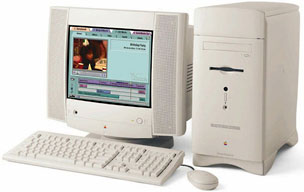 Shaun Nichols states, “When Steve Jobs tells people ‘we don’t know how to make a cheap computer,’ he’s partially referring to the Performa line.” Iain Thomson claims that “the Performa line produced some of the worst computers in the company’s history.” Were they really that bad?
Apple launched the Performa line in September 1992 with the Performa 200, 400, and 600 – rebadged versions of the Classic II, LC II, and IIvx. The first two were identical to their Macintosh counterparts, but the Performa 600 was a slightly more crippled version of the handicapped IIvx – identical except that the “consumer” machine could not accept a Level 2 cache card.
The line came to an end in February 1997 when the Performa 5400 all-in-one and Performa 6400 minitower were replaced by the Power Mac 5500 and 6500. And, as Thomson says, some of the worst Macs ever were part of the Performa line.
However, there were also some excellent Performas. In particular, the Performa 630 was a great computer with a CD-ROM drive bay, an LC Processor Direct Slot, a modem/ethernet slot, and a video slot for either a TV tuner or a video I/O card. There was even a version with a DOS card. The 33 MHz 68LC040 CPU provided sufficient power for a home computer.
There were some real dogs – which we’ll look at later – but overall the Performa hardware was generally identical to Macintosh models. The real problem was marketing, as some models were sold as Macs, as LCs (primarily to the eduction market), and Performas, and then sometimes with several different Performa model numbers. The Performa line confused matters, but by and large “some of the worst computers” in Apple’s history were also available with other nameplates.
That includes the worst Mac ever, which we’ll discuss shortly.
Further Reading
- Apple’s Performa Line, 1992 to 1997
- Macintosh Performa, Wikipedia
- Apple Macintosh Performa – 1994 Commercial, YouTube
3. ‘Hockey Puck’ Mouse
Ever since Apple introduced the Lisa in 1983, the company was always about the user interface. It standardized on a one-button mouse with religious fervor, and when it finally produced the multibutton Mighty Mouse, it behaved as a single-button mouse by default. The shape of the mouse has changed over the years, but with one exception they all fit the hand well.
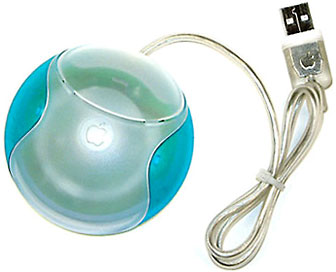 That exception, of course, was the round USB “hockey puck” mouse introduced with the first iMac in 1998. Unlike every mouse before or since, there was no tactile clue that you were holding the mouse with the correct orientation, so you might grab the mouse, move it right, and have the cursor move up-and-right or down-and-right. It was a case of poor ergonomic design and bad human interface, yet Apple stuck with it for years – even including it with its professional Power Mac models starting with the Blue & White G3.
Curiously, Steve Jobs maintained that it was the best mouse ever created. Fat lot he knows! Or maybe he was only judging it by its visual design – it was quite stylish – and not its usability.
Apple did improve the round mouse along the way, adding a dimple at the center of the mouse button and finally providing some tactile feedback. If you didn’t feel the dimple, you were holding it wrong. It was a small improvement to a bad design.
There was great rejoicing when Apple discontinued the round mouse in 2000, replacing it with the lozenge-shaped Pro Mouse that used the entire mouse as a button.
Further Reading
- Round USB Mouse
- Of Mice and, Well, Hockey Pucks
- The Evolution of the Apple Mouse, Vectronic’s Apple World
- Dumbest Gadgets and Technologies Ever, Digital Trends
- Top Apple Debacles, PC World
2. 20th Anniversary Macintosh
 Iain Thomson says the 20th Anniversary Macintosh (TAM) was “very nearly a contender” for the #1 spot on the list, while Shaun Nichols has no issues with the computer itself – but definitely with its timing.
The timing was 1997. Apple was 20 years old and teetering on the edge of bankruptcy. The TAM was designed to celebrate that anniversary (not the Mac’s anniversary) as elegantly as possible, costs be damned. The computer was essentially a PowerBook 3400c modified and reconfigured for desktop use. It had the same 12.1″ 800 x 600 display, a motherboard with a faster bus and CPU, and even the keyboard was from the PowerBook – complete with trackpad. Memory topped out at 128 MB – even less than the PB 3400.
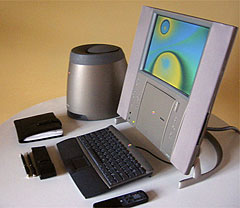 The machine had a front-loading vertical CD-ROM drive and a subwoofer, and it looked gorgeous. At $7,499, it had better!
Apple produced 12,000 TAMs, and they never sold well. However, with its flat panel display and thin design, it did foreshadow today’s iMac design.
Further Reading
- Twentieth Anniversary Macintosh, Wikipedia
- 20th Anniversary Macintosh, Apple Museum, Dr. Bott
1. Apple III
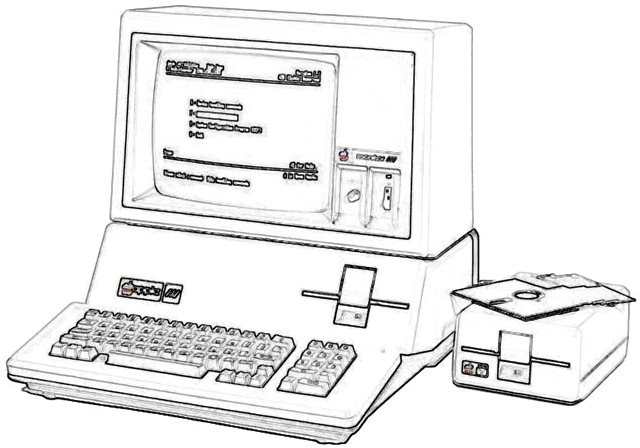 I don’t think anyone will disagree that the Apple III was by far the worst Apple product of all time. Steve Jobs insisted that the new business computer be compact and quiet, so there were no cooling fans or heat sinks. So the computer ran hot, and the chips would expand and partially unseat themselves from their sockets. The Apple III would lock up, and it was not good.
The Apple III could get so hot that it would damage floppy disks and warp its motherboard. Steve Wozniak said it was the first Apple designed by the marketing department, with the engineering subservient to marketing demands. The Apple III was an unmitigated disaster and merits the #1 spot on this list.
Further Reading
- The Ill-Fated Apple III
- Apple III Chaos: Apple’s First Failure
- 2 Apple Failures: Apple III and Lisa
- The Apple III Project, Apple II History
- The 10 Greatest Flops in Computer History, Telegraph
- Whatever happened to the Apple III, Dvorak Uncensored
- Apple III, Wikipedia
Missing from the List
PC Authority missed a few. The Mac LC, LC II, and Classic II are as deserving of a place on this list as the Color Classic, as they share the same hobbled logic board architecture. And of the four, the Classic II is the most crippled, as it is the only one without an expansion slot or any way to support full-color output.
Here are five Macs that deserve a place on the worst list in order of their introduction:
Classic II
Apple deliberately limited the Macintosh LC to prevent it from cannibalizing Mac IIsi sales (and the IIsi itself was limited so it wouldn’t steal Mac IIci sales). While it might have made sense to do that in October 1990, the Classic II was introduced a year after that – and six months after the 40 MHz Mac IIfx displaced the IIci as the fastest Mac.
In theory, the Classic II replaced the SE/30, which was more expensive and superior in almost every respect. The SE/30 has a 32-bit CPU on a 32-bit data bus; the Classic II puts the same CPU on a 16-bit data bus. The SE/30 supports up to 128 MB of RAM; the Classic II is limited to 10 MB. The SE/30 has a Processor Direct Slot; the Classic II has no expansion slot. The Classic II does have 32-bit clean ROMs, while the SE/30 has “dirty” ROMs – the only advantage it has over the SE/30 other than a lower price.
Performa 600 (a.k.a. Macintosh IIvi)
We looked at the Performa line above, noting that it included some of the worst Macs ever – but also some great ones. The Performa 600, introduced in September 1992, belongs on the list of worst ones. Where the LC had put a 32-bit CPU on a 16-bit bus, the Performa 600 (and its near-twin, the Mac IIvi) put a 32 MHz CPU on a 16 MHz bus. The result was worse performance than the older 25 MHz IIci, which has a 25 MHz bus.
The best way to improve IIvi performance inexpensively is to install a Level 2 cache card, but the Performa 600’s logic board was modified to make that impossible.
On the plus side, the Mac IIvx, IIvi, and Performa 600 introduced a new case design with room for an internal CD-ROM drive. This design remained in use through the Quadra era and into the first generation of Power Mac computers. A somewhat updated version of that design was used in the Power Mac 7200-7600 and the Beige Power Mac G3 – quite a legacy.
Further Reading
Macintosh TV
 Long before Apple TV, there was Macintosh TV. Rolled out in October 1993, Mac TV took an LC 520, added a TV tuner with cable input, crippled memory expansion (limited to 8 MB vs. 36 MB on the 520), and made everything black. Only 10,000 units were produced, and they were available exclusively through Best Buy (if I recall correctly).
On the plus side, they were great for the dorm room, as you could watch TV fullscreen or use it as a Mac. On the minus side, memory upgrades were seriously limited.
Further Reading
- Learning from Failure: Apple’s Most Notorious Flops, Wired
- Macintosh TV, Wikipedia
Performa x200 Series
In terms of hobbled hardware design, Apple’s low point began with the introduction of the Performa 5200 in April 1995 and the Performa 6200 in May 1995. Without getting too technical (we have links below if you’re interested in that), here are the issues:
- The PowerPC 603 CPU has caches that are too small to efficiently process 680×0 code. This was solved with the later 603e design, which doubled cache sizes.
- The logic board is based on the 32-bit Quadra 605 design, but the PPC 603 works best on a 64-bit data bus. It takes four memory cycles to read two 32-bit chunks of code and integrate them as a single 64-bit piece of code.
- The 75 MHz CPU in the original models runs on a 37.5 MHz data bus. With small caches and a 32-bit bus, this further crippled the CPU, giving the PPC 603 a poor reputation.
- Tasks are divided into “left” and “right” sides of the motherboard. The left side handles communication, networking, audio, ADB (keyboard and mouse), and SCSI (for the CD-ROM drive). The right side handles memory, IDE (for the hard drive), graphics, and the video/TV card, when present. All data transfer between the two sides is handled by the CPU, so things can get bogged down when networking.
- The North American model doesn’t support hardware handshaking, which limits the modem to 9600 bps throughput.
Over the years, things improved. The 603e solved the small cache problem, but most of these architectural problems persisted until Apple designed an entirely new motherboard, which was introduced with the Performa 5400 in April 1996.
As networking via modem or ethernet became more and more important, the Performa x200 series became worse and worse performers. These computers are at their best when they aren’t networked. In all of Apple’s history, only the Apple III is worse.
Further Reading
Mac mini Core Solo
There’s only one Mac from the Intel era that belongs on a worst list, the 1.5 GHz Core Solo version of the Mac mini.
At 1.5 GHz, this was the lowest clock speed of any Intel Core or Core 2 Mac ever, and it was the only Intel Mac ever designed with a single-core CPU. Put these two factors together, and this is the slowest, least powerful Intel Mac by quite a margin. Apple never should have released a Core Solo model at all, and this model should be avoided unless you’re the kind of person who is comfortable replacing that underperforming CPU with a Core Duo or Core 2 Duo.
Apple’s 10 Worst Products
Comparing our 10 Worst Macs list with PC Authority’s 10 Worst Apple Products list, here’s my list of the ten worst in countdown order:
- 10. iPod Hi-Fi
- 9. Apple QuickTake digital cameras
- 8. eWorld online service
- 7. Classic II
- 6. Macintosh TV
- 5. Performa 600
- 4. 20th Anniversary Macintosh
- 3. Round USB “hockey puck” mouse
- 2. Performa x200
- 1. Apple III
Absent compared with PC Authority’s list: the Performa line (although we list two Performa models), Mac OS 9, PowerPC CPUs, and the Pippin @mark, which was an Apple technology that was released as an Apple branded product. If we were to expand the list to a dozen items, the Color Classic and Pippin @mark would round out that list.
Do you feel something else should be on this list, maybe a newer Mac or iPod? If so, share your thoughts in the comments section.
Keywords: #apples10worst #apple10worst
Short link: http://goo.gl/CTZNrO
searchword: apples10worst, apple10worst

The iPod Hi-Fi was too big, too heavy and too expensive, but where Apple muddied the sound with too much bass the Bose Sound Dock offered, in typical Bose fashion, minimal highs and minimal lows. I remember there was another dock around that time that put both of them to shame, but can’t recall who made it.
As you stated, Apple frequently crippled their machines to protect sales of more expensive models and that strategy was one of the primary reasons for the near collapse of the company in the 1990s. While you’ve rightly identified the Classic II as one of those crippled designs I’d argue that the bigger mistake was the original Classic. At its core the Classic was nothing more than a Mac Plus with a hard drive. As a low end 5 year old design the Classic was obsolete long before it was introduced, a fact that far too many buyers learned to their dismay. The Classic single handedly created millions of Windows users.
There’s no question that the Performa x200 series and Apple III were the worst hardware. The early 5200 and 6200 were not only crippled, but shipped with an actual hardware defect too.
The whole Performa era was a confusing mess. Quadra computers were sold by US Apple dealers. The same machine with an LC label was sold by Canadian Apple dealers and to US education customers. Large American retailers sold the same machine with a Performa label. The Power Macintosh name was then used by both Canadian and US dealers. At its worst there were a half dozen different names for what was essentially the same Mac. Sometimes there was an actual hardware difference (one model comes with a modem while another comes with an Ethernet card) and sometimes the only difference was a single piece of bundled software and the name of the store you bought it in.
According to my local Apple dealer the Color StyleWriter Pro had a 13-14 month lifespan. Shortly after the warranty expired so did the printer. They also told me that 60% of the AppleVision 1710 displays that they sold were returned within 3 months for repair or replacement with something more reliable.
But the true pinnacle of Apple incompetence had to be System 7.5.2. It shipped on the then new Power Macintosh 7200, 7600 and 8600. Unlike most versions of System 7 it rarely ran for more than an hour without crashing in a way that forced a reboot. Because it was shipped on expensive professional machines, the fallout was intense. Entire businesses were crippled for weeks while Apple worked on a fix. The fix, going by the bizarre name of System 7.5 Update 2.0, had the potential to make things even worse. Update 2.0 came with a 17 step installation guide. Anyone who accidentally left out a step or did one in the wrong order, like doing 13 before 12, was left with a computer that either wouldn’t boot at all or would freeze solid as a rock within 10 minutes of powering up.
Just getting the update was an exercise in extreme patience. It was the era of 9600 and 14400 bps modems, but demand for the update was so high that my download speeds rarely exceeded 500. Making matters even worse, modems of the day frequently lost their connection and ISPs would arbitrarily cut off users who’d been signed in for too long. Several of us volunteered to help the staff at the local Apple dealer download the disk images. It took our group nearly a week to download all the disk images.