Mac Musings
Was the Macintosh IIci the Best Mac Ever?
Daniel Knight - 2009.01.19 -
Follow Low End Mac's blogs: LEMblog and Low End Mac Services.
Was the "best Mac ever" really released two decades ago?
The Macintosh was not a runaway success when it was introduced in 1984. Many would argue that it didn't come into its own until 1986, when the Mac Plus was introduced with expandable RAM and support for SCSI hard drives and other SCSI devices. And most would agree that the SE/30 was the culmination of the original all-in-one black & white Macintosh design with its 16 MHz 68030 CPU, internal hard drive, expansion slot, and potential to handle 128 MB of RAM.
The Mac II was a powerhouse, and with its larger displays, it helped establish the Mac as the preeminent platform for desktop publishing. It wasn't without its shortcomings, but with a 16 MHz CPU, six NuBus expansion slots, room for a 5.25" hard drive, and the possibility of using 128 MB of RAM, it defined Apple's top end in 1987.
The Mac II gave way to the Mac IIx in 1988; it was just as big and expandable, but it had a slightly better CPU and a high-density floppy drive. It would set you back over $9,000 with a 40 MB hard drive!
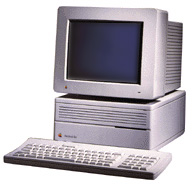 Apple introduced a more compact Mac II
model for those who needed more than a compact Mac offered but didn't
require 6 expansion slots or 5.25" hard drives. The Mac IIcx came out in March 1989 with the
same 16 MHz 68030 CPU as the IIx, but the smaller case only had room
for a 3.5" drive, and the motherboard had only three NuBus expansion
slots.
Apple introduced a more compact Mac II
model for those who needed more than a compact Mac offered but didn't
require 6 expansion slots or 5.25" hard drives. The Mac IIcx came out in March 1989 with the
same 16 MHz 68030 CPU as the IIx, but the smaller case only had room
for a 3.5" drive, and the motherboard had only three NuBus expansion
slots.
Best of all, you saved over $2,000 by choosing the IIcx instead of the IIx. It sold like hot cakes.
Making a Good Thing Better
Six months later, Apple introduced the Macintosh IIci, a computer some consider to be one of Apple's best designs ever. The IIci used the same case as the IIcx, and IIcx owners could upgrade with a motherboard swap. But there were big differences under the hood.
The IIci was the first Mac to pass the 16 MHz mark - and not by just a little bit. Its 25 MHz CPU gave it 56% more computing power than the IIcx and IIx.
That was just the beginning. Where earlier models in the Mac II family had required you to add a video card, the IIci had built-in graphics capable of supporting a 640 x 480 color display or a 640 x 870 portrait display. Not only that, but because graphics ran on the 25 MHz motherboard instead of a 10 MHz NuBus card, video was fast. (Using onboard video used up to 320 KB of system memory.)
In addition to its three NuBus slots, the IIci also had a processor direct slot (PDS) that could hold a cache card, later on, a CPU upgrade. Adding a low cost level 2 (L2) cache could boost performance another 20-30%, making it nearly twice as powerful as 16 MHz Macs.
The IIci even had the fastest SCSI bus of any Mac in the Mac II family - including the "wicked fast" 40 MHz Mac IIfx that shipped six months later.
Finally, the IIci was the first Macintosh with 32-bit "clean" ROMs. Until System 7, all Macs ran in 24-bit mode, so system ROMs weren't designed to work in 32-bit mode. With the IIci, Apple finally had a model that could run in 2-bit mode without special software patches, making it the first Mac able to take full advantage of having more than 8 MB of memory installed.
Future Oriented
"Clean" ROMs was just one way the IIci was designed for the future, as System 7 with its 32-bit addressing didn't arrive until early 1991. The cache/PDS slot made it easy to add a big L2 cache at first, and later on it could be used to support up to 50 MHz 68030, 45 MHz 68040, or 100 MHz PowerPC processor upgrades.
While onboard video was fast, accelerated video cards were just around the corner. Not only were these faster than built-in graphics, they also supported larger monitors, more resolutions and bit-depths, and freed up the RAM used by internal video.
The beauty of the IIci was its flexibility. You could buy a base model, add your own RAM and hard drive, use the onboard video, and have a powerful machine from the start. You never had to buy a video card unless you wanted to, and you could put network cards, SCSI boosters, and the like in those three expansion slots - or a bunch of video cards, if you wanted to work with multiple monitors.
Once System 7 shipped, you could use all the RAM you could afford. In the end, the 25 MHz IIci was so powerful after a 32 KB L2 cache was made standard that Apple had to keep it in the line after it introduced the 32 MHz Mac IIvx in 1992. Where the IIci had a 25 MHz memory bus, the IIvx ran its at 16 MHz. Even with a cache card this proved a big enough liability that the IIci readily trounced it in benchmarks.
The Legacy
The IIci design was the basis for the Quadra 700, one of Apple's first 68040-based models. The 25 MHz Quadra was a powerhouse, and with onboard video that used dedicated memory and an AAUI ethernet port, Apple decided it could eliminate one NuBus slot, giving Q700 owners less expansion options.
The Mac IIci was definitely one of the best Macs ever, because it traded maximum expandability - which the high-end Mac IIx and IIfx offered - for sufficient expandability. In the era before built-in ethernet ports, two expansion slots was an absolute minimum, and three was the least that provided true flexibility.
As Apple moved forward, with the exception of the Quadra 700, all future Macs with built-in NuBus or PCI expansion slots would support at least three cards, giving Mac users plenty of options. One of the things that doomed the Power Mac G4 Cube was its lack of any available expansion slots - and it's one of the biggest arguments against the iMac and Mac mini by longtime Mac users as well.
For many of us, the Mac IIci is the very model for the perfect midrange Mac - enough power, enough expandability, and enough built-in capabilities to make it useful today and keep it useful for years to come. We don't need all the power and expansion options of the Mac Pro, but the iMac and Mac mini just don't have enough possibilities to satisfy us.
I won't call the IIci the best Mac ever. It was a great Mac, and it may even make my personal Top 10 list, but there have been better Macs. However, I will say that it was an excellent value in its day and declare it the best choice of its era.
Join us on Facebook, follow us on Twitter or Google+, or subscribe to our RSS news feed
Dan Knight has been using Macs since 1986, sold Macs for several years, supported them for many more years, and has been publishing Low End Mac since April 1997. If you find Dan's articles helpful, please consider making a donation to his tip jar.
Links for the Day
- Mac of the Day: Performa 630, introduced 1994.07.01. The first desktop Mac with an IDE hard drive could accept a TV or radio tuner.
- Support Low End Mac