
2008: Has it really been five years since Apple introduced the Power Mac G5?
Yes, and the new enclosure introduced on June 23, 2003, lives on as the housing of the Mac Pro.
In the early 1990s, Apple had joined with IBM and Motorola to produce a new family of Reduced Instruction Set (RISC) CPUs based on IBM’s POWER architecture but also implementing some features of Motorola’s 88000 design. The first fruits of these were the Power Mac 6100, 7100, and 8100, designed around the PowerPC 601 CPU and introduced in March 1994.
The next big step was the PowerPC G3 CPU, which was optimized for real-world performance and offered a lot more processing power per CPU cycle than earlier PowerPC designs.
From here IBM and Motorola diverged. IBM wanted to remain true to the RISC concept and kept pushing clock speed higher and higher, eventually reaching the 1.1 GHz mark. Motorola decided that it was time to add a “velocity engine” to the RISC architecture, and its AltiVec unit was the primary difference between the G3 and G4 family of CPUs.
Unfortunately, while IBM was making significant progress on the clock speed front, Motorola was languishing. Although Apple announced a 500 MHz Power Mac G4 on August 31, 1999, Motorola simply wasn’t able to produce 500 MHz chips in sufficient quantity. Apple addressed this by scaling back CPU speed of each Power Mac G4 model by 50 MHz on October 13, 1999. It wasn’t until February 16, 2000, that Apple again added a 500 MHz G4 model to its line.
IBM had reached 600 MHz with the G3 in 1998, so a lot of Mac users were frustrated with Apple’s choice of the Motorola G4. Things didn’t get any better when the next generation of G4 Power Macs was introduced in July 2000 with no increase in clock speed, although Apple did add a second G4 CPU to the 450 MHz and 500 MHz models.
Enter the G5
Motorola was falling behind on clock speed, and IBM emphatically was not interested in producing G4 CPUs. Apple eventually prevailed on IBM to design a chip with a velocity engine, and the PowerPC 970 (a.k.a. G5) was the result of that agreement.
In conjunction with IBM, Apple took a very different approach when designing the Power Mac G5. Where G4 Power Macs would run their CPUs at up to 8.5x bus speed, accessing 133 MHz or 167 MHz RAM while running a 1 GHz or faster CPU created a bottleneck, even with a big, fast Level 2 (L2) cache. The Power Mac G5 was designed to use much faster RAM – it ran at half of CPU speed in the original Power Mac G5 line – 800 MHz to 1 GHz.
The new model ran 1.6 GHz to 2.0 GHz CPUs, a significant improvement over the 1.0 GHz to 1.42 GHz CPUs found in the last generation of G4 Power Macs, and most G5 Power Macs had dual processors.
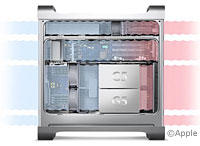 The PowerPC 970 ran hot, so Apple’s engineers created a multi-zone enclosure with 9 fans to keep things cool. Those holes in the “cheese grater” case helped move air through the computer.
Based on promises from IBM, Steve Jobs promised the Apple faithful that the Power Mac G5 would reach 3.0 GHz within a year.
Overpromise, Underdeliver
We all remember what happened. In August 1999, Apple promised 500 MHz G4 Power Macs but couldn’t deliver that speed until February 2000. In June 2003, Apple promised 3.0 GHz G5 Power Macs no later than June 2004, a promise that Apple was never able to fulfill.
The G5 did get faster, and Apple was eventually able to deliver a 2.7 GHz overclocked model with liquid cooling in August 2005. The Power Mac G5 reached its ultimate level of power with the October 2005 Power Mac G5 Quad, which had two dual-core 2.5 GHz CPUs and a liquid-cooling system.
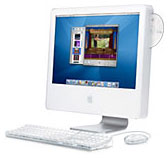 The G5 made its way into the iMac in August 2004, where it ran on a one-third-CPU-speed bus, which helped keep costs down. G5 iMacs ranged in speed from 1.6 GHz to 2.1 GHz (that was the final revision), and they introduced the thin white iMac design that we still have today, although it has changed from white to aluminum and glass.
Although rumored for years, Apple was never able to bring a PowerBook G5 to market, as Charles W. Moore chronicles in The PowerBook G5: Long Rumored, Never Produced.
Hello, Intel
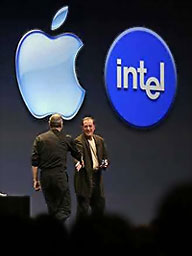 In the end, Steve Jobs ended up with egg on his face twice because Apple’s PowerPC partners couldn’t produce what they had promised. With Intel preparing to launch a new CPU architecture in 2006, Jobs decided that the time was ripe for a change, which was announced at the 2005 Worldwide Developer Conference.
Needless to say, the Mac community was in shock. Microsoft and Intel had long been the enemy, and such a radical change in hardware architecture would create a huge divide between PowerPC Macs and the Intel-based Macs of the future.
Fortunately – and unknown to the rest of the world – Apple had been compiling Intel versions of Mac OS X for years, a task made easier because NeXTstep, on which OS X was based, had already been written for the x86 architecture. Over the course of 2006, Apple phased out its PowerPC models, and the PowerPC’s last hope – the G5 CPU – was retired with the introduction of the Mac Pro that August.
The G5 had a short but significant 38-month life at Apple. And for those who love the PowerPC architecture, the Power Mac G5 Quad will always be a high-water mark.
keywords: #powerpcg5 #ppcg5 #powermacg5
short link: https://wp.me/p51SSp-ddq
