Mac Musings
A Brief History of Portable Computing: From Dynabook to Netbooks
Daniel Knight - 2008.11.06 -
Wired is celebrating the 40th birthday of laptop computing a bit prematurely. Problem is, in 1968 portable computing was only an idea. The first portable computer didn't come to market until 1981, the first notebook until 1982, and it's only in the past couple of years that netbooks have come anywhere close to the 2 pound weight that Alan Kay envisioned 40 years ago.
Dynabook
The concept of the handheld portable computer goes back to Alan Kay's days at Xerox PARC. In 1968, when computers were massive and lived in clean rooms, he envisioned the Dynabook, a handheld computer weighing less than two pounds.
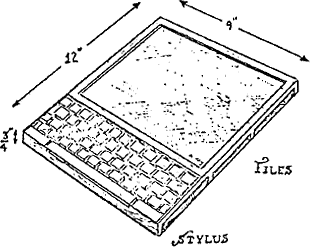
Kay's concept was a computer about 9" x 12" x 3/4" with a fixed keyboard, so it was neither a tablet PC nor a notebook. To my knowledge, nothing like it has ever been brought to market - at least not anywhere close to size Kay expected. The Dynabook would have a stylus so the user could interact with the display, which would have at least 1 million pixels.
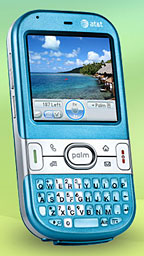 Today's devices that most resemble the Dynabook are
smartphones, which you have to admit bear an uncanny resemblance
despite the difference in scale.
Today's devices that most resemble the Dynabook are
smartphones, which you have to admit bear an uncanny resemblance
despite the difference in scale.
The First Portable Computers
The first portable computers was the Osborne 1, a CP/M computer with a 4 MHz Z-80 CPU introduced in April 1981 with 64 KB or RAM, two 92 KB floppy drives, and a 5" screen that displayed 24 lines of text with 52 characters per line. Adam Osborne's brainchild sold for US$1,795 with a collection of bundled software (SuperCalc, WordStar, Microsoft MBASIC, and Digital CBASIC), was the size of a small suitcase, and weighed 24 pounds (50% more than the original Macintosh!).
 The Osborne 1 was designed to run from 120V 60 Hz AC power, but
a third-party one-hour battery pack was available. The spaces below the
floppy drives allowed you to store your single-sided, single-density
5-1/4" disks and take them anywhere you brought the computer. An
optional circuit board added double-density support for 92 KB and 182
KB Osborne, 82 KB Xerox 820, 80 KB Cromemco, 171 KB DEC VT-180, and 156
KB IBM PC CP/M-86 formatted floppies. An optional 300 baud modem fit in
the left bay.
The Osborne 1 was designed to run from 120V 60 Hz AC power, but
a third-party one-hour battery pack was available. The spaces below the
floppy drives allowed you to store your single-sided, single-density
5-1/4" disks and take them anywhere you brought the computer. An
optional circuit board added double-density support for 92 KB and 182
KB Osborne, 82 KB Xerox 820, 80 KB Cromemco, 171 KB DEC VT-180, and 156
KB IBM PC CP/M-86 formatted floppies. An optional 300 baud modem fit in
the left bay.
 The
computer was an overnight success, with sales reaching 10,000 units per
month. The Osborne 1 enclosure was redesigned with a cleaner, more
rugged design and support for 220-240V and 50 Hz or 60 Hz power.
The
computer was an overnight success, with sales reaching 10,000 units per
month. The Osborne 1 enclosure was redesigned with a cleaner, more
rugged design and support for 220-240V and 50 Hz or 60 Hz power.
Osborne updated the design with the release of the US$2,495 Executive in 1982. The biggest difference was a 7" amber display capable of displaying 80 character lines of text, which increased the computer's weight to nearly 29 pounds.
Competition for Osborne
 Responding to
Osborne's success, Non-Linear Systems began designing a similar
computer in 1981. Kaypro Corporation was formed to sell the new
computer, the Kaypro
II. Specs were virtually identical to the Osborne, but the Kaypro
had a 2.5 MHz CPU, a no nonsense aluminum case, and a 9" display - a
huge advantage over Osborne's offerings. Two 191 KB double-density
floppy drives were standard, and it had a similar software bundle.
Responding to
Osborne's success, Non-Linear Systems began designing a similar
computer in 1981. Kaypro Corporation was formed to sell the new
computer, the Kaypro
II. Specs were virtually identical to the Osborne, but the Kaypro
had a 2.5 MHz CPU, a no nonsense aluminum case, and a 9" display - a
huge advantage over Osborne's offerings. Two 191 KB double-density
floppy drives were standard, and it had a similar software bundle.
The later Kaypro IV had two double-sided drives, and the Kaypro 10 was the first model with a hard drive. both were introduced in 1983, and in 1984 the Kaypro 4 was introduced with a 4 MHz CPU.
One feature beloved by Kaypro users was the ability to read a multitude of disk formats, which made the Kaypro compatible with most 5-1/4" CP/M disks regardless of what brand of computer they were created on.
Competition from IBM
CP/M had been the first general operating system for personal computers, much as MS-DOS and Windows were later on. And that was the problem - IBM introduced its PC in August 1981. That was the beginning of the end for CP/M.
IBM was unsure of the personal computing market, so it designed its computer using off-the-shelf parts - and avoided the expense of developing an operating system by licensing three different ones. CP/M-86 from Digital Research was widely expected to be the norm, the UCSD p-system was for geeks, and PC-DOS from Microsoft was considered the dark horse. Ever savvy, Microsoft had not licensed DOS exclusively to IBM, so when other companies designed alternative hardware, they could sell it with the same operating system as the IBM PC.
Competition for IBM
 The first IBM compatible was
introduced by Compaq Computer Corporation in November 1982. Unlike the
desktop IBM PC, the Compaq Portable was
portable, following the design path blazed by Osborne. At US$3,590, it
was over twice the cost of the Osborne and Kaypro offerings, but it ran
the same OS and apps as the IBM PC.
The first IBM compatible was
introduced by Compaq Computer Corporation in November 1982. Unlike the
desktop IBM PC, the Compaq Portable was
portable, following the design path blazed by Osborne. At US$3,590, it
was over twice the cost of the Osborne and Kaypro offerings, but it ran
the same OS and apps as the IBM PC.
The Compaq Portable had a unique feature: The graphics card and internal display could do either high resolution text (640 x 350 pixels) or CGA graphics (640 or 320 by 200 pixels).
From this start, Compaq bridged out to desktop computing, lunchbox portables, servers, and notebook computers, eventually merging with Hewlett Packard.
IBM tried to compete with Compaq with the IBM Portable PC. Released 13 months after the Compaq, it only supported CGA graphics and fizzled.
The First Notebook Computer
 The Grid Compass is widely
considered to be the first notebook computer. Introduced in April 1982,
it introduced the clamshell design, ran a proprietary operating system,
had a 320 x 200 display, used bubble memory for storage, weighed 11
pounds, and sold for over US$8,000.
The Grid Compass is widely
considered to be the first notebook computer. Introduced in April 1982,
it introduced the clamshell design, ran a proprietary operating system,
had a 320 x 200 display, used bubble memory for storage, weighed 11
pounds, and sold for over US$8,000.
A year later this was joined by two competing notebooks, the Gavilan SC and Sharp PC-5000. The Gavilan was half the price of the Grid and ran MS-DOS, although it was not fully compatible with the IBM PC. The Sharp was more IBM compatible and, like the Grid, used bubble memory for data storage. Neither of these notebook computers had a full sized display.
Slate Computers
 The
Epson HX-20
introduced a different kind of field computer when it was announced in
November 1981, although it was not widely sold until 1983. It had a
full-sized keyboard and a similar form factor to the TRS-80 Model 100
(below). It used rechargeable NiCad batteries and has a built-in
thermal printer. Its display only had room for 4 lines of 20
characters, and an optional microcassette could be used to store
files.
The
Epson HX-20
introduced a different kind of field computer when it was announced in
November 1981, although it was not widely sold until 1983. It had a
full-sized keyboard and a similar form factor to the TRS-80 Model 100
(below). It used rechargeable NiCad batteries and has a built-in
thermal printer. Its display only had room for 4 lines of 20
characters, and an optional microcassette could be used to store
files.
 Unfortunately the HX-20 was slow in
coming to market, which gave Kyocera the opportunity to design
something different and, in many ways, better. Tandy, the parent
company of Radio Shack, introduced its own version of the Kyocera
Kyotronic 85 in 1983 (it was also repackaged and sold by Olivetti
and NEC). The
TRS-80 Model 100 was a journalist's dream, a portable word
processor that was easy to use anywhere and affordable (US$499).
Unfortunately the HX-20 was slow in
coming to market, which gave Kyocera the opportunity to design
something different and, in many ways, better. Tandy, the parent
company of Radio Shack, introduced its own version of the Kyocera
Kyotronic 85 in 1983 (it was also repackaged and sold by Olivetti
and NEC). The
TRS-80 Model 100 was a journalist's dream, a portable word
processor that was easy to use anywhere and affordable (US$499).
The Model 100 had a full sized keyboard with a much more useful 8 line, 40 character display, a built-in word processing program, Microsoft BASIC, and a 300 baud modem. It turned on instantly, ran for 20 hours on AA alkalines, and the telecommunication software made it relatively easy to send word processing files to other computers.
PC World names it one of the 25 greatest PCs of all time and one of the 10 most important laptops.
IBM Compatible Notebooks
 Although IBM wasn't the first
with a portable PC compatible, the IBM PC Convertible
was one of the first PC compatible notebooks. Introduced on April 3,
1986, it was IBM's first personal computer with a 3.5" floppy drive. It
weighed 13 pounds and had a CGA (640 x 200) display, which was
compressed vertically - find for text, but graphics were misshapen.
Although IBM wasn't the first
with a portable PC compatible, the IBM PC Convertible
was one of the first PC compatible notebooks. Introduced on April 3,
1986, it was IBM's first personal computer with a 3.5" floppy drive. It
weighed 13 pounds and had a CGA (640 x 200) display, which was
compressed vertically - find for text, but graphics were misshapen.
The PC Convertible had room for an internal modem, but no room for a hard drive. It included a suspend mode that put the computer to sleep rather than shutting it down all the way to avoid the long, slow, floppy-based boot process.
The PC Convertible was a failure on the market because it was big, heavy, and didn't include standard PC ports - serial and parallel ports could be added via modules that docked to the rear of the computer, making it even more unwieldy. One such module put a printer on the back of the computer.
 The
Toshiba T1000,
introduced later in 1986, made Toshiba an early leader in the notebook
field. Unlike the PC Convertible, it had serial and parallel ports
built into the computer, supported a nonvolatile RAM disk, and ran
MS-DOS 2.11 from ROM. At 6.4 pounds, it was half the weight of IBM's
beast. The only drawback it had relative to the PC Convertible was a
single floppy drive.
The
Toshiba T1000,
introduced later in 1986, made Toshiba an early leader in the notebook
field. Unlike the PC Convertible, it had serial and parallel ports
built into the computer, supported a nonvolatile RAM disk, and ran
MS-DOS 2.11 from ROM. At 6.4 pounds, it was half the weight of IBM's
beast. The only drawback it had relative to the PC Convertible was a
single floppy drive.
Compaq's Notebook Sized Notebooks
Early notebooks had much larger footprints, CGA displays, and relatively slow CPUs. The first notebook with a VGA (640 x 480) display was the Compaq SLT/286 introduced in 1988. It had a 12 MHz 80C286 CPU, a 20 MB hard drive, and was just 8.5" deep, making it suitable for use on an airline tray. The keyboard could be removed for desktop use. On the downside, the SLT/286 was very thick (I can't find dimensions anywhere), and it weighed 14 pounds.
Compaq took another step forward (and one step back) with it LTE family of laptops in 1989, which were much slimmer (again, I can't find dimensions) and lighter (6.7 pounds) than the SLT - but gave up VGA graphics for CGA. I remember these being very popular with Mac users, as Apple had no portable at the time.
Macintosh Portable
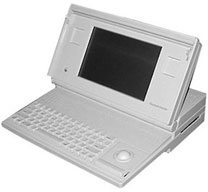 That
changed in September 1989 with the introduction of the Macintosh Portable, which has been
widely maligned for being big, heavy, and expensive. The thing is, it
wasn't "big, heavy, and expensive" in comparison to other top-end
notebooks, although compared to the Toshibas, Compaq's SLTs, and the
NEC UltraLight, it seemed so.
That
changed in September 1989 with the introduction of the Macintosh Portable, which has been
widely maligned for being big, heavy, and expensive. The thing is, it
wasn't "big, heavy, and expensive" in comparison to other top-end
notebooks, although compared to the Toshibas, Compaq's SLTs, and the
NEC UltraLight, it seemed so.
Unlike the competition, the Portable had a 640 x 400 active matrix display, a 10 hour battery, a trackball, and it ran the Mac OS. It also ran at 16 MHz in an era when most high-end DOS notebooks were using 12 MHz 286 CPUs.
Apple Does Small and Light
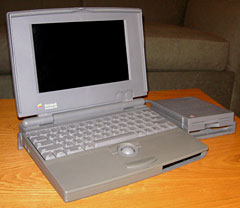 The first Macintosh without a built-in floppy drive
wasn't the 1998 iMac;
it was the PowerBook 100,
introduced in October 1991. Apple hired Sony to shrink the Mac
Portable, and they got it down to 5.1 pounds and an 8.5" by 11"
footprint in part by making the floppy drive an accessory. Mac users
finally had a portable as compact as the Compaq SLT 286, although more
people opted for the larger, more powerful, and more costly PowerBook 140 and 170.
The first Macintosh without a built-in floppy drive
wasn't the 1998 iMac;
it was the PowerBook 100,
introduced in October 1991. Apple hired Sony to shrink the Mac
Portable, and they got it down to 5.1 pounds and an 8.5" by 11"
footprint in part by making the floppy drive an accessory. Mac users
finally had a portable as compact as the Compaq SLT 286, although more
people opted for the larger, more powerful, and more costly PowerBook 140 and 170.
These models introduced the trackball-forward design that has defined most notebooks designed since then, although the PC industry still experimented with other locations and types of pointing devices.
More Apple Innovation
The first notebook to support 256 colors was the PowerBook 165c (Feb. 1993), and the PowerBook 500 family (May 1994) were the first notebooks with a trackpad, built-in ethernet, stereo speakers, 16-bit stereo audio, an expansion bay, and automatic sleep when closing the lid. The titanium PowerBook G4 (Jan. 2001) was the first 1" thin notebook and introduced widescreen displays.
More recently, the MacBook Air showed how thin and light Apple could make a notebook without shrinking the keyboard or display. It also introduced the unibody construction that is now used on the newest MacBook and MacBook Pro models.
Looking Ahead
Notebook computers range in size from 7" netbooks to 18" behemoths, desktop replacements in almost every sense of the word. The hottest range today is netbooks, which have 12" and smaller screens, energy sipping CPUs that don't run anywhere close to bleeding edge speed, and are designed to work well with the wireless Internet and sell for as little as possible.
I see that segment growing, and I hope Apple will enter that market within the coming year. Of course, Apple could come at it from a completely different direction - a scaled up iPod touch instead of a scaled down MacBook is one possibility. Another would be a new product, neither iPod nor MacBook, that's more like a scaled-down Dynabook with a flat design, a real keyboard, and a touchscreen.
Further Reading
- Osborne 1, Wikipedia
- Osborne Executive, Old-Computers.com
- Our Debt to the IBM PC, Low End Mac
- Dynabook, Wikipedia
- Epson HX-20 Portable Computer, Gizmodo
- TRS-80 Model 100, Old Computers
- TRS-80 Model 100, Wikipedia
Join us on Facebook, follow us on Twitter or Google+, or subscribe to our RSS news feed
Dan Knight has been using Macs since 1986, sold Macs for several years, supported them for many more years, and has been publishing Low End Mac since April 1997. If you find Dan's articles helpful, please consider making a donation to his tip jar.
Links for the Day
- Mac of the Day: PowerBook 500 Series, introduced 1994.05.16. 'Blackbird' includes a 25 to 33 MHz 68040 along with smart batteries and grayscale or color displays.
- Support Low End Mac